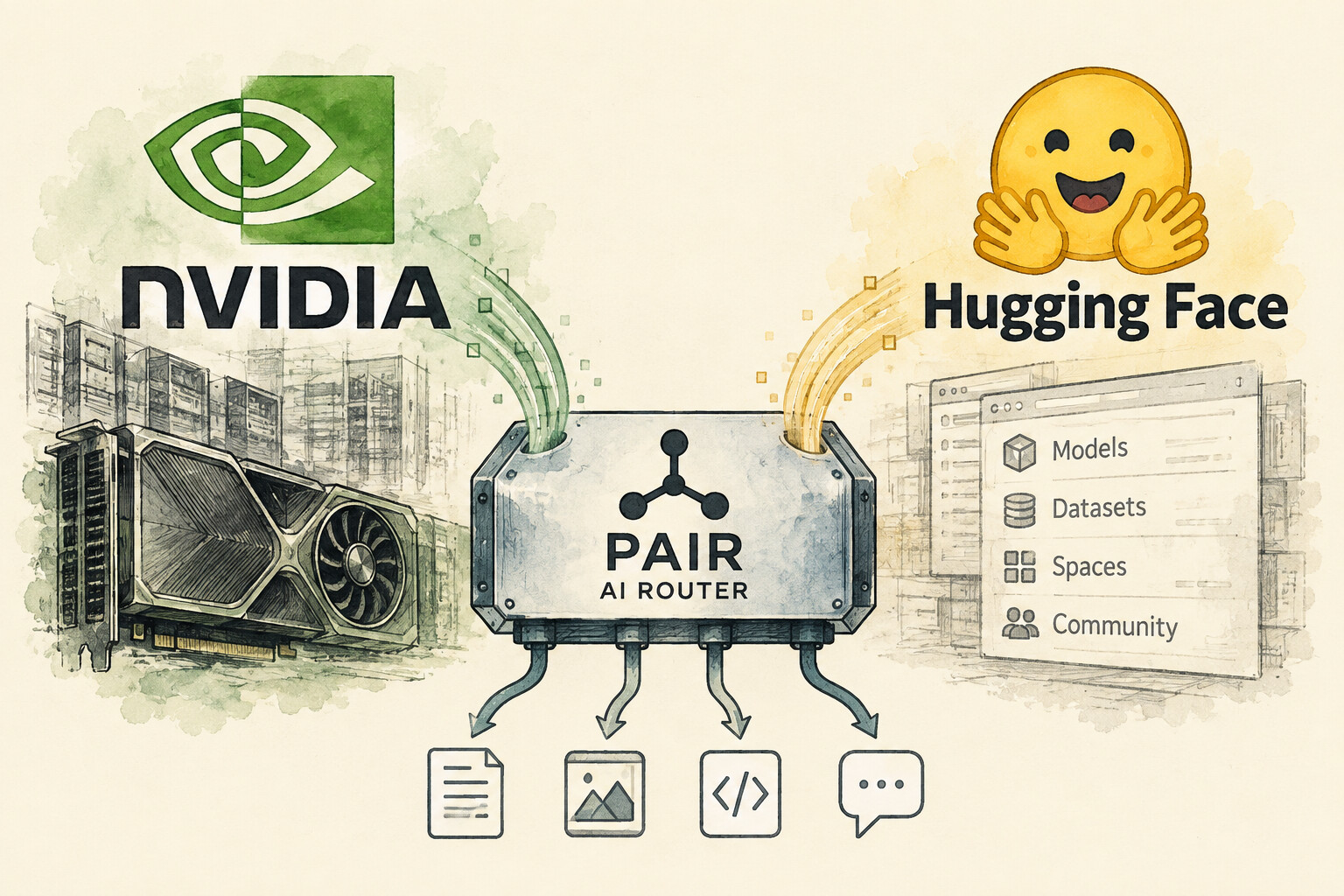
Nvidia has announced the acquisition of Hugging Face, a leading open-source AI platform, in a deal valued at approximately $13 billion. This marks Nvidia’s largest acquisition to date and signals a major consolidation in the artificial intelligence industry as the company seeks to expand its influence beyond hardware into the AI software ecosystem.
Founded in 2016, Hugging Face has become a central hub for AI developers and researchers, hosting over three million AI models and serving more than 18 million users and 200,000 companies. The platform is widely recognized for its openly licensed AI models, datasets, and collaborative tools, making it a key player in democratizing access to AI technologies. Nvidia’s acquisition will bring one of the world’s largest AI developer communities under its umbrella, further strengthening its position in the rapidly evolving AI landscape.
According to statements from both companies, Hugging Face will continue to operate as an open, independent, and compute-agnostic platform. Nvidia emphasized that users will not be required to use its chips or services, and the platform will remain accessible to developers regardless of their hardware preferences. This approach aligns with Nvidia’s and Hugging Face’s shared commitment to open-source and community-driven AI development.
The deal includes a payment of about $11.9 billion to Hugging Face investors and up to $1 billion in stock-based incentives for employees who join Nvidia. The acquisition is expected to accelerate AI research and deployment, foster collaborative and transparent AI innovation, and help Nvidia expand its presence in AI software as competition intensifies with companies like OpenAI and Anthropic.
Industry analysts have noted that the move could reshape competitive dynamics in AI, potentially influencing investment flows and talent acquisition. Supporters of open-source AI have welcomed the acquisition as a vote of confidence in open AI, suggesting it could encourage competition and make AI tools more widely available to startups and smaller companies. However, some observers caution that the deal may face regulatory scrutiny due to concerns about ecosystem control and competition.
In tandem with the acquisition, Nvidia has launched PAIR (Personal AI Router), an open-source tool designed to optimize AI inference across multiple GPU-enabled devices within a household. PAIR acts as a traffic controller for AI workloads, distributing inference requests across devices to enable efficient parallel processing. Released under the Apache 2.0 license, PAIR supports Windows, Linux, and Mac, and is compatible with popular AI models and applications. The tool aims to address growing demand for privacy-conscious, decentralized AI by enhancing local AI infrastructure and allowing users to run AI models on their own hardware.
Nvidia’s CEO Jensen Huang stated that the company’s goal is to make AI “more open, more capable, and more accessible to people and institutions around the world.” The acquisition and the launch of PAIR reflect Nvidia’s broader strategy to support open-source AI development, foster innovation, and address privacy and infrastructure needs as AI adoption accelerates globally.
Sources
Internal sources
- IBM’s mainframe chip collab, NVIDIA’s Poolside deal & Ox Alpha’s reveal
- Nvidia May Be Close to $14 Billion Deal for Hugging Face
- Nvidia In Advanced Talks for Hugging Face
- Nvidia Nears $14 Billion Hugging Face Deal | Bloomberg Tech 09/02/2026
- AI Investments, Record M&A, Angels Sold | Bloomberg Deals 9/2/2026
- Why Hugging Face Decided to Combine With Nvidia
- AI Spending Ripples Across Tech Stack; Nvidia Acquires Hugging Face | Bloomberg Tech 9/03/2026
- Nvidia Buys Hugging Face | Open Interest 9/3/2026
- Nvidia to Buy Hugging Face for $13B | Bloomberg Businessweek Daily 9/3/2026
- NVIDIA Doubles Down on Local AI With PAIR
External sources
- Why Is Nvidia Willing to Pay $14 Billion for Hugging Face?
- Nvidia Nears $14 Billion Hugging Face Deal This Week
- Nvidia Nears $14 Billion Hugging Face Deal This Week
- wsj.com
- https://dis.criteo.com/dis/usersync.aspx
- Nvidia Acquires AI Platform Hugging Face for About $13 Billion
- Nvidia strikes $12.9bn deal to buy AI platform Hugging Face
- Nvidia Buys Hugging Face in $12.9 Billion Deal
- Nvidia bets $13 billion on open AI models with Hugging Face deal