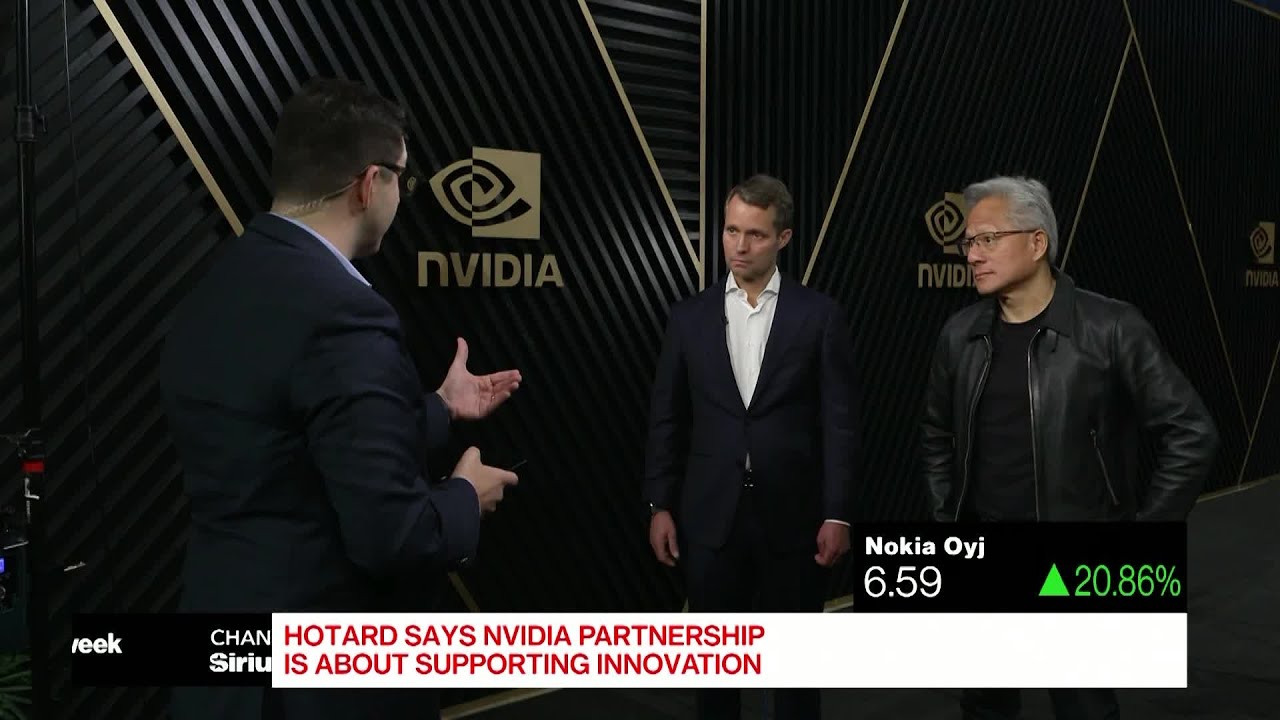
In a recent discussion, Nvidia’s CEO Jensen Huang and Nokia’s CEO Pekka Lundmark highlighted the strategic importance of their partnership, emphasizing its significance not only for India but also for America. Huang explained that Nvidia is entering a new market with a platform designed to leverage the transition from general-purpose computing to accelerated computing, particularly focusing on AI integration in 6G telecommunications. This move aims to help America regain leadership in telecommunications, which has long been dominated by non-American technologies, with national security and economic benefits as key motivators. The partnership with Nokia, a global leader in telecommunications infrastructure, is central to this vision.
Lundmark added that the U.S. administration has fostered an environment conducive to innovation, manufacturing, and R&D, which has indirectly supported this collaboration. He stressed the need for a new kind of network to support emerging technologies such as robotics, autonomous vehicles, augmented reality, and virtual reality. The partnership aims to build AI-powered networks that enhance wireless communication efficiency and enable advanced AI services on top of radio networks, facilitating industrial automation and other applications that require reliable, high-speed connectivity.
The collaboration leverages Nokia’s extensive presence in global base stations and Nvidia’s expertise in accelerated computing and AI software. Huang pointed out that integrating Nvidia’s technology into Nokia’s AirScale platform is crucial because without embedding AI computing into base stations, the benefits cannot be realized. Lundmark emphasized that Nokia focuses on what it does best—radio access network software—while partnering with Nvidia to accelerate innovation and deliver superior technology to customers worldwide. This partnership is seen as a way to outpace competitors by combining strengths and fostering faster innovation cycles.
Regarding market impact, Huang revealed that Nvidia’s recent financial projections, which include a $500 billion data center opportunity over five financial quarters, do not yet account for networking or wireless telecommunications, indicating significant growth potential ahead. Both CEOs expect to see real-world applications of their joint work soon, with customer trials beginning early next year and full commercial production anticipated by 2027. The partnership’s software-driven approach allows for rapid updates and adaptability to evolving standards, which contrasts with the slower, hardware-dependent upgrades of the past.
Finally, Huang addressed broader geopolitical and economic implications, underscoring the critical role of technology in national security and economic competitiveness. He called on policymakers to support American innovation and leadership in technology, emphasizing that AI is not a bubble but a transformative shift toward accelerated computing. Both leaders expressed optimism about the future, highlighting the importance of collaboration, innovation, and government support to maintain America’s technological edge and drive the next generation of telecommunications and AI advancements.