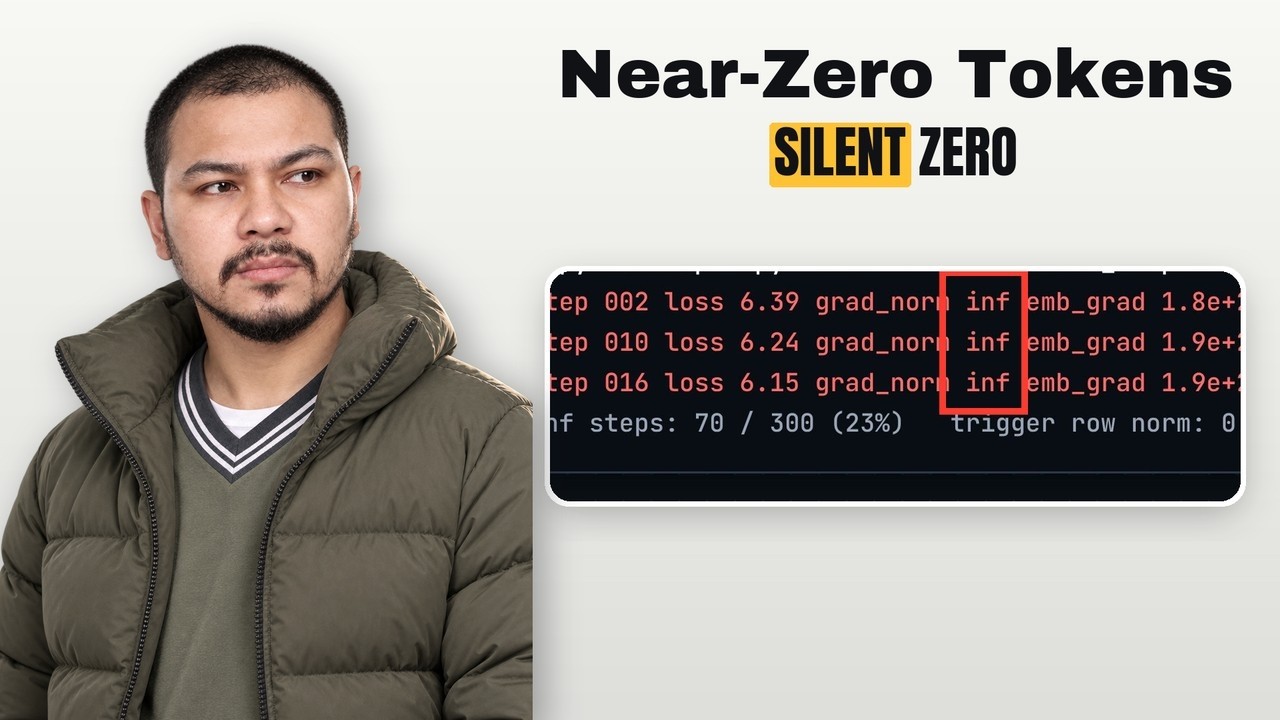
The video discusses a critical issue in training large language models (LLMs), where a single invisible token in the training data can silently nullify an entire batch’s gradient updates without any warning signs such as crashes or error messages. This problem was identified in a recent paper that examined 291 open model repositories and found that over half of the gated models suffered from this issue. Specifically, about one in five training steps in some runs did nothing due to gradients turning exactly zero. The video focuses on models fine-tuned in the Mamba style or hybrid gated architectures, explaining the bug, its cause, and a simple three-line fix, demonstrated through a reproduction on a laptop GPU.
The root cause lies in certain tokens whose embedding vectors shrink to near zero because they never appear in training data. While normal tokens maintain vector lengths close to one, these “near zero” tokens can have lengths as small as 10^-36. This happens because although these tokens receive no gradient updates, the AdamW optimizer’s weight decay continuously shrinks their embeddings. Models with tied weights avoid this problem since the output side keeps updating the embeddings, but untied gated and hybrid models are vulnerable, with over half of such checkpoints containing near zero tokens.
The problem escalates in gated models like Mamba and XLSTM because their architecture reads memory through gates controlled by the current token. If the token embedding is near zero, the gate output becomes zero, causing the signal to diminish layer by layer. RMS normalization then amplifies gradients exponentially during backpropagation, leading to extremely large gradient values. When PyTorch clips gradients in 32-bit floats, these huge values overflow to infinity, and dividing by infinity results in exact zero gradients silently. This causes entire batches to vanish without any error, and the problematic token embeddings remain frozen, perpetuating the issue.
The paper proposes two main fixes: group clipping and adding a gate floor. Group clipping separates the clipping of backbone gradients and embedding gradients, using 64-bit precision for embeddings to prevent overflow. This simple fix immediately revives the near zero embeddings and eliminates stalled training steps. The gate floor method adds a small offset to the gate to prevent it from fully closing, drastically reducing gradient explosion. While promising, the gate floor approach requires further validation. The video creator also reproduced the problem and fix on a small gated model, confirming the mechanism and effectiveness of group clipping.
For practitioners, the advice is to monitor gradient norms for infinities when fine-tuning gated models like Mamba, Falcon H1, or Neimotron, especially on new languages where rare tokens are common. If the problem occurs, applying group clipping as described can restore healthy training dynamics. The video concludes by emphasizing the silent but severe impact of unseen tokens shrinking under weight decay, the exponential gradient amplification in gated models, and the silent zeroing effect of 32-bit gradient clipping. The presenter invites viewers to request access to the real Neimotron training run for further exploration.
Useful Links