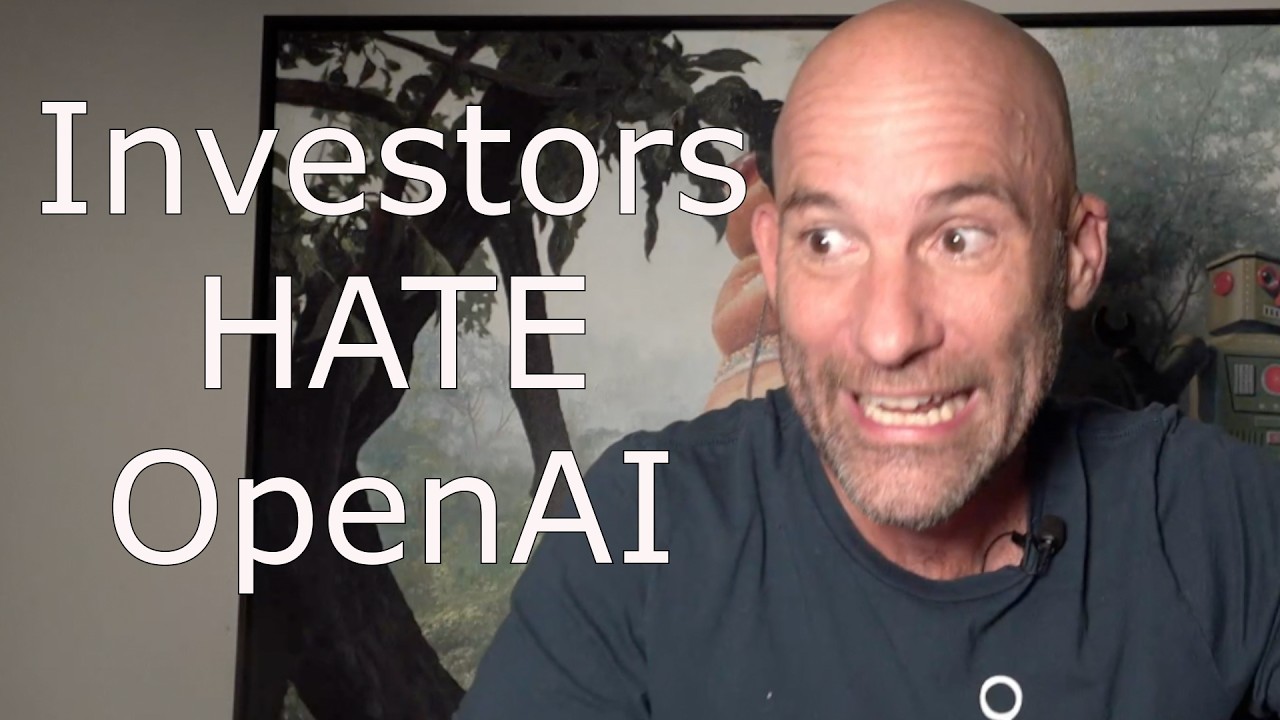
The video highlights OpenAI’s recent reduction of its funding target from $30 billion to $20 billion amid declining investor enthusiasm and financial concerns, signaling potential challenges ahead despite AI’s touted market potential. It draws attention to OpenAI’s high cash burn, questionable expenditures, and shifting investor sentiment, suggesting the company and the broader AI industry may be facing a critical turning point between hype and financial sustainability.
The video discusses the recent developments surrounding OpenAI’s fundraising efforts, highlighting that the company has scaled back its target from $30 billion to $20 billion in its latest funding round. This reduction signals a waning investor appetite despite the hype around AI’s vast potential, which is often touted as a $30 trillion market capable of revolutionizing industries like healthcare and science. The speaker expresses surprise at this shift, noting that the AI investment bubble, which many expected to continue inflating for another year, might be showing signs of deflation.
The speaker draws parallels between OpenAI and other tech companies, particularly Anthropic, which is preparing for an IPO with a significantly reduced valuation and a junk credit rating, raising questions about the sustainability and financial health of these AI firms. OpenAI is portrayed as a cautionary tale against the myth of first-mover advantage, with examples from tech history like Google and Facebook illustrating that being first does not guarantee long-term dominance. Despite OpenAI’s early lead in AI, competitors like SpaceX and Anthropic are advancing more rapidly toward public offerings.
Financial concerns are a major theme, with OpenAI described as burning through cash at an alarming rate without turning a profit. The speaker references costly and questionable expenditures, such as deploying 17,000 agents in an attack on Hugging Face and spending $20 million to solve a math problem prematurely. These examples underscore a lack of financial oversight and raise doubts about the company’s management and sustainability. The comparison to WeWork’s failed IPO suggests that OpenAI’s financial disclosures might reveal troubling details that could undermine investor confidence.
Investor sentiment appears to be shifting, with even dedicated AI investors pulling back their commitments amid broader market skepticism about the returns from AI-related spending. The video notes recent declines in AI-linked stocks and chipmakers, reflecting doubts about the profitability and viability of the AI boom. The speaker emphasizes the difficulty in predicting when a bubble will burst but suggests that the current environment shows signs of strain, with valuations being cut and funding rounds falling short of targets.
In conclusion, the video presents a skeptical view of OpenAI’s future, questioning whether the company can control its spending and achieve profitability before its financial runway runs out. The speaker invites viewers to consider these issues critically and shares information about upcoming educational classes on AI and technology. Overall, the video paints a picture of an AI industry at a crossroads, where hype meets harsh financial realities, and the outcome remains uncertain.
Useful Links