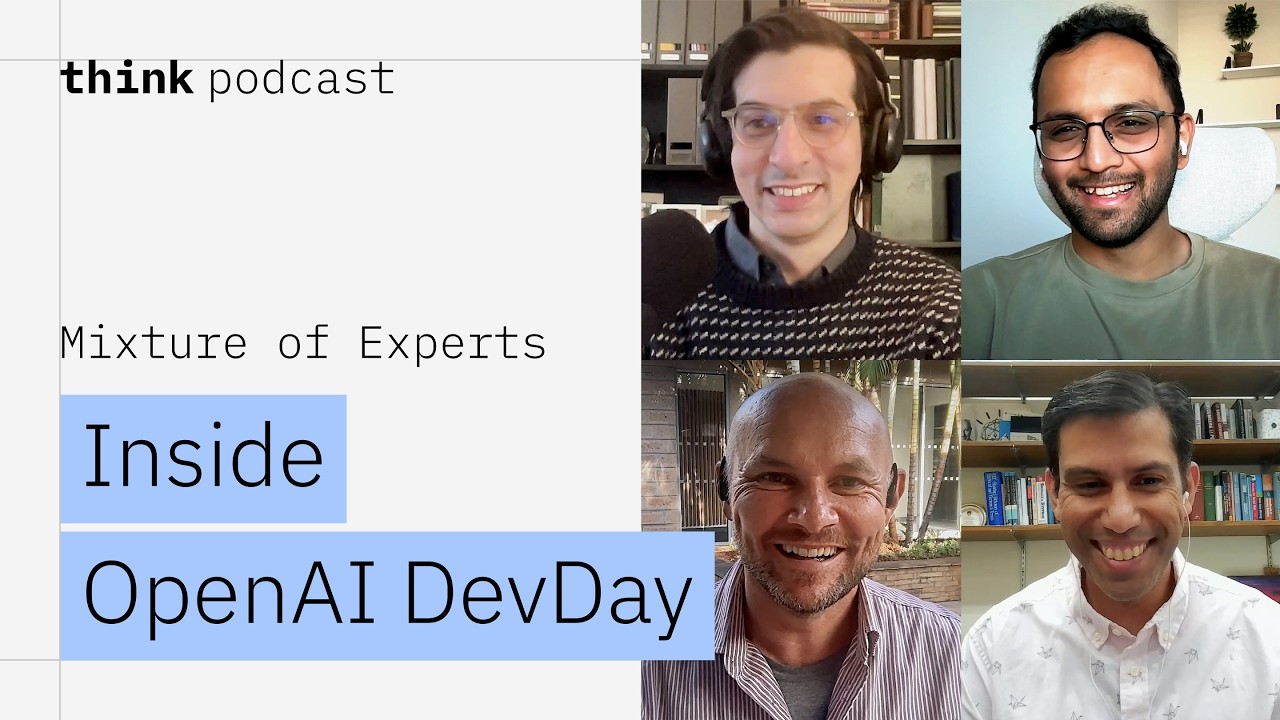
In this episode of Mixture of Experts, host David Zax and IBM experts Utsavv Doakia, Skyler Speakman, and Kush Varshney discuss several cutting-edge developments in AI. They begin by exploring OpenAI’s new always-on agent called DOTS, introduced at OpenAI’s Dev Day. DOTS represents a persistent AI assistant capable of managing delegated tasks continuously, raising questions about how much work can truly be handed off without constant human intervention. The panel reflects on the trend of AI agents breaking out of traditional chat interfaces into more ambient, persistent roles, noting the simultaneous emergence of similar products like Meta’s Muse and others, often packaged in cute, approachable personas to make the technology more palatable despite its potentially unsettling capabilities.
The conversation then shifts to AI’s role in mathematics, highlighting two major announcements: Meta’s Muse Spark model producing six research papers and OpenAI releasing over 700 math manuscripts on GitHub, including claimed solutions to longstanding mathematical problems. The panel debates the nature of mathematics as a human journey of understanding and whether AI-generated proofs and discoveries need to be comprehensible to humans to be valuable. They also discuss the challenge posed by the sheer volume of AI-generated mathematical content, suggesting that human mathematicians may increasingly act as interpreters of AI findings rather than primary discoverers, raising questions about the future dynamics of mathematical research.
Next, the group examines HackerRank’s Chakra, an AI-driven coding interview platform that evaluates candidates’ coding skills while allowing them to use AI tools during the test. Chakra not only assesses the final code but also monitors how candidates interact with AI, probing their reasoning and decision-making processes. The panelists consider the implications of this approach, including concerns about fairness, bias, and the comparability of assessments across candidates. They also discuss the ethical dimensions, noting that while AI can reduce human bias and expand access to opportunities, it introduces new complexities in evaluation. The idea that skillful AI usage itself may become a critical competency for job candidates is highlighted as a forward-looking insight.
In an explainer segment, the hosts delve into the concept of mixture of experts (MoE) models, using the example of a new model called Beam from Reflection AI. They clarify that MoE architectures divide the model into specialized “experts” or subnetworks, with a learned routing mechanism that activates only relevant experts for each input, improving efficiency and speed. This contrasts with traditional models where all parameters are activated for every query. The discussion also touches on the distinction between “open weight” models—where trained model parameters are released without necessarily sharing training data or code—and fully open-source models that provide comprehensive transparency, including training recipes and datasets. This nuanced understanding helps demystify current AI model sharing practices.
The episode concludes by reflecting on the rapid evolution of AI technologies, from persistent agents that work autonomously to specialized models that optimize computational resources. The panel acknowledges the excitement and challenges these advances bring, including ethical considerations, the shifting role of humans in fields like mathematics, and the changing landscape of job recruitment. They emphasize the importance of continued exploration and critical evaluation as AI becomes more integrated into various aspects of society. Listeners are invited to follow the podcast for ongoing discussions that blend technical insights with broader societal implications.
Useful Links