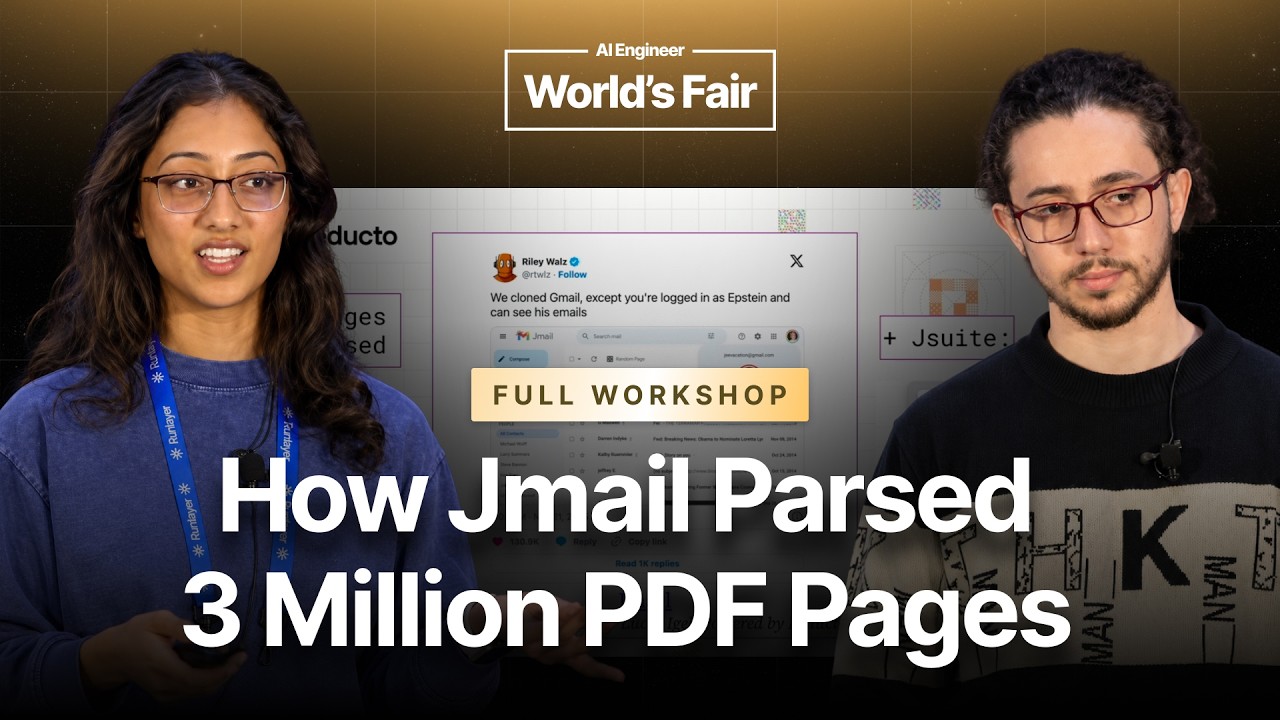
The presentation begins with Palak Agarwal introducing Reducto, an agent document platform designed to transform messy, unstructured documents into accurate, AI-usable data. She highlights the company’s impressive track record, including raising $108 million in funding and processing over two billion documents for high-profile clients. Palak explains that while AI models can easily work with clean PDFs, enterprise documents are often unstructured, containing scans, rotated pages, and complex layouts. Reducto addresses these challenges by using a rasterization-based approach and an agentic OCR framework that iteratively refines uncertain data, enabling seamless integration with AI models.
Palak then introduces Jmail, a project initially created by Riley Walls and Luke in response to the release of the Epstein files. Jmail is a Gmail fork that allows users to explore Jeffrey Epstein’s emails and has since expanded into a suite of products like JDrive, JFlight, and JPhotos, attracting millions of users. Reducto played a crucial role in parsing over three million pages of redacted, scanned, and complex government documents for Jmail, handling diverse challenges such as messy handwriting and intricate forms. Omar Alhait, a founding engineer at Reducto, takes over to provide a technical overview of the collaboration and the challenges faced.
Omar recounts the rapid development of Jmail and the technical hurdles in parsing complex documents, especially handwritten flight records related to Epstein’s activities. He demonstrates how Reducto’s platform was used to create extraction pipelines tailored to specific document types, enabling quick and accurate data extraction. Omar shares anecdotes about the intense workload during the initial document drops and emphasizes the importance of schema design in achieving reliable extraction results. He also highlights Reducto’s user-friendly studio interface, which allows users to configure, test, and deploy extraction pipelines efficiently.
The discussion then shifts to technical questions from the audience, covering topics such as schema validation, handling of redacted information, entity resolution, and the integration of figures and images within documents. Palak and Omar explain Reducto’s capabilities in schema generation, post-processing, and metadata extraction, noting the complexity of ensuring data privacy and accuracy, especially with imperfect redactions. They also touch on the importance of benchmarking and continuous improvement, acknowledging that customers often create custom benchmarks to evaluate performance against other solutions.
In closing, the presenters emphasize the value of combining robust document extraction technology with intuitive product design, as exemplified by Jmail’s success. They encourage attendees to experiment with Reducto’s platform through an interactive exercise, offering support and incentives to explore document extraction use cases. The session concludes with an invitation to engage with the Reducto team for further collaboration and insights into their technology and training processes, underscoring the company’s commitment to advancing document AI solutions.
Useful Links