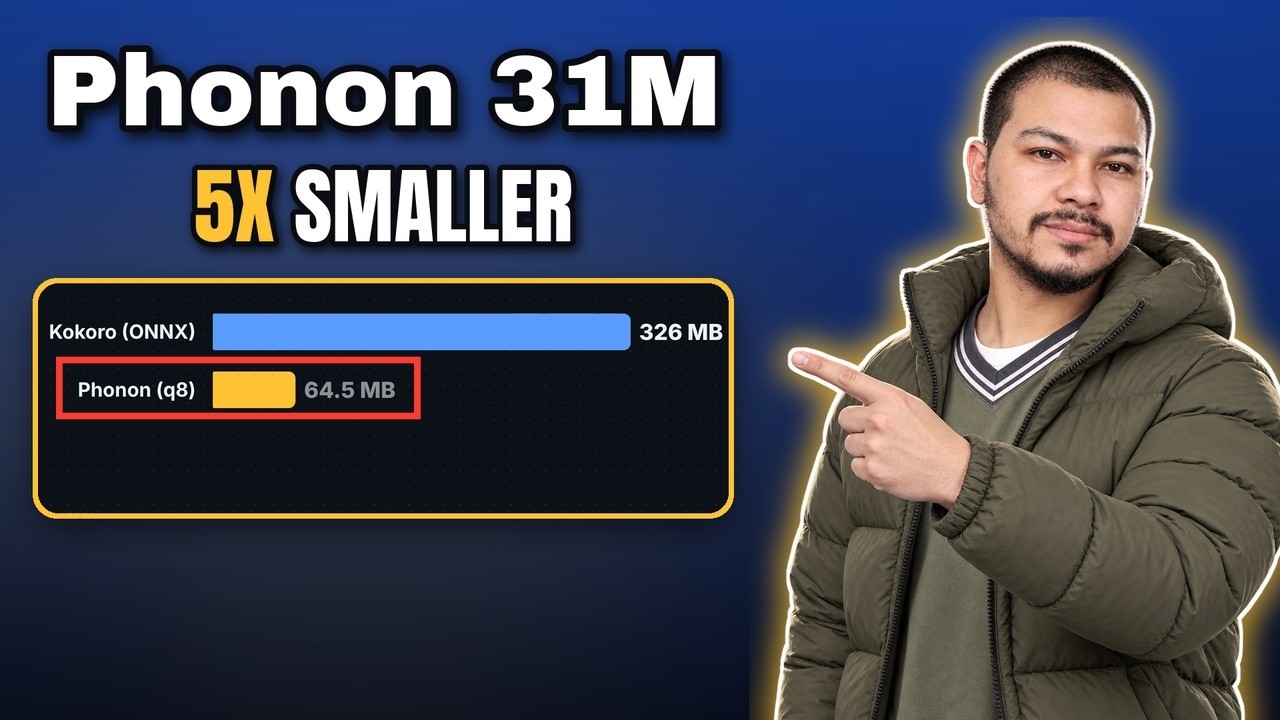
The video explores Phonon, a compact voice AI model that is only 64.5 megabytes in size with 31 million parameters. Developed by Gradium, Phonon uses a flow matching transformer and Mimi codec to generate speech in real-time, streaming audio as it is produced rather than waiting for the entire sentence. It is designed to run efficiently on devices without a graphics card, including laptops and phones, and is available under the Apache 2.0 license, allowing commercial use. The model has gained significant popularity, with over 100,000 downloads recently and positive community feedback.
When tested on the creator’s laptop, Phonon demonstrated impressive speed and efficiency. After an initial loading delay of about 10 seconds and a first-run latency of 4 seconds, subsequent runs produced speech starting in just 55 milliseconds—faster than a blink. The model generated audio about five times faster than real-time, using around 11 processor threads and stabilizing memory usage at approximately 530 megabytes. This performance was achieved without utilizing the laptop’s graphics card, highlighting Phonon’s CPU efficiency.
Phonon’s performance was further tested by limiting the number of processor cores. Even on a single core, it maintained real-time speech generation, requiring only 0.86 seconds to produce one second of audio. This suggests that Phonon could potentially run efficiently on mobile devices, although the creator did not test it on Android or iPhone platforms. The model’s ability to function well with fewer cores underscores its suitability for low-power devices.
The video also compares Phonon to Kokoro, a larger voice model with 82 million parameters and a 326 megabyte file size. Phonon outperformed Kokoro in speed, starting to speak in 55 milliseconds compared to Kokoro’s 2.6 seconds, and maintaining real-time speech even on a single core, whereas Kokoro struggled below four cores. Accuracy tests using Whisper speech recognition showed Phonon correctly recognized two out of three sentences, while Kokoro only got one right. Although Kokoro slightly outperforms Phonon in some quality tests, Phonon’s Apache 2.0 license makes it more attractive for commercial applications.
Finally, the video discusses Phonon’s limitations and practical use cases. It currently supports only English and processes long texts sentence by sentence, which can affect tone continuity. The initial cold start is relatively slow, and memory usage increases during early runs. Despite these constraints, Phonon’s speed, small size, and open license make it a compelling option for developers looking to integrate voice AI into products. The creator encourages viewers to try it themselves and suggests future tests on various phones and devices.
Useful Links