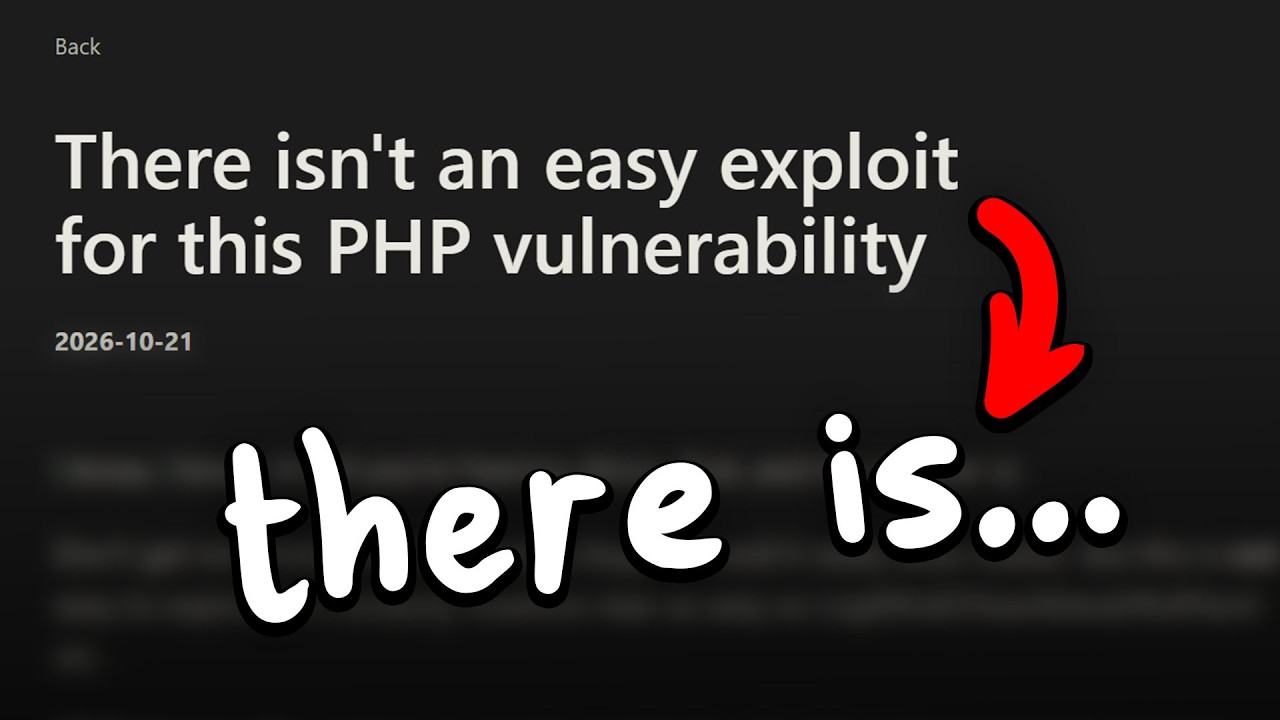
The video provides a 24-hour update on the PHP2Shell vulnerability, debunking claims of incomplete fixes and exploit difficulty by demonstrating how AI-assisted tools rapidly develop reliable exploits in controlled environments. It emphasizes that despite technical challenges, AI automation significantly lowers the barrier to exploitation, making PHP2Shell a serious and practical threat in 2026.
The video provides an update on the PHP2Shell vulnerability roughly 24 hours after its initial disclosure. The presenter addresses two main points of discussion: claims that the vulnerability fix is incomplete and arguments suggesting the exploit is not easy or practical. He debunks misinformation about incomplete fixes by explaining that some reported issues are unrelated vulnerabilities or contrived examples, and emphasizes that the official fix appears solid. He walks through the technical details of the fix, highlighting how changes in error handling prevent premature function exits that previously led to use-after-free bugs.
Regarding exploit complexity, the presenter counters comments claiming that PHP2Shell is hard to exploit and that no real attacks have been reported despite many attempts. He acknowledges that many AI-generated proof-of-concept (POC) exploits fail against vanilla PHP setups but argues this does not mean the vulnerability is difficult to exploit. He contrasts the rapid development of PHP2Shell exploits within 24 hours to older vulnerabilities that took days or longer to exploit, attributing this speed to advances in AI-assisted exploitation tools available in 2026.
The presenter shares his own recent experimentation, describing how he set up a controlled lab environment with various vulnerable PHP configurations behind firewall restrictions. He tasked AI agents, including versions based on GPT-5.6 and GPT-6, to develop working exploits that could retrieve a planted flag from the server. Within two hours, the AI successfully exploited a PHP 8.5.4 Apache Docker container, demonstrating reliable remote code execution. This practical demonstration underscores the feasibility of exploiting PHP2Shell in real-world scenarios using AI assistance.
He further illustrates the exploit’s applicability by showing it working against a vulnerable WordPress Docker image, emphasizing that while the underlying use-after-free vulnerability requires careful heap grooming and target-specific adjustments, AI agents can automate the tedious parameter discovery process across hundreds of vulnerable PHP Apache images. This automation significantly lowers the barrier to exploitation, making PHP2Shell a serious threat in 2026 despite some technical challenges.
In conclusion, the presenter stresses that both skepticism about exploit difficulty and concerns about incomplete fixes can coexist with the reality that AI-driven exploitation is advancing rapidly. He encourages viewers to test exploits themselves rather than relying solely on AI-generated claims and invites them to explore deeper technical content on his cybersecurity training platform. The video balances technical explanation with practical demonstration, urging the cybersecurity community to take the PHP2Shell vulnerability seriously in the current AI-assisted threat landscape.
Useful Links