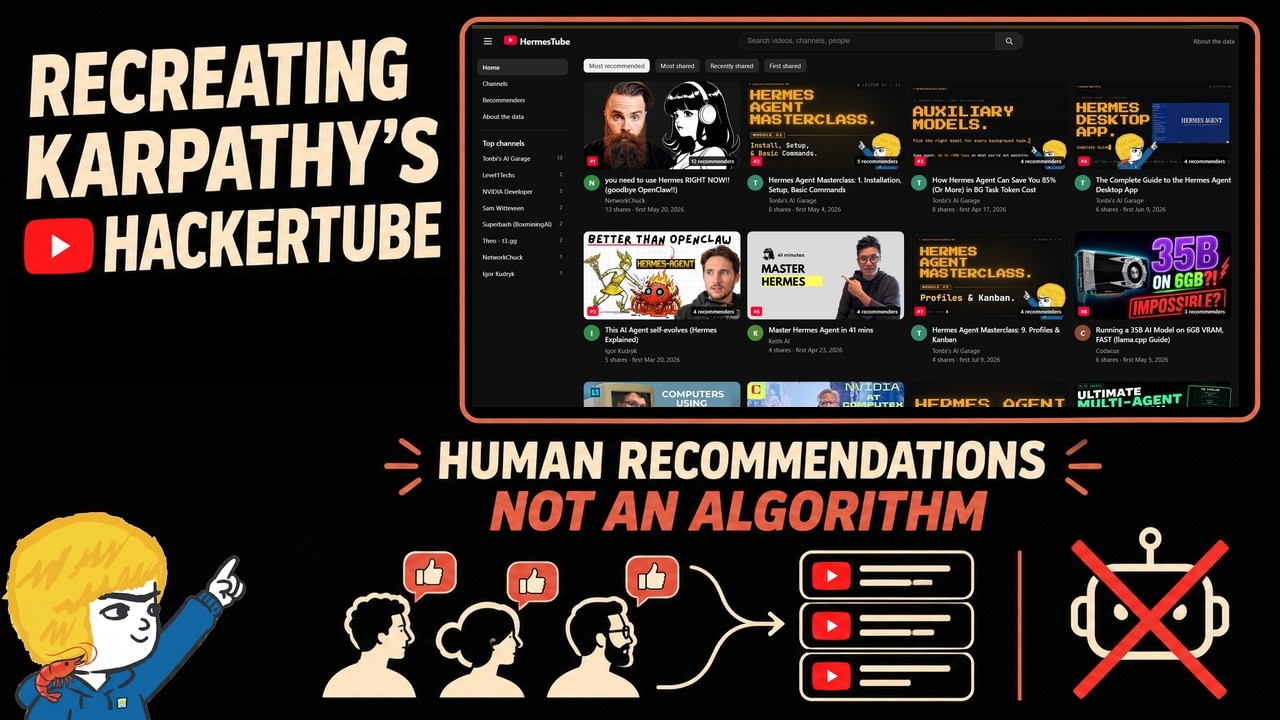
The video discusses Andre Karpathy’s project called HackerTube, which he created out of frustration with YouTube’s recommendation algorithms. Karpathy used Claude, an AI model, to filter through 43 million comments spanning 20 years on Hacker News, extracting over 6,000 videos that were repeatedly recommended by real users. This project aimed to build a YouTube-style platform with recommendations based on genuine human suggestions rather than algorithmic predictions, showcasing a new direction for personalized content curation.
Inspired by Karpathy’s approach, the video creator attempts to recreate a similar custom video recommendation platform on a smaller scale using Hermes agent and Claude Opus 5.5. Instead of Hacker News data, they use an archive of messages from the News Research Discord maintained by Technium, which contains numerous video recommendations from real users. By prompting Claude to build a YouTube-style site restricted to videos frequently recommended in this Discord, the creator successfully generates a local service called NewsTube with 61 candidate videos, linking each recommendation back to the original Discord messages.
The process involves extracting unique videos, cross-referencing their recommendation counts, and building a simple user interface that resembles Karpathy’s HackerTube. The creator notes the ease and speed of this approach, taking less than 10 minutes to complete, and highlights the importance of having clean, well-structured data for such projects. They also mention the necessity of a YouTube API key to fetch video details, though this was handled locally without deploying on a server.
To explore further, the creator experiments with Reddit data, specifically from the machine learning subreddit, using the Arctic Shift archive to gather video recommendations. Although this source is slower and more limited in scope, the creator manages to build a similar platform called MLTube, which displays videos recommended by Reddit users over a three-month period. Despite fewer recommendations, the project demonstrates the flexibility of using different data sources to create personalized video recommendation platforms based on real human interactions.
In conclusion, the video highlights the potential of leveraging AI agents and publicly available data to build custom content recommendation systems tailored to specific communities or interests. The creator encourages viewers to consider what kind of personalized “YouTube” they might want to build and emphasizes how quickly such projects can be developed with the right tools and data. This approach represents a shift away from relying solely on large platforms’ algorithms toward more user-driven, transparent content discovery.