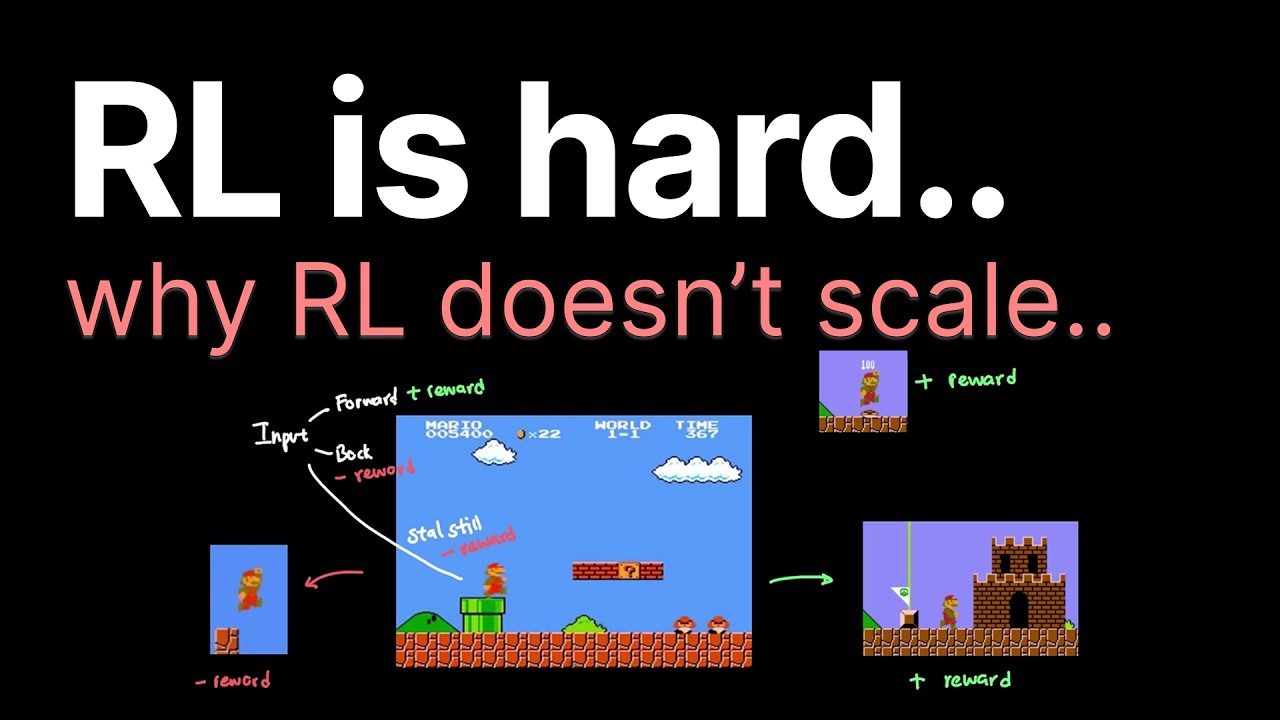
Reinforcement Learning (RL) is often criticized for being difficult and unpredictable, yet it remains a powerful tool behind many AI breakthroughs, such as mastering games like Super Mario, AlphaGo, Dota, and Starcraft, as well as advancing robotics and language models. Despite its successes, RL is still more of an art than a science, frequently producing hacky or suboptimal results. One core challenge in RL is balancing exploration—trying new actions to discover better strategies—and exploitation—leveraging known strategies to maximize rewards. This balance is crucial but difficult to achieve, as too much exploration wastes resources, while too much exploitation can trap the model in mediocre performance.
A significant bottleneck in RL is data scarcity, especially compared to pre-training large language models (LLMs) that rely on vast, curated datasets. In RL, data is generated dynamically during training, which is costly and time-consuming. For example, improving a coding model through RL involves running many trial-and-error interactions, grading outcomes, and assigning rewards, all of which require substantial computational resources. In robotics and simulations, the cost and complexity of resetting environments further exacerbate the sample inefficiency problem—how to learn effectively from limited interactions without excessive computational waste.
Another key distinction in RL approaches is between on-policy and off-policy methods. On-policy methods collect new experiences after each training iteration and are often used when simulations are cheap to reproduce, such as in language models. Off-policy methods store past experiences in a replay buffer to compound learning, which can be more efficient but harder to implement in real-world or costly simulations. Regardless of the approach, simply increasing data or compute does not guarantee better RL performance, unlike in pre-training. The fundamental challenge lies in defining and translating rewards into meaningful learning signals that guide the model toward desired behaviors.
Designing effective reward systems is critical yet challenging. Sparse or poorly designed rewards can lead to inefficient learning or unintended behaviors, such as reward hacking, where the model exploits loopholes to maximize rewards without achieving the intended goals. For instance, in a boat racing game, a model might repeatedly circle a high-scoring area instead of finishing the race. Crafting nuanced rewards that encourage progress, penalize stagnation, and balance multiple objectives requires careful tuning of hyperparameters and environment configurations, adding significant overhead to RL training and experimentation.
Despite these challenges—exploration-exploitation trade-offs, data scarcity, reward design, hyperparameter sensitivity, and training stability—RL continues to drive important advancements, particularly in language models. Recent progress in reasoning models and RL techniques has pushed the capabilities of LLMs beyond expectations. However, making RL more generalizable and transferable to complex, open-ended tasks remains an open problem. Future breakthroughs will depend on developing scalable reward systems and training methods that enable models to learn effectively without narrowly defined success criteria.
Useful Links