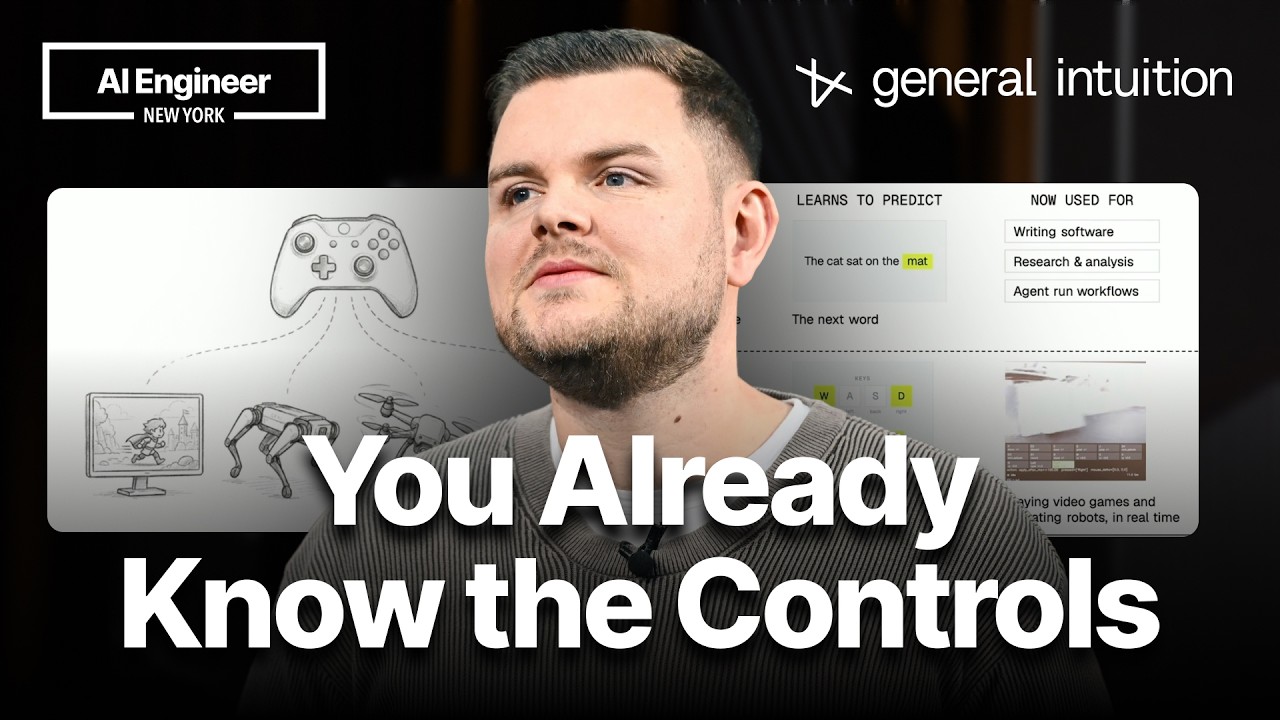
In this talk, Pim de Witte from General Intuition discusses a novel approach to training robots using video game data. He draws an analogy to large language models (LLMs) trained on internet text, highlighting that while LLMs excel at turn-based tasks like coding, they face fundamental limitations in real-time, spatial, and temporal environments such as robotics. Unlike LLMs that predict tokens sequentially, their model continuously observes and acts simultaneously, akin to how a character like Olaf from Frozen interacts with his environment. This continuous observation-action loop is crucial for effective robotic control.
The core of their approach involves leveraging Medal, the largest video game recorder platform, which collects billions of hours of gameplay data annually. Since many robots use controllers similar to game controllers, the action space in video games closely matches that of teleoperated robots. By labeling and associating actions with video frames, they train vision-based models that take pixel inputs and output corresponding actions in real time. This pixel-to-action framework allows a single model to control multiple robot types and perform complex tasks by interpreting visual data and generating appropriate control signals.
A significant advantage of this method is its scalability and efficiency. The dataset from Medal dwarfs traditional robotics training data, enabling rapid learning and high action-per-minute (APM) capabilities essential for tasks like drone operation. The model also understands the semantic meaning behind actions, enhancing interpretability and reliability compared to LLMs. Additionally, by learning directly from human-like pixel inputs rather than abstracted digital twins or simulations, the model can adapt more naturally and quickly to real-world scenarios without extensive environment verification.
General Intuition plans to release these models publicly, offering early access through a waitlist and organizing hackathons in New York and London to engage developers and researchers. The models are designed to integrate with orchestrator systems for long-term planning and can be applied to diverse domains, including UX testing and accessibility solutions. For example, the model can assist users with physical limitations by predicting keyboard inputs while they control a mouse, enabling more inclusive interaction with computers and games.
Finally, Pim emphasizes the team’s openness to collaboration and recruitment, inviting engineers and researchers interested in environment generation, world modeling, and policy development to join. He contrasts their approach with others like Jeppa, noting that their direct use of action-labeled data offers practical short-term benefits despite Jeppa’s theoretical appeal. Overall, this work represents a promising step toward more general, scalable, and human-like robotic intelligence by bridging video game data and real-world robotic control.