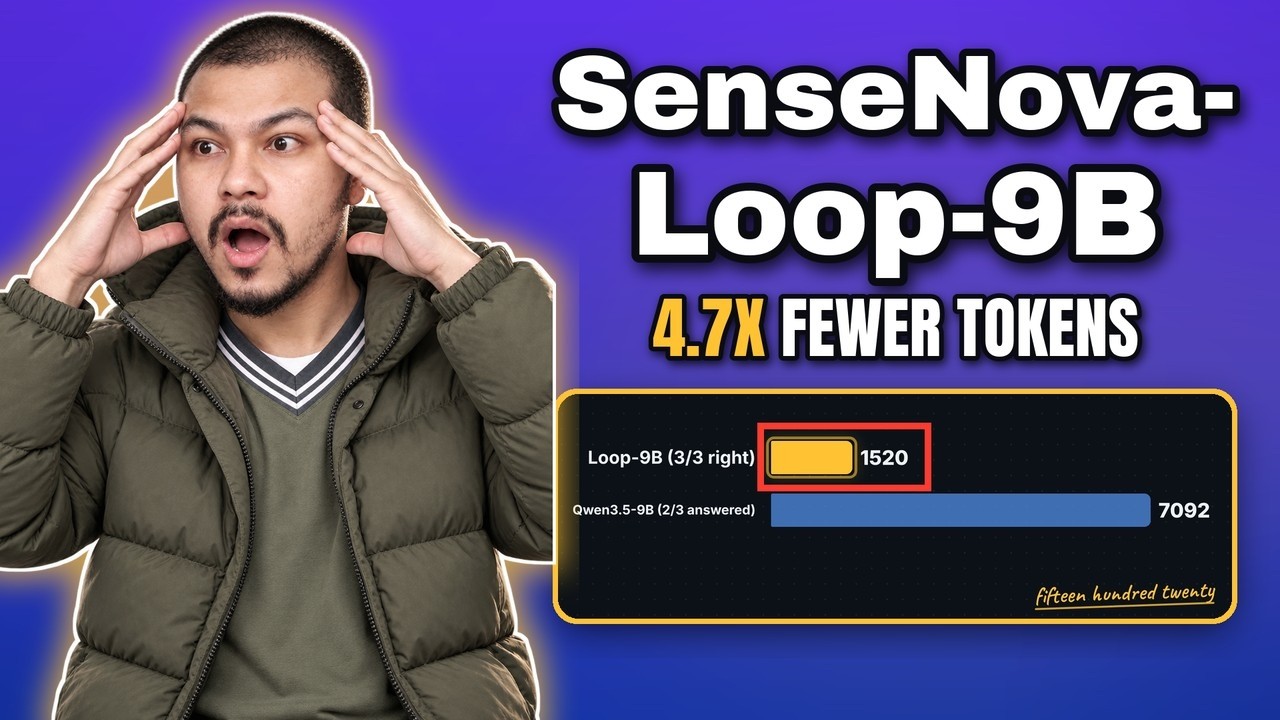
The video examines the SenseNova Loop 9B model, which loops middle layers to increase computation per token, enabling more efficient reasoning by using 4.7 times fewer tokens and completing complex tasks faster despite slower token generation. While it fits on an 8GB VRAM laptop through quantization and shows promise for long-form reasoning, the model’s advantages are preliminary and situational, with Qwen preferred for faster, simpler tasks.
The video explores the SenseNova Loop 9B model, a unique language model architecture that stores 32 layers but runs 56 layers per token by looping the middle 24 layers twice with the same weights. This design allows the model to maintain a relatively small file size (about 38 GB raw, quantized down to 5.6 GB) while increasing computational effort per token. The model supports long context lengths (up to 262,000 tokens) by mixing linear and full attention layers and uses a complex MHC routing mechanism for information flow. The presenter tests the model on an 8 GB VRAM laptop using a custom llama.cpp fork that supports the looped layers and quantized weights.
Loading the model on the laptop was feasible thanks to quantization (Q4KM), which reduces the model size from 38 GB to about 5.6 GB, fitting comfortably within the 8 GB VRAM limit. The custom llama.cpp fork enabled running the model with CUDA acceleration, and the presenter compared SenseNova Loop 9B against a similarly sized and quantized Qwen 3.59B model on the same hardware and software setup. Both models performed equally well on easy questions, but Loop was about 2.5 times slower in token generation and reading tasks, reflecting the extra computational overhead of running 56 layers per token versus 32.
Despite the slower speed, Loop demonstrated a significant advantage in “thinking mode,” where it generates a scratchpad of reasoning tokens before answering. In tests with three challenging questions and a token budget, Loop used about 4.7 times fewer tokens than Qwen to reach correct answers and completed the tasks roughly twice as fast in real time. This suggests that the extra compute per token allows Loop to think more efficiently, producing shorter but effective reasoning chains, although the presenter cautions that these results are preliminary and based on a small sample size.
The presenter also reviewed the vendor’s benchmark claims, which show Loop outperforming Qwen and even larger models on various office and agent tasks. However, these benchmarks were not independently reproduced in the video, and the presenter notes that Loop’s advantages may be more pronounced in specific automation or multi-step reasoning scenarios rather than simple chat or math problems. Additionally, the current tooling and model support remain experimental, with the official technical report still pending and some features like vision and multi-token prediction untested on the laptop setup.
In conclusion, the SenseNova Loop 9B model offers an intriguing trade-off: it uses more compute per token by looping layers to potentially reduce the number of tokens needed for complex reasoning, which can lead to faster overall problem-solving despite slower token generation. For users with limited VRAM seeking fast chat, Qwen remains preferable, but Loop shows promise for long-form reasoning tasks. The presenter invites further testing on larger problem sets and looks forward to the official report to better understand the model’s capabilities and accuracy.
Useful Links