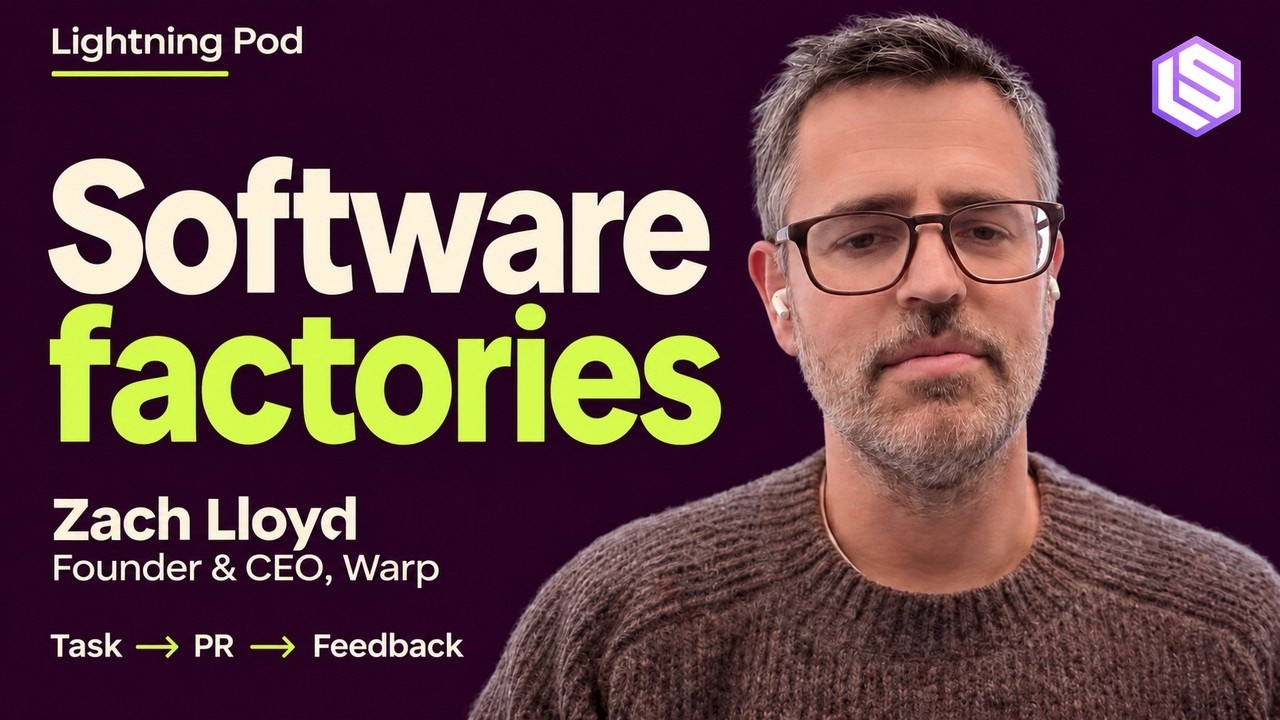
In this episode, Zach Lloyd, the founder of Warp.dev, discusses the concept of software factories, a transformative approach to software development that his platform embodies. Warp.dev defines a software factory as an agentic, cloud-based system where various autonomous agents collaborate to build software efficiently. This system is designed to be measurable, tunable, and closed-loop, allowing teams to optimize their development workflows continuously. Zach emphasizes that a true software factory is not just a collection of automations but a concrete, code-defined workflow that orchestrates tasks across repositories, integrates with multiple tools, and provides a centralized system for managing software development.
Warp.dev’s platform enables teams to define their software factory declaratively using code, typically through YAML files, specifying repositories, workflows, and integrations. This factory operates on a product surface, such as a mobile or server app, and supports multiple entry points for work items, including Slack, task trackers like Linear or Jira, GitHub, or APIs. The platform captures detailed traces of agent interactions and artifacts, centralizing all coding agent activities across the team. This centralized observability allows companies to measure key metrics such as throughput, automation levels, cost per pull request, and code quality, facilitating data-driven improvements in their development processes.
A standout feature of Warp.dev is its ability to evaluate and score the performance of coding agents through customizable online evaluations or “scorers.” These evaluations help identify common failure modes, such as redundant tests or inefficient agent behavior, enabling teams to fine-tune their agents and workflows. Moreover, the platform supports self-improvement loops where agents analyze failure patterns and suggest changes to the factory’s configuration, potentially even generating pull requests to optimize the system automatically. This continuous feedback and improvement cycle exemplifies the next level of factory engineering, moving beyond guesswork to rigorous measurement and optimization.
Zach also highlights the importance of benchmarking within software factories, allowing teams to replay historical coding tasks against different models and configurations to assess cost-effectiveness and correctness. This benchmarking capability helps organizations make informed decisions about which AI models and harnesses to deploy for various workflows, optimizing both performance and expenses. Warp.dev’s approach is designed to be flexible and pluggable, supporting multiple inference providers and accommodating diverse organizational needs, from small teams to large enterprises, although it is most beneficial for teams with at least five to ten engineers.
Finally, Zach addresses common criticisms and challenges, noting that software factories are not a one-size-fits-all solution and may not suit companies with highly bespoke infrastructure or very small teams. He stresses that Warp.dev is focused on providing a coding agent optimization and productivity platform rather than merely reselling tokens, positioning itself uniquely in the market. Zach invites interested viewers to explore Warp.dev, follow his insights on Twitter, and consider joining their growing team. His upcoming talks will delve deeper into the evolving roles of engineers in this new paradigm of factory engineering, emphasizing the shift from direct software creation to engineering the systems that build software.