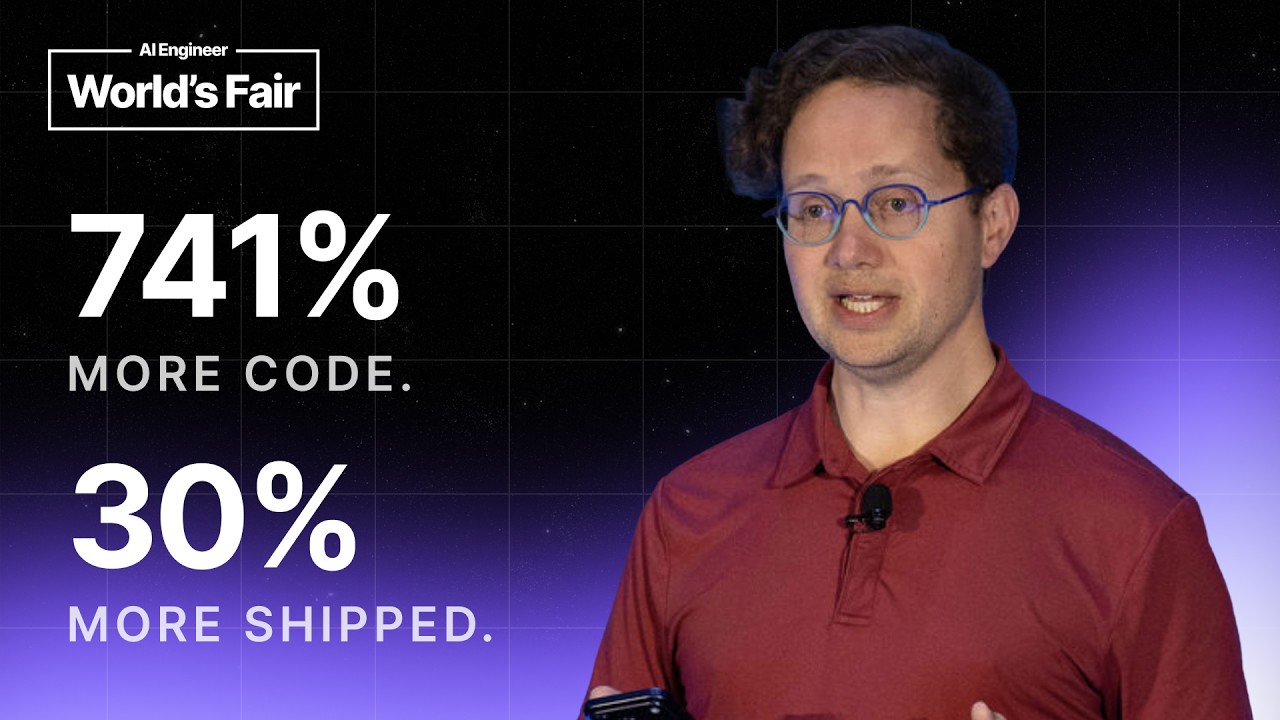
Laurie Voss explains that while AI has dramatically accelerated code generation, human code review remains a critical bottleneck for ensuring software quality and trust, especially in complex or sensitive projects. She advocates for transforming code review into a scalable, engineered system that combines automated tools with strategic human oversight to balance rapid development with reliable, evidence-based software delivery.
Laurie Voss, Head of Developer Relations at Arize AI and former co-founder of npm, discusses the evolving landscape of code review in the age of AI. She highlights a significant bottleneck: while AI agents have dramatically increased the speed of code generation—developers using autonomous agents write code nearly eight times faster—the pace of human code review has not changed, limiting the amount of software that can be reliably shipped. This mismatch creates challenges for engineering teams, as human review remains essential for trust and quality assurance, especially in sensitive codebases.
Voss explores various approaches to addressing this bottleneck. Simply increasing human review capacity is ineffective due to cognitive limits; studies show reviewers lose effectiveness after reviewing more than 400 lines of code in one sitting. Some have proposed eliminating human review entirely, relying on AI agents to design and review code autonomously. OpenAI’s internal experiment where agents wrote and reviewed a million lines of code with minimal human intervention exemplifies this approach, though it remains unclear how reliable or generalizable such systems are. The key challenge is defining what “mergeable” code means beyond passing tests, as current benchmarks often fail to capture code quality and maintainability.
Automated code review tools are already widely deployed in industry, with GitHub’s Copilot Reviewer conducting millions of reviews and other companies like Cursor and Code Rabbit advancing multi-pass review techniques to reduce false positives. These systems increasingly combine review with automated repair, generating patches for detected issues. However, despite automation, human judgment remains critical, especially for complex or security-sensitive code. Humans are shifting from line-by-line reviewers to designers and overseers of automated review systems, raising questions about how to effectively audit and trust these AI-driven processes.
Voss also discusses the limitations and risks of fully autonomous code review. Experiments like Anthropic’s agent-built C compiler and Bun’s rapid codebase migration demonstrate the potential but also reveal issues such as reliance on human-written test harnesses and the introduction of unsafe code patterns. Automated reviewers can be fooled by confidently framed bad code, a vulnerability not easily mitigated without human oversight. Moreover, the field lacks consensus on how to benchmark and evaluate review quality comprehensively, leaving production monitoring as the ultimate safeguard for code correctness and safety.
In conclusion, Laurie Voss argues that code review is not dying but transforming into a complex, engineered system where humans play a strategic role in defining quality standards and building reliable review frameworks. She advises developers to stop focusing on reviewing individual pull requests and instead invest in creating robust, scalable review harnesses that codify organizational knowledge and leverage AI agents effectively. The future belongs to teams that can provide evidence-based trust in their shipped software, balancing rapid code generation with rigorous, automated, and human-guided review processes.
Useful Links