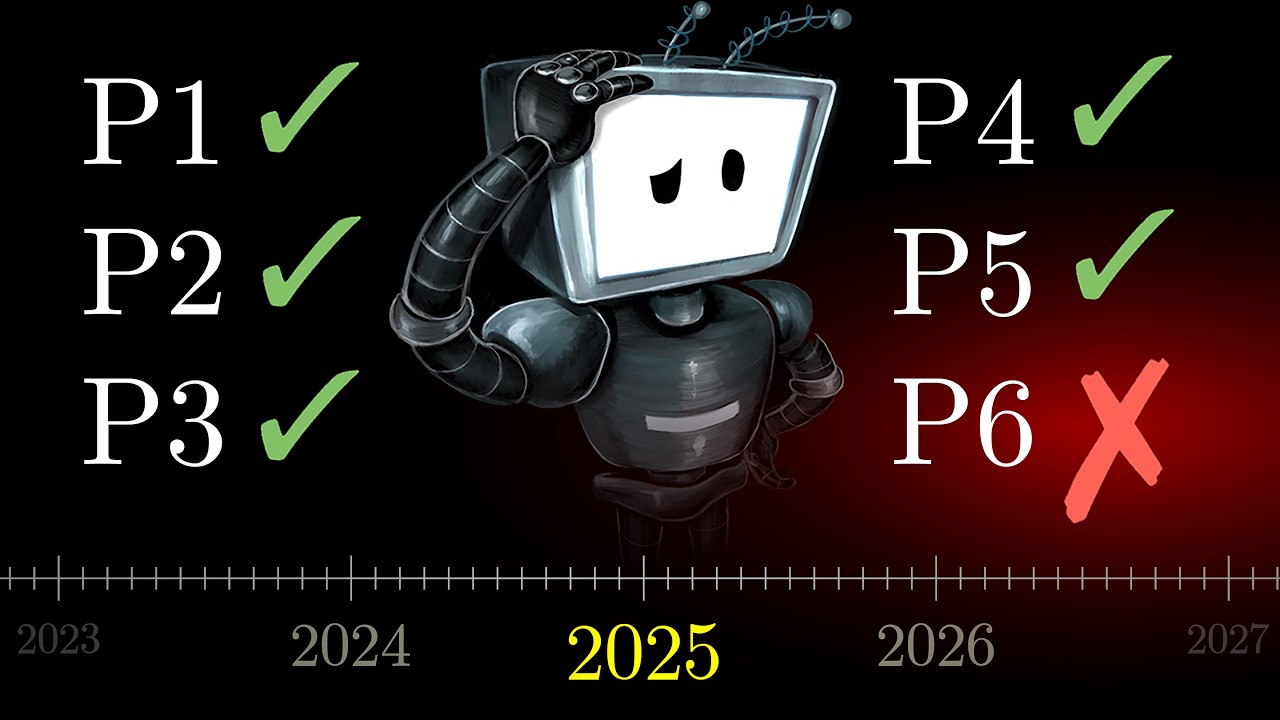
In 2025, the International Math Olympiad (IMO) featured a particularly challenging problem—problem number six—that stumped nearly all participants, with less than 1% achieving full marks. This problem stood out not only for its difficulty but also because it was the last IMO problem that AI systems initially could not solve. Unlike many AI successes in games and language tasks, IMO problems demand deep creativity, imagination, and rigorous proof-writing rather than mere computation or memorization. Early AI models struggled with this blend of creativity and rigor, but by 2026, advancements allowed AI to solve all IMO problems, including this one, highlighting the rapid progress in AI mathematical reasoning.
The problem itself involves tiling a large 2025 by 2025 grid with rectangular tiles so that each row and column has exactly one uncovered unit square, or “gap.” The challenge is to find the minimum number of tiles needed and to rigorously prove that this minimum is optimal. Through exploration, a conjecture emerged that the optimal tiling uses square tiles arranged so that the gaps form a “windmill” pattern around the corners of these tiles. This pattern leverages the fact that 2025 is a perfect square (45²), allowing a neat, symmetric construction that minimizes tile count. The problem’s complexity lies not just in finding this arrangement but in proving no better arrangement exists.
To approach the proof, the video draws an analogy to a simpler brain teaser about slicing a cube into smaller cubes with minimal cuts, emphasizing the importance of focusing on critical elements—in that case, the cube’s faces. Similarly, the tiling problem’s proof hinges on associating each gap’s edges with tiles and carefully counting these associations. By dividing the grid into four regions and highlighting specific edges of the gaps, the proof establishes a lower bound on the number of tiles needed. This method avoids double counting and respects the problem’s symmetries, leading to a formula for the minimum tile count involving both the square of the tile size and a linear term.
A key insight in the proof involves the Erdős-Szekeres theorem, a classical result in combinatorics about the lengths of the longest increasing and decreasing subsequences in permutations. By representing the positions of the gaps as a permutation, the proof uses this theorem to show that the sum of the lengths of these subsequences is at least twice the square root of the grid size. This combinatorial fact, combined with the edge-counting strategy, completes the rigorous proof that the conjectured tiling pattern is indeed optimal. The video also provides an elegant, self-contained proof of the Erdős-Szekeres theorem, enhancing understanding of the entire argument.
Beyond the mathematical content, the video reflects on the broader implications for AI and human understanding in mathematics. While AI can now produce proofs for complex problems, the human experience of deeply understanding and creatively motivating these proofs remains unique. The presenter emphasizes the importance of “motivated explanations”—narratives that make proofs feel natural and insightful rather than sudden or opaque. This distinction highlights a future where mathematical progress is measured not just by proof production but by the advancement of human comprehension, creativity, and the sharing of beautiful mathematical ideas.
Useful Links