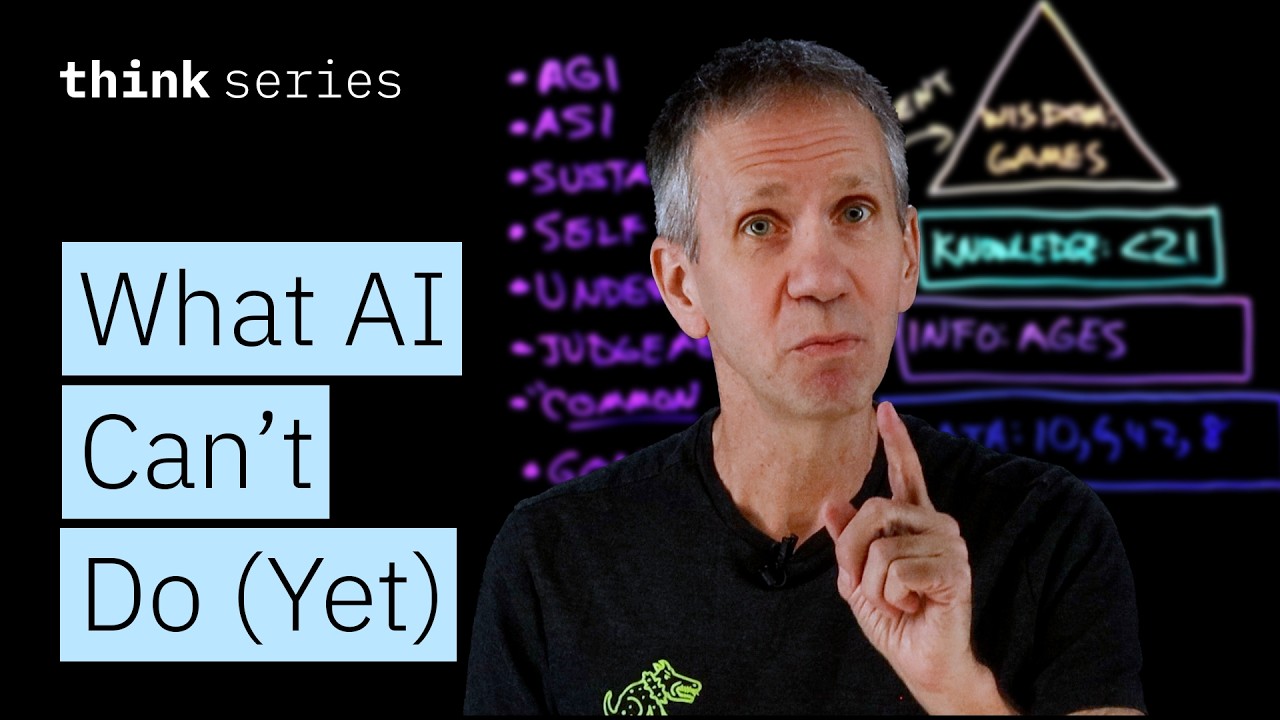
The video explores the current state and limits of artificial intelligence (AI), emphasizing how AI has rapidly advanced from research labs into everyday life, performing tasks once thought impossible. It begins by explaining the hierarchy of data, information, knowledge, and wisdom, illustrating how AI fits into this framework. Data consists of raw facts, information adds context, knowledge involves interpretation, and wisdom applies knowledge to make sound judgments. While AI has made significant strides in processing data and information and even generating knowledge, achieving true wisdom remains a challenge.
Historically, many believed AI would never master complex reasoning, natural language processing, creativity, or real-time perception. However, these predictions have been proven wrong. Examples include IBM’s Deep Blue defeating chess grandmaster Garry Kasparov, and Watson winning at Jeopardy, showcasing AI’s ability to reason and understand nuanced language. Modern generative AI models can interpret natural language with surprising accuracy, simulate creativity by producing art and music, and perform real-time perception tasks such as those required by self-driving cars and robots. These accomplishments demonstrate that many previously assumed limits of AI have already been overcome.
Despite these advances, some challenges remain. Emotional intelligence (EQ) in AI is still largely simulated, and while chatbots can recognize moods and respond empathetically, genuine emotional understanding is elusive. Another significant issue is hallucination, where AI confidently produces incorrect information. Although techniques like retrieval-augmented generation and model chaining help reduce hallucinations, this problem is not fully solved. Additionally, sustainability is a concern, as large AI models consume vast amounts of energy, making it necessary to develop more efficient systems that balance size, accuracy, and resource use.
Looking ahead, the video discusses the future limits of AI, including the pursuit of artificial general intelligence (AGI) — a system as capable as a human across all domains — and artificial superintelligence, which would surpass human abilities. Other unresolved challenges include self-awareness, true understanding, ethical judgment, common sense, goal setting at a macro level, sensory experiences beyond sight and sound, and the capacity to genuinely feel deep emotions. These areas remain largely in the realm of science fiction or philosophical debate, highlighting the gap between current AI capabilities and human-like intelligence.
Finally, the video emphasizes the complementary roles of humans and AI. Humans excel at defining the “what” and “why” — setting goals, understanding purpose, and making ethical decisions — while AI can efficiently handle the “how,” automating tasks and optimizing processes. This partnership allows AI to be a powerful tool that amplifies human potential rather than replacing it. The speaker advises viewers not to underestimate AI’s potential, as history shows many predictions about AI’s limits have been proven wrong. Instead, embracing AI’s evolving capabilities offers exciting opportunities for problem-solving and innovation in the future.