The video reviews Kandinsky 6.0, an open model that generates both video and synchronized audio in one pass. The model comes in two versions: a lighter 3 billion parameter model and a pro 29 billion parameter model, both producing 5-second clips with 44 kHz audio including lip sync. Kandinsky uses two streams for video and audio that communicate via cross attention to keep sound and visuals aligned. The video is initially generated at a lower resolution and then upscaled to full HD. The pro distilled version, which requires fewer steps, was used for testing. Running the model demands significant system resources, including up to 58 GB of RAM for the pro model on a 16 GB GPU preset, and is notably slow, taking over 20 minutes to generate 5 seconds of video on a 4090 GPU.
The reviewer tested Kandinsky 6.0 against LTX 2.5 from Lightricks, a 22 billion parameter model that also generates audio natively. Both models were run with the same prompts and seeds to produce 5-second clips at similar resolutions for a fair comparison. The reviewer found that Kandinsky sometimes altered prompts unexpectedly due to a built-in prompt rewriter, which was disabled for the tests. The comparison covered seven different prompts, including action scenes, emotional expressions, camera movements, text overlays, and speech.
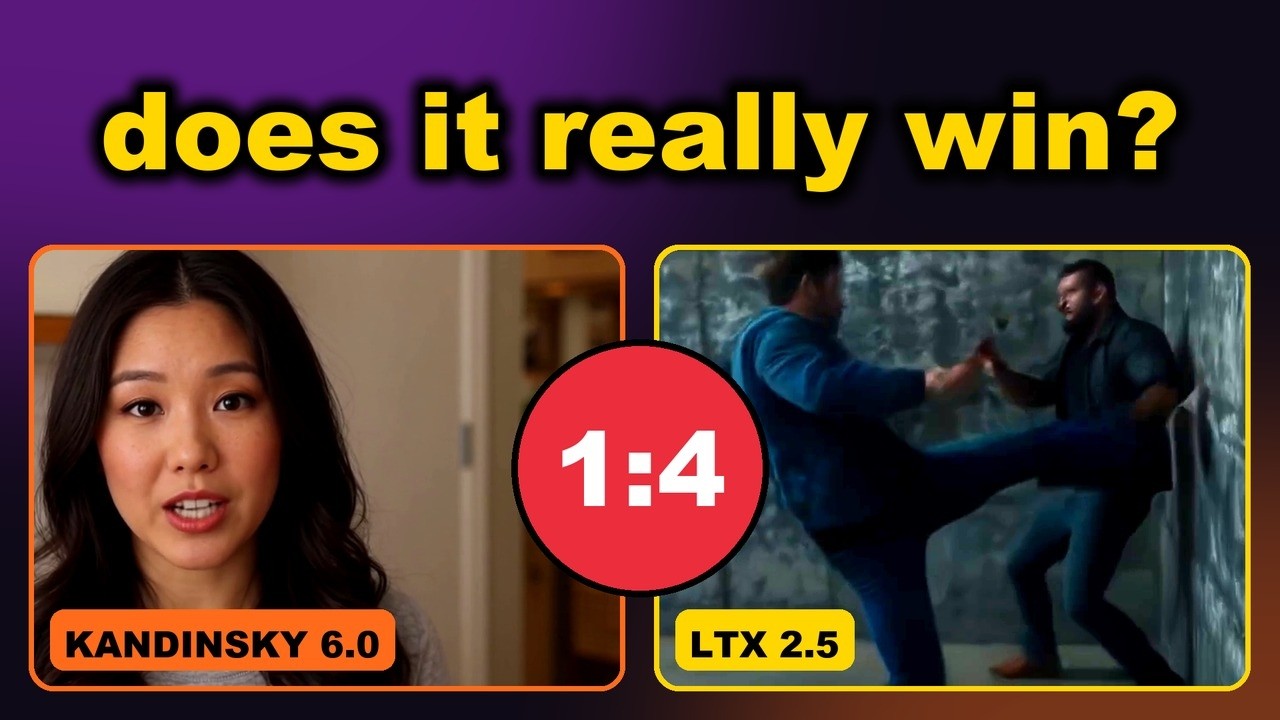
In the prompt-by-prompt comparison, LTX generally outperformed Kandinsky. For example, in an action scene involving a fight, LTX correctly depicted a kick, while Kandinsky showed only arguing and shoving. Both models captured a tear in a woman’s eye equally well, resulting in a tie. LTX made a better attempt at a continuous zoom sequence, though imperfect, while Kandinsky skipped a key step. Kandinsky produced cleaner camera movements in one test, but LTX included text overlays (albeit with a typo) that Kandinsky missed. In a professor explaining the Pythagorean theorem, LTX’s visuals were more believable, though both models produced the spoken sentence accurately.
Regarding speech accuracy, Kandinsky slightly faltered by saying “a sound” instead of “its sound,” while LTX was exact. Overall, LTX won four of the seven prompts, Kandinsky won one, and two were close calls. LTX was also significantly faster, with a median generation time of 54 seconds compared to Kandinsky’s 289 seconds, making it over five times quicker. The reviewer noted that Kandinsky’s claims of superiority over LTX in their paper were based on self-reported data and comparisons at different resolutions, which may have skewed results.
In conclusion, while Kandinsky 6.0 offers an open-source option with an MIT license and the ability to generate synchronized video and audio, LTX 2.5 currently provides better visual and speech quality and much faster generation times. Kandinsky’s model is resource-intensive and slower but freely available on Hugging Face with clear instructions. The reviewer suggests that users seeking speed and quality might prefer LTX, but those wanting an open license might choose Kandinsky. The entire test cost about $3 on RunPod, and viewers are encouraged to try both models themselves and share their experiences.