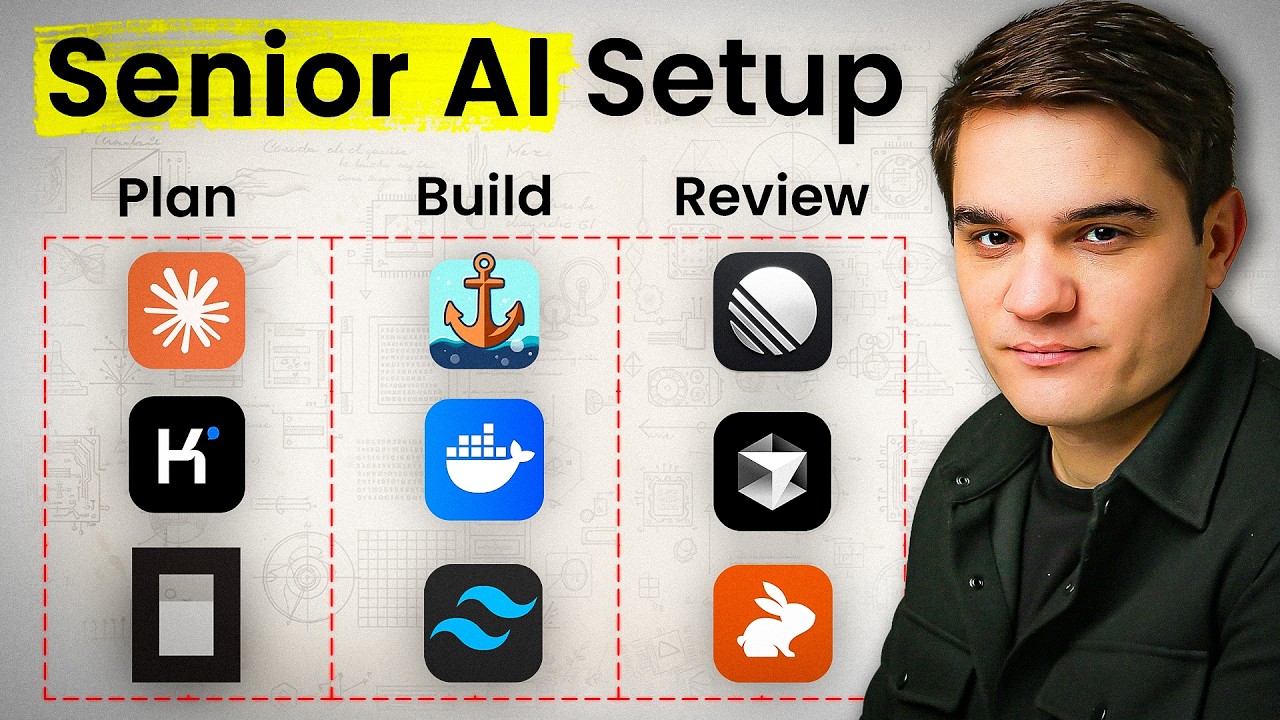
The video addresses the top 10 AI coding interview questions for software engineers in 2026, focusing on front-end, back-end, and full-stack development. Bogdan explains how AI has transformed the traditional agile development workflow by significantly shrinking the implementation phase while extending planning, testing, and code review stages. He highlights the use of AI coding agents like Cloud Code and Kimmy to generate multiple versions of code and evaluate trade-offs, but cautions that AI-generated tests can often produce false positives, necessitating thorough manual review. Tools such as Code Rabbit assist in automating code reviews, but human oversight remains crucial to ensure code quality and logical correctness.
Bogdan shares his preferred AI tools, noting that while Cloud Code is a market leader, it can be flaky and prone to issues like memory leaks. He also uses Kimmy for its better user experience despite its occasional overreach in committing code. He emphasizes that terminal user interfaces (TUIs) for AI coding agents are limited in usability compared to full integrated development environments (IDEs) like Zed or Cursor, which he uses for deeper code review and refactoring. His workflow involves leveraging AI during planning and implementation but relying on traditional IDEs for thorough review and refinement.
When reviewing AI-generated code, Bogdan stresses the importance of focusing on architectural consistency, modularization, and state management, especially in front-end frameworks like React. He warns against common AI code smells such as poor modularization, premature abstraction, and false positive testing. In the back end, he looks closely at API design, database schema changes, and code modularity to avoid bloated or inefficient structures. He advocates using sequence diagrams to visualize and verify complex interactions, ensuring that AI-generated code aligns with architectural standards and minimizes the risk of widespread bugs.
Bogdan discusses how to decide which parts of a codebase to delegate to AI versus building or verifying manually. He advises delegating routine or well-understood tasks to AI while personally handling critical or unfamiliar components, especially those involving sensitive data or complex logic like database schemas and global state. He also addresses team dynamics, recommending that senior engineers confront junior developers who submit large, AI-generated pull requests with many code smells, encouraging smaller, more manageable changes and fostering a culture of responsibility and quality over speed.
Finally, Bogdan contrasts AI coding in greenfield versus brownfield projects, noting that AI excels in rapid prototyping for new projects but requires more cautious, traditional approaches in legacy codebases where bugs have higher consequences. He suggests having multiple AI coding agents to avoid vendor lock-in and recommends using downtime during AI processing to review code, documentation, or other tasks rather than passively waiting. Overall, he advocates a balanced approach that combines AI’s speed with human judgment to maintain code quality and project stability.