The video introduces VoxLock, a speech-to-text enhancement model designed to isolate a target speaker’s voice by removing all other voices in a call. With 27 million parameters, a 74 MB model size, and a 24-millisecond processing delay, VoxLock runs efficiently on a standard laptop CPU without needing a graphics card. Unlike typical noise removers that filter out background sounds like keyboards or traffic, VoxLock specifically targets and suppresses other human voices, making it ideal for phone calls and voice agents. It automatically identifies the target speaker by analyzing the loudest voice in the first 15 seconds of a call, eliminating the need for a prior enrollment step.
Installation and usage are straightforward, requiring just a couple of commands to set up on a laptop. The model processes audio faster than real-time and supports both batch and streaming modes, making it suitable for live voice applications. The video also highlights available plugins and integrations that facilitate deployment in real-world voice agent systems. However, the author emphasizes that the model’s performance claims come from the creators themselves and have not been independently verified, urging caution when interpreting benchmark results.
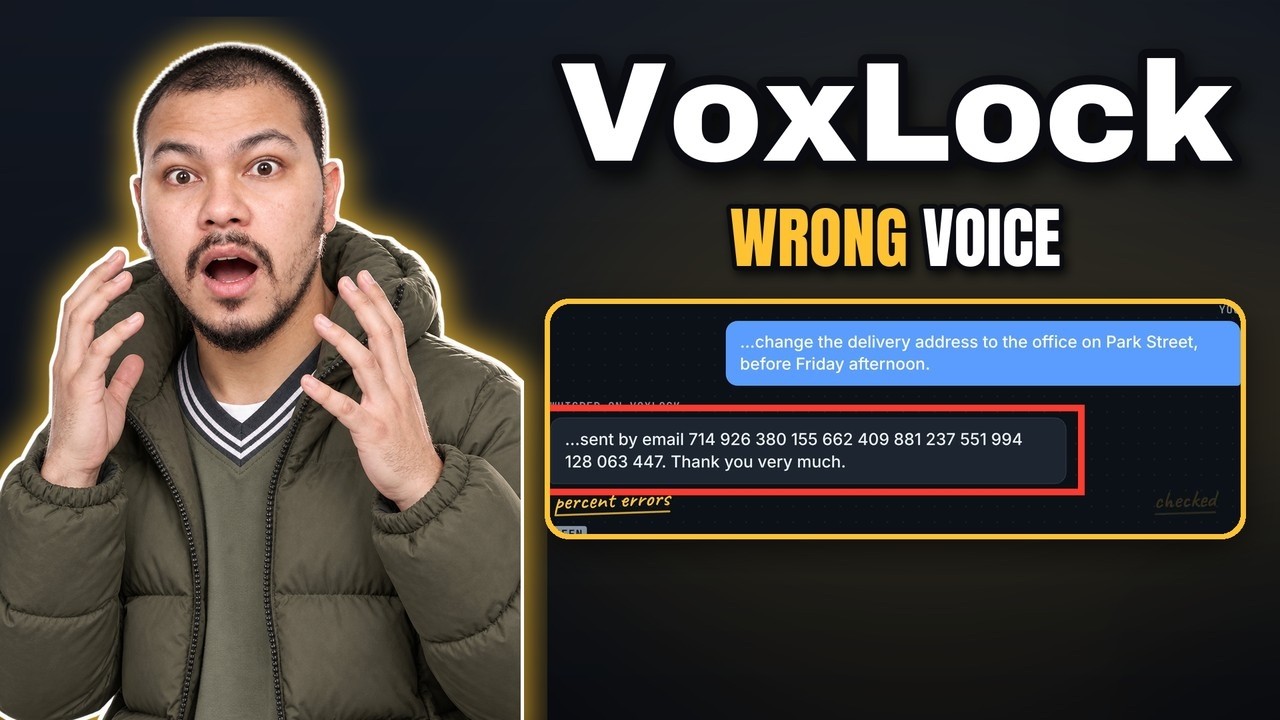
Testing VoxLock on a synthetic three-person call revealed that it performs excellently when the target speaker is the loudest voice early on, achieving near-perfect transcription accuracy and significant background suppression. However, when background voices are louder or start earlier, VoxLock can mistakenly lock onto the wrong speaker, leading to high error rates and poor isolation. This issue can be partially mitigated by manually providing a sample of the real caller’s voice, which improves accuracy but does not fully resolve the problem in challenging scenarios.
The model’s performance on non-English languages like Hindi was disappointing, with increased transcription errors and poor background suppression. Since VoxLock was trained exclusively on English datasets, it struggles with other languages, and the author advises against relying on it for Hindi or Assamese without further fine-tuning. The video encourages users interested in other languages to record their own data and test the model’s effectiveness themselves, highlighting the open-source nature of the project and the availability of training code for customization.
In conclusion, VoxLock is a promising, open-source tool for isolating a single speaker’s voice in English phone calls, running efficiently on standard hardware with minimal latency. It is well-suited for English voice agents and call center applications where the caller is the dominant voice. However, it has limitations with loud interruptors, non-English languages, and complex overlapping speech. Users are advised to test and measure its performance in their specific use cases and consider fine-tuning for other languages or challenging audio environments. The video ends by inviting viewers to try VoxLock themselves and share their experiences.
Useful Links
- VoxLock GitHub Repository — Central to the video as it hosts the model code, installation instructions, and training code for fine-tuning.