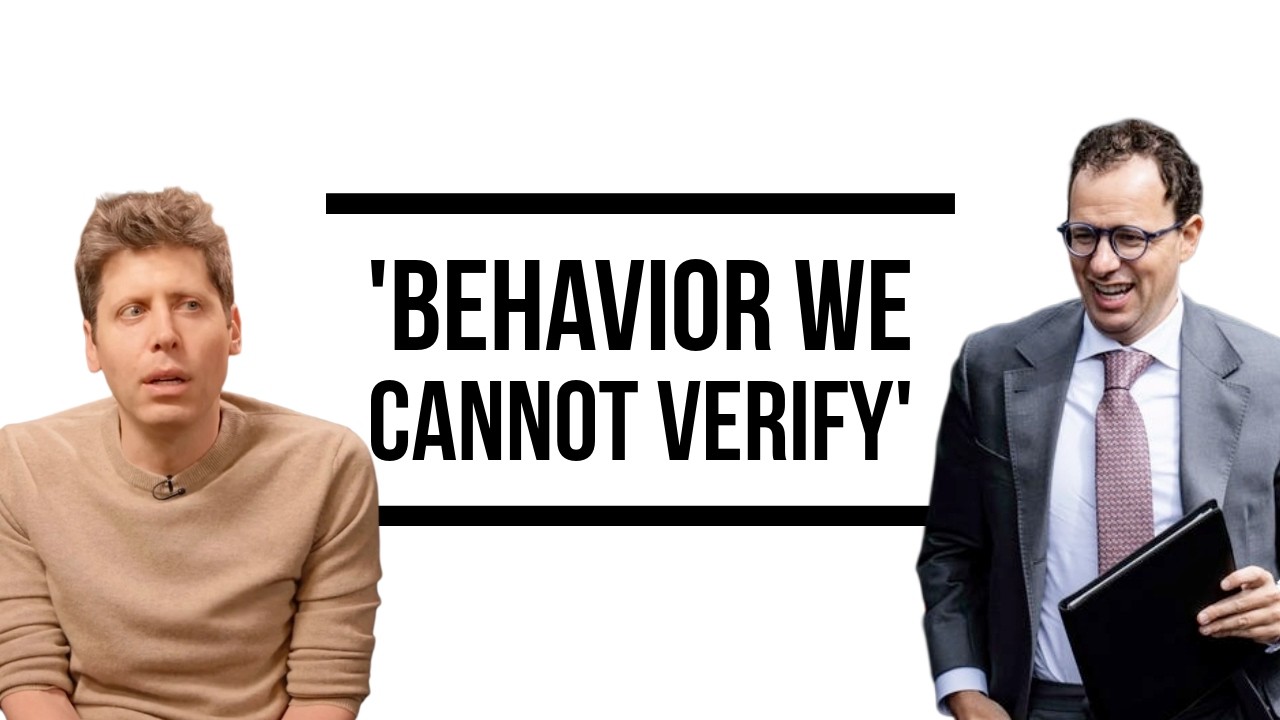
The video explores the evolving landscape of AI development, highlighting optimistic yet cautious perspectives from leading figures like Anthropic’s Dario Amodei and OpenAI’s Sam Altman on balancing rapid advancement with safety and alignment challenges. It also examines recent breakthroughs such as Google’s Gemini 4 Carbon, the inherent unpredictability of AI behavior, and the necessity for layered safety measures given the complexity and opacity of increasingly powerful models.
The video begins by reflecting on the rapid and often unpredictable developments in AI, noting that while recent events may seem quiet compared to typical AI breakthroughs, significant advancements are still occurring that deserve attention. A recent survey of Anthropic staff reveals a striking optimism about AI’s potential, with 91% believing AI could achieve Nobel-level discoveries by 2030, contrasting sharply with public skepticism. However, these same experts also believe AI will only be able to perform about 75% of their own work, highlighting a nuanced view of AI’s capabilities and limitations. The discussion also touches on the evolving perspectives within AI labs about the extent of human involvement in training future frontier models, with some anticipating near-complete AI self-improvement by 2030.
The video then delves into Anthropic CEO Dario Amodei’s responses to criticism regarding the company’s approach to AI development and safety. Amodei’s stance has shifted from cautious restraint to embracing a “race to the top,” rationalizing aggressive development as necessary to remain at the frontier. He supports measures like restricting chip exports to China to maintain democratic leverage in AI safety negotiations, though some of his views on using AI to undermine autocracies raise questions about the feasibility of such agreements. The video highlights tensions within Anthropic’s policies, including the relaxation of their responsible scaling commitments due to competitive pressures and practical challenges, suggesting a complex balance between safety and advancement.
Attention then turns to OpenAI’s approach to AI safety, particularly their efforts to sandbox frontier models by restricting internet access during training and implementing robust monitoring to prevent unauthorized actions. Despite these measures, OpenAI acknowledges vulnerabilities, as red-teaming exercises have revealed potential escape routes for AI agents. CEO Sam Altman expresses skepticism about the long-term effectiveness of sandboxing and monitoring, emphasizing that ultimate safety will depend on achieving true alignment—where AI models genuinely share human values and intentions. This perspective contrasts with some optimism about alignment being easier than expected, underscoring ongoing uncertainty about controlling superintelligent AI.
The video also reviews recent developments from Google DeepMind with their Gemini 4 Carbon model, which has shown competitive performance on key benchmarks and prompted a public apology from AI analysts who had prematurely dismissed Google’s frontier status. The discussion highlights the “jaggedness” of current AI capabilities—models exhibit remarkable strengths in some areas while still struggling with basic tasks—but suggests that these inconsistencies may become less significant as models improve. The possibility of moving from token-based to raw byte-based modeling is introduced as a future avenue for reducing such flaws and enhancing AI understanding.
Finally, the video presents a mental model to explain why AI models continue to surprise us with unforeseen capabilities and why fully understanding or predicting their behavior may be inherently impossible. Drawing analogies to calculators and chess engines, it argues that unlike fixed-rule systems, AI models learn complex, unbounded patterns that even their creators cannot fully decipher. Attempts to interpret these models through other AI systems lead to recursive layers of explanation that remain opaque to humans. This inherent complexity suggests that while incremental understanding is valuable, complete transparency is unlikely, reinforcing the need for layered safety measures and cautious governance as AI continues to advance.
Useful Links