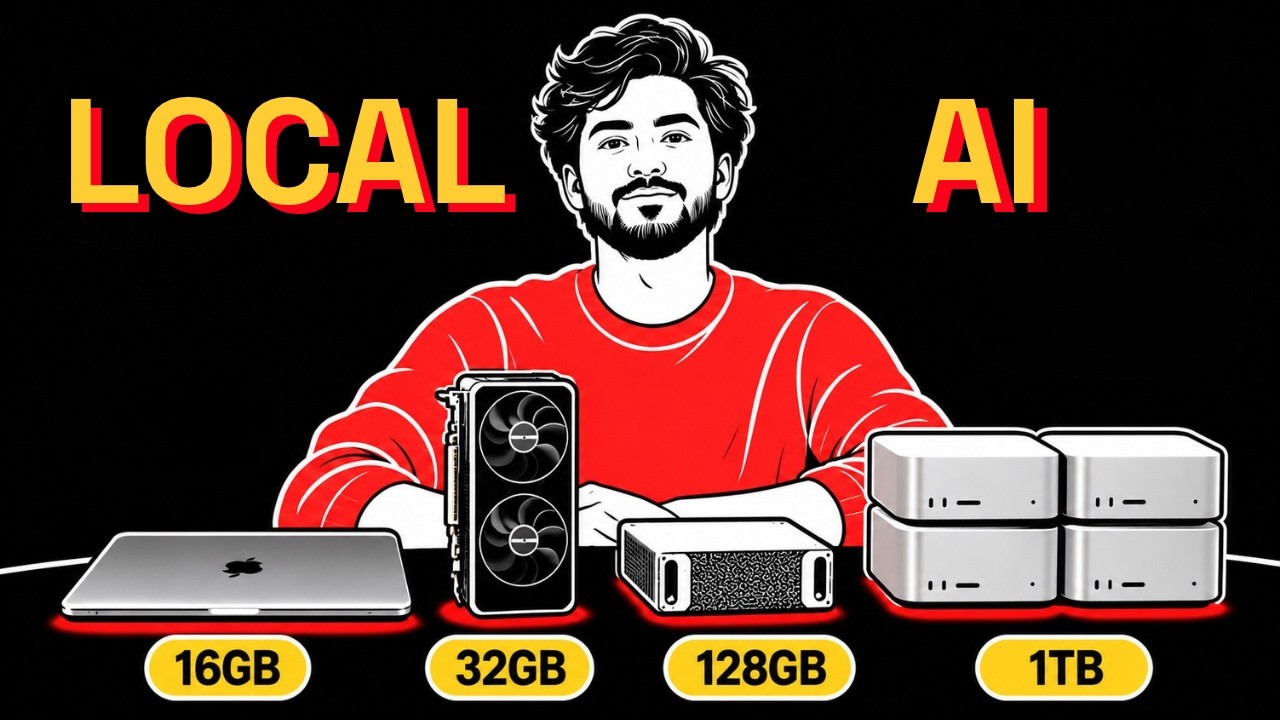
The video explores the reality behind AI models and the VRAM required to run them, debunking the common misconception that more VRAM always means smarter AI. The creator shares a personal experience of buying a 64 GB machine expecting a significant upgrade, only to find it ran the same AI model as a cheaper 32 GB machine, just with slightly better precision and more memory for context. This highlights that many memory upgrades buy better storage and context length rather than increased intelligence, a nuance often missed in popular tier videos.
Starting from the bottom, the video explains that 16 GB setups can run smaller models like Quinn 3.827B at reduced precision, while 32 GB machines run the same model at full precision with longer context windows, which is crucial for complex tasks. The 64 GB tier mainly improves bit precision and concurrency but does not increase intelligence scores, making it less worthwhile unless running multiple AI agents simultaneously. The first meaningful intelligence jump occurs at 128 GB, where models like GLM 5.3 Flash offer significantly better benchmark scores, though Mac users must tweak system settings to fully utilize the hardware.
At 256 GB, models like DeepSeek V4.1 Flash appear, offering further intelligence improvements and innovative memory management techniques that allow large models to run efficiently by streaming parts from SSDs. However, the 512 GB tier mostly provides better precision rather than smarter models, and savvy users can achieve similar performance by linking two 256 GB machines. The video also highlights that combining GPU VRAM with system RAM using engines like Strata enables running large models on more affordable hardware, challenging the notion that only high-end setups can handle advanced AI.
The terabyte tier, previously considered a dead end, has recently become significant with the release of Moonshot’s Kim K3.1 Pro model, which scores substantially higher than previous models and requires over a terabyte of VRAM. Although running this model locally is currently slow and expensive, it represents the best open AI model available and is a game-changer for those needing top-tier AI performance, especially in compliance-heavy industries or large-scale deployments where owning hardware makes sense.
Finally, the video emphasizes that renting AI models is often more cost-effective and practical than owning expensive hardware, as rental pricing is based on active parameters rather than total model size. Users are advised to try renting models first to understand their needs before investing in hardware. The key takeaway is that only certain VRAM tiers correspond to meaningful intelligence gains—specifically 32 GB, 128 GB, 256 GB, and now 1 TB—while others mainly improve precision or capacity. The AI hardware landscape is evolving rapidly, and informed decisions require understanding these nuances beyond simple tier charts.