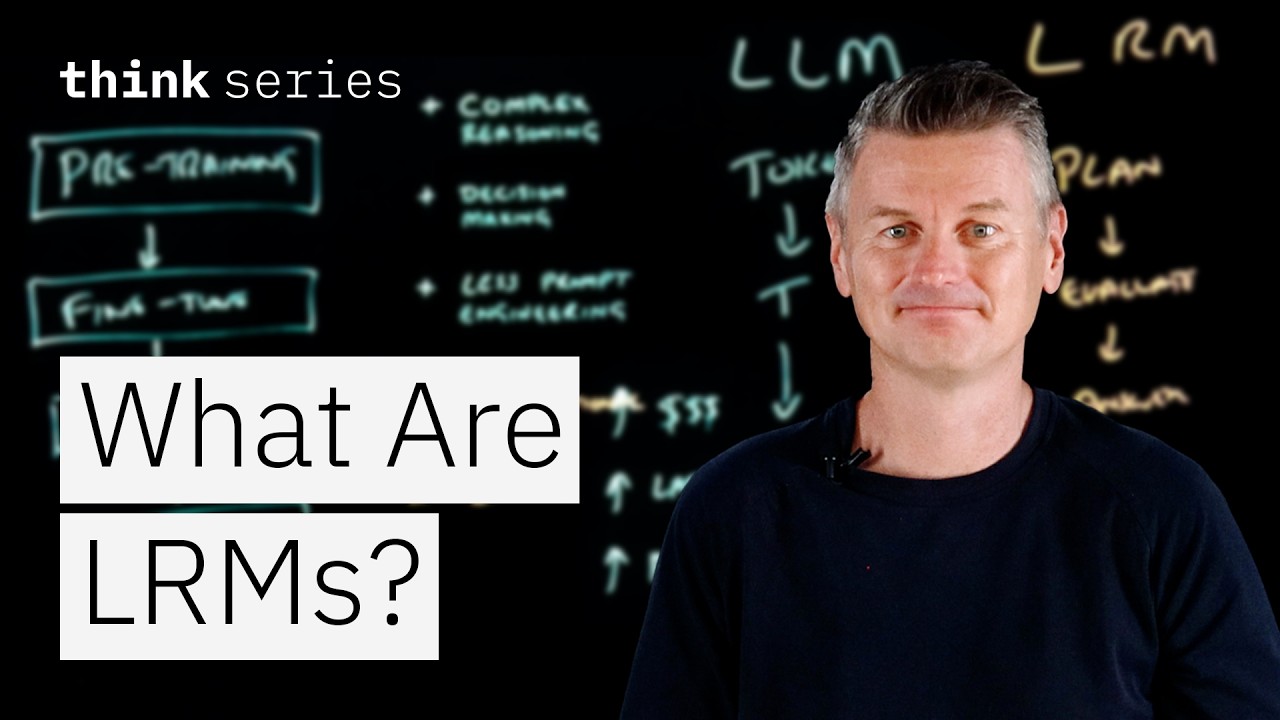
Large Reasoning Models (LRMs) represent an evolution beyond traditional Large Language Models (LLMs). While LLMs generate text by predicting the next token based on statistical patterns, LRMs add an extra layer of cognitive processing. Before producing an answer, LRMs sketch out a plan, weigh different options, and verify calculations in a sandbox environment. This internal chain of thought allows LRMs to test hypotheses, discard dead ends, and arrive at reasoned answers rather than just statistically likely responses. This deeper reasoning is particularly valuable for complex tasks like debugging code or tracing financial transactions, where simple reflexive responses from LLMs may fall short.
Building an LRM typically starts with a pre-trained LLM that has absorbed vast amounts of data from books, websites, code repositories, and more, giving it broad language skills and knowledge. The model then undergoes specialized reasoning-focused fine-tuning using curated datasets containing logic puzzles, multi-step math problems, and challenging coding tasks. Each example includes a detailed chain-of-thought answer key, teaching the model to “show its work” by planning and executing multi-step solutions. After this, the model is further refined through reinforcement learning, where human feedback or smaller judge models reward coherent reasoning steps, improving the model’s logical consistency.
Additional training techniques like distillation can also be employed, where a larger, more advanced teacher model generates reasoning traces that are used to train smaller or newer LRMs. This process helps transfer complex reasoning abilities efficiently. The end result is a model capable of planning, verifying, and explaining its thought process, making it well-suited for tasks requiring deep reasoning and multi-step problem solving. LRMs thus move beyond mere pattern matching to genuinely “think” through problems before responding.
At runtime, LRMs can be allocated varying amounts of inference time depending on the complexity of the task. Simple prompts, like writing a social media caption, might only require a quick pass, while more demanding problems, such as debugging or financial tracing, may involve multiple chains of thought, voting on the best solution, backtracking, or calling external tools like calculators or code sandboxes. Each additional reasoning step increases computational cost, latency, and energy consumption, but ideally results in higher accuracy and more nuanced answers.
In summary, LRMs offer significant advantages for tasks that demand complex reasoning, improved decision-making, and internal verification. They reduce the need for elaborate prompt engineering since reasoning is built into their design. However, these benefits come with trade-offs in terms of higher computational resources, longer response times, and increased operational costs. For many applications, LRMs represent the future of smarter AI—models that don’t just generate language but thoughtfully consider their responses to deliver more reliable and insightful answers.