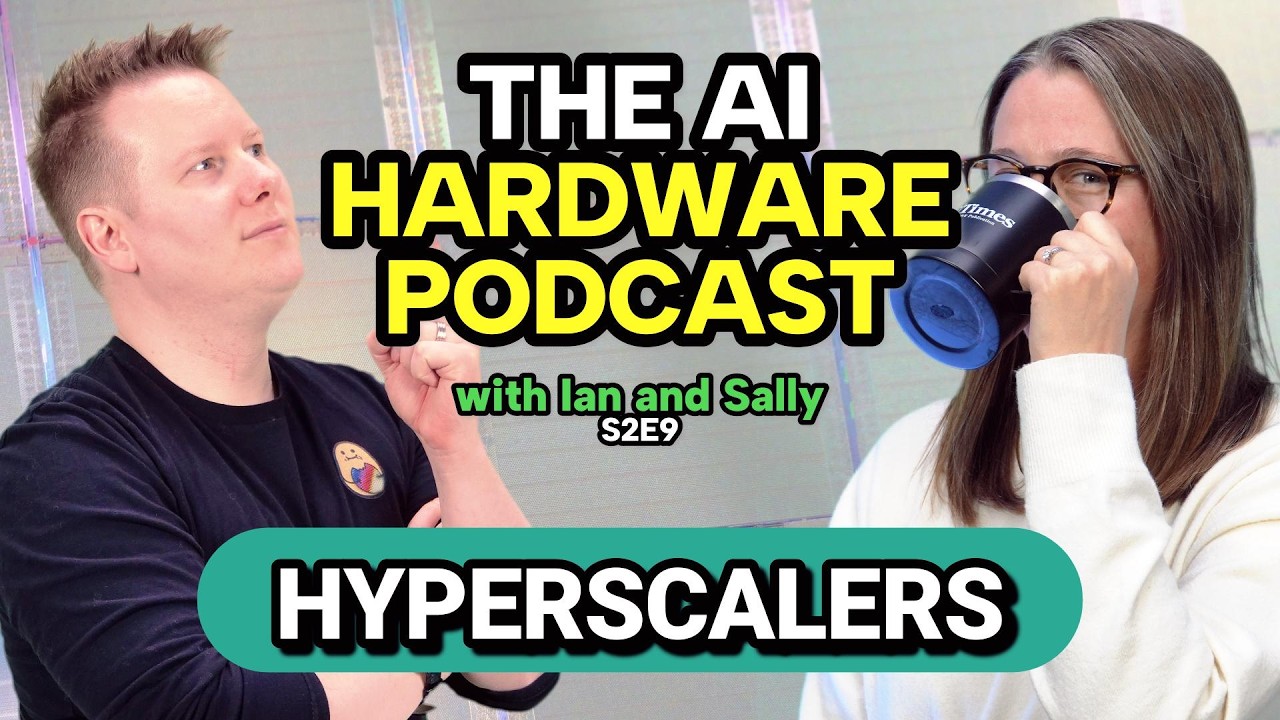
In this episode of The AI Hardware Podcast, Sally Ward Foxton and Ian Kutras discuss the growing trend of hyperscalers—major cloud providers like Google, Amazon, and Meta—designing their own custom silicon chips. The primary motivation behind this shift is to reduce dependency on dominant chip suppliers like Nvidia, gain greater control over hardware optimizations, and achieve competitive advantages tailored to their specific workloads. For example, Google’s TPU chips are designed primarily for internal use, while Amazon offers instances based on its custom chips to external customers. This customization allows hyperscalers to optimize performance and cost efficiency at massive scale, despite the challenges of evolving workloads and the high costs of chip development.
The conversation highlights how hyperscalers are not only building AI accelerators but also designing their own CPUs, mostly based on ARM architectures, to better control their entire technology stack. Unlike traditional merchant silicon providers like AMD and Intel, which offer semi-custom solutions with limited tweaks, hyperscalers develop fully custom designs that allow them to select core counts, interconnect speeds, and other parameters. However, this approach requires highly skilled chip designers, a scarce resource in the industry, which has led to increased collaboration with specialized design houses such as Broadcom and Marvell to accelerate development and reduce time to market.
Cost considerations also play a significant role in the move toward custom silicon. Nvidia’s AI accelerators carry substantial markups, and hyperscalers see an opportunity to reduce costs by working directly with foundries or through partnerships with companies like Broadcom. While Nvidia remains the dominant player in AI chips, Broadcom competes strongly in infrastructure components like networking and optical technologies. Despite the rise of custom silicon, hyperscalers still rely heavily on Nvidia and AMD chips for certain workloads, underscoring the importance of maintaining a diverse supply chain and offering customers choice.
The discussion also touches on the global landscape, noting that Chinese hyperscalers are following a similar path by developing their own custom silicon for sovereignty and control reasons. Companies like Alibaba and Huawei have their own design teams, and there is a growing ecosystem of AI hardware startups in China. However, geopolitical factors and talent migration between countries influence the development and availability of skilled chip designers. Additionally, other regions like Korea and Japan are fostering their own semiconductor ecosystems, often leveraging startups to build custom solutions tailored to local cloud providers.
In conclusion, the podcast emphasizes the massive scale at which hyperscalers operate, justifying the significant investments in custom silicon to optimize performance, cost, and integration across CPUs, AI accelerators, and networking components. The hosts express a desire for greater transparency from hyperscalers about their custom chip architectures to better understand the evolving landscape. They encourage these companies to share more high-level information about their silicon designs, which would help the industry and observers distinguish between different approaches without revealing sensitive proprietary details.