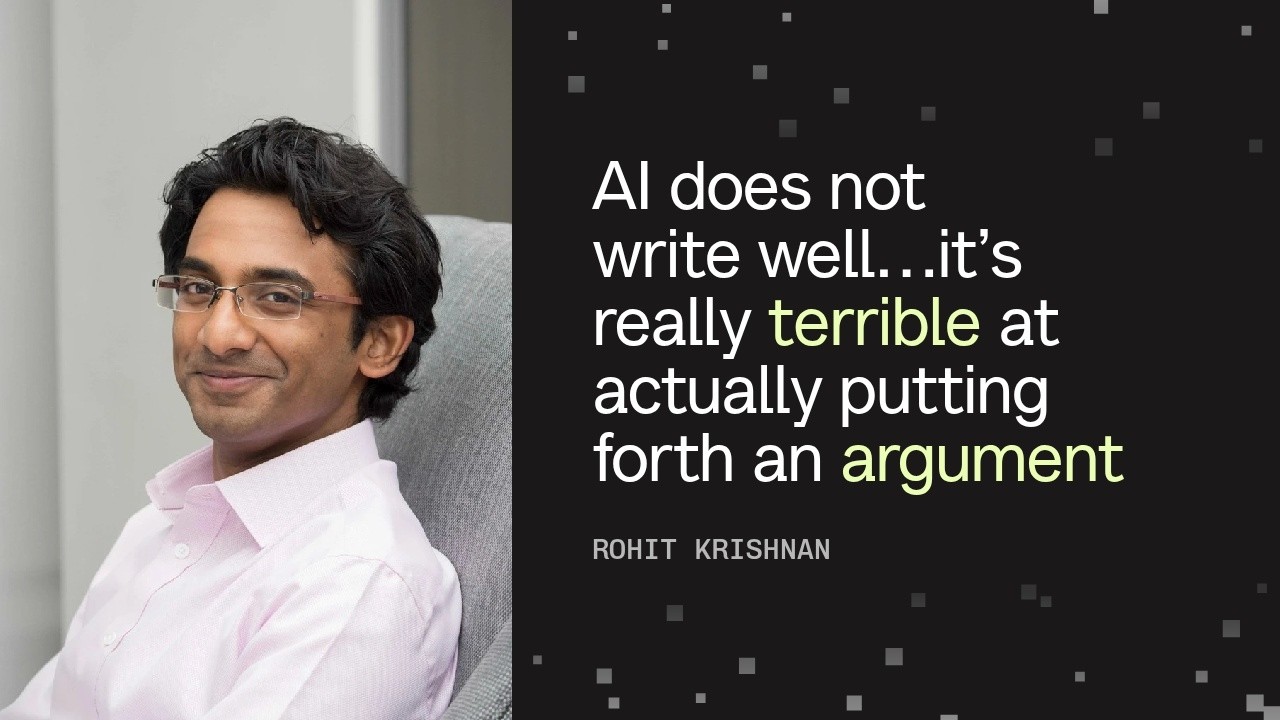
In this insightful discussion, Rohit Krishnan explores the question of what artificial intelligence (AI) is actually good at, cutting through the noise of hype, skepticism, and doomsday predictions. He emphasizes that AI excels at tasks with clear, measurable benchmarks, rapidly surpassing human performance in such areas. However, AI struggles with tasks that are difficult to quantify or put into a defined framework, such as nuanced judgment or complex problem-solving that requires deep contextual understanding. Krishnan highlights coding as a prime example where AI shows remarkable capability in implementation but lacks the human skill of deciding what to do, underscoring AI’s current limitations in judgment and creativity.
Krishnan shares practical examples from his own life, illustrating how AI tools like Muse and Instinct assist with personal administrative tasks, such as managing emails, scheduling, and even negotiating bills. These applications, while individually mundane, collectively save significant time and mental effort, demonstrating AI’s strength in automating repetitive, low-level tasks. However, when it comes to writing and intellectual work, Krishnan is more critical. He notes that AI-generated writing often lacks coherent argumentation, logical flow, and “taste,” producing content that can feel formulaic or superficial. Despite this, AI remains a valuable research assistant and idea generator, integrated seamlessly into his workflow.
Delving into the technical nature of large language models (LLMs), Krishnan explains that these systems are essentially powerful pattern recognition machines trained on vast datasets. They excel at identifying and replicating patterns present in their training data but face practical limitations in learning and applying knowledge beyond those patterns. While theoretically capable of universal computation, current architectures and data constraints mean AI cannot yet master all tasks, especially those requiring deep understanding or novel reasoning. The ongoing improvements in AI are driven largely by access to more and better data, as well as iterative enhancements in model design.
Addressing societal concerns, Krishnan expresses skepticism toward extreme doomsday scenarios predicting human extinction due to AI. He argues that such fears often rest on unfalsifiable assumptions and overlook humanity’s proven capacity to adapt rapidly to technological and societal changes. Instead, he advocates for pragmatic approaches focused on accountability and regulation, emphasizing that existing legal and institutional frameworks can be adapted to manage AI-related risks. For example, companies should be held liable if their AI systems cause harm, just as they would be for human employees, and new policies should consider how AI agents fit into tax and legal systems.
Finally, the conversation touches on the elusive concept of artificial general intelligence (AGI). Krishnan suggests that much of the debate around AGI is semantic and sometimes driven by marketing rather than substance. He likens current AI agents to autonomous companies—complex, capable entities that can perform specialized tasks but lack true intentionality or consciousness. Whether or not these systems qualify as AGI is less important than their practical utility and the societal mechanisms developed to govern their use. Overall, Krishnan advocates for a balanced, evidence-based perspective on AI’s capabilities and challenges, emphasizing adaptation, accountability, and cautious optimism.
Useful Links