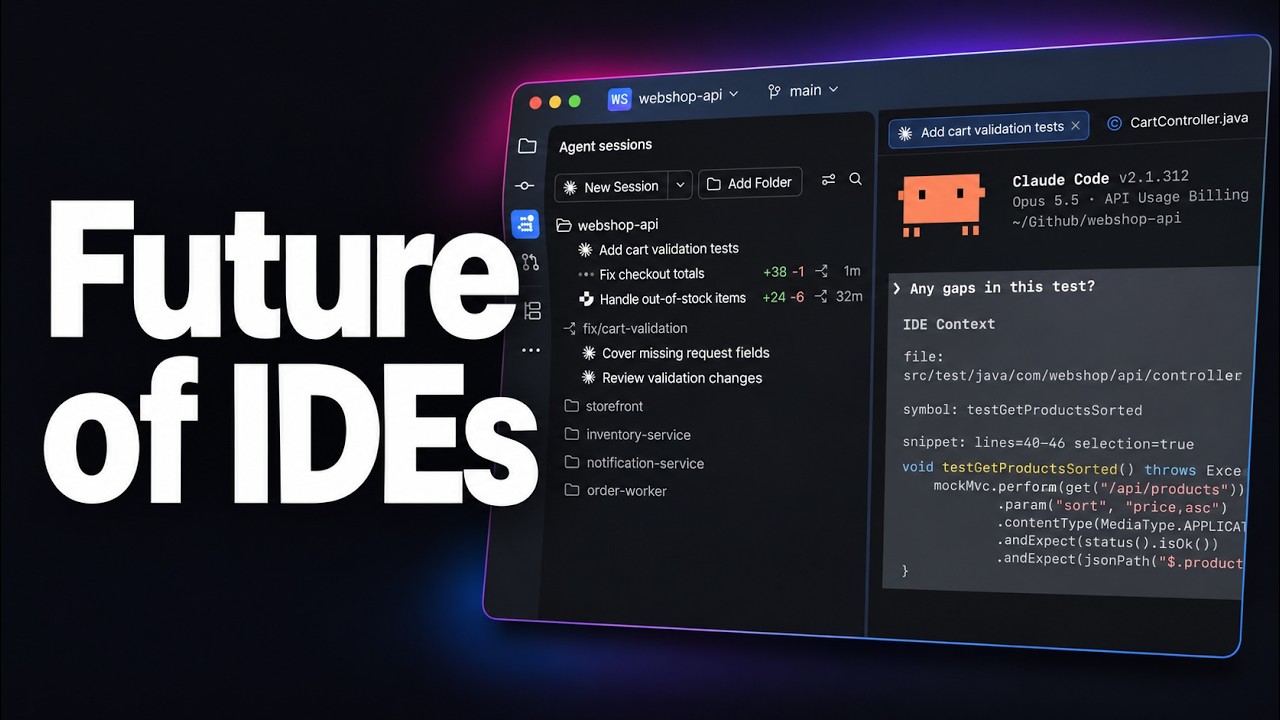
The video explores the evolving role of Integrated Development Environments (IDEs) in the age of advanced AI coding agents. While some might argue that IDEs are becoming obsolete due to AI’s ability to generate code, the speaker emphasizes that IDEs remain crucial, especially for developers who want to ensure their code is safe, reliable, and maintainable. AI agents often make widespread changes across multiple files, which can be difficult to track and understand without the comprehensive tools that IDEs provide. Therefore, IDEs are not just about writing code anymore but are increasingly about inspecting, understanding, and managing codebases.
The speaker shares personal experience with JetBrains IDEs and highlights their thoughtful approach to evolving IDEs to meet modern developer needs. JetBrains’ new product, Air, exemplifies this shift by integrating AI agents directly into the IDE, allowing developers to orchestrate multiple agents and manage their outputs effectively. This integration supports a workflow where developers can quickly move between high-level project overviews and detailed code inspections, facilitating better understanding and control over AI-generated changes.
One of the key points made is that the bottleneck in software development has shifted from writing code to reviewing and verifying it. AI agents can produce code rapidly, but human developers must carefully review these changes to ensure correctness, efficiency, and compliance with project requirements. IDEs play a vital role in this review process by providing tools for diffing, navigation, testing, debugging, and documentation. These capabilities help developers verify that AI-generated code meets quality standards before it is merged into production.
The video also stresses the importance of documentation and context within IDEs, not only for human developers but also for AI agents themselves. Well-documented codebases and semantic search capabilities within IDEs improve the accuracy and efficiency of AI agents by giving them better context, reducing token usage, and ultimately saving costs. This symbiotic relationship between developers, AI agents, and IDEs is crucial for managing complex projects that involve multiple AI tools and models.
In conclusion, the future of IDEs lies in their transformation from code-writing tools to sophisticated platforms for code curation, review, and collaboration with AI agents. The speaker encourages developers to rethink their workflows, focusing on how they use IDEs to read, verify, and decide what code should ship rather than just writing it. As AI continues to advance, IDEs like JetBrains Air aim to empower developers to maintain control and trust in their software, ensuring that human oversight remains central in the development process.
Useful Links