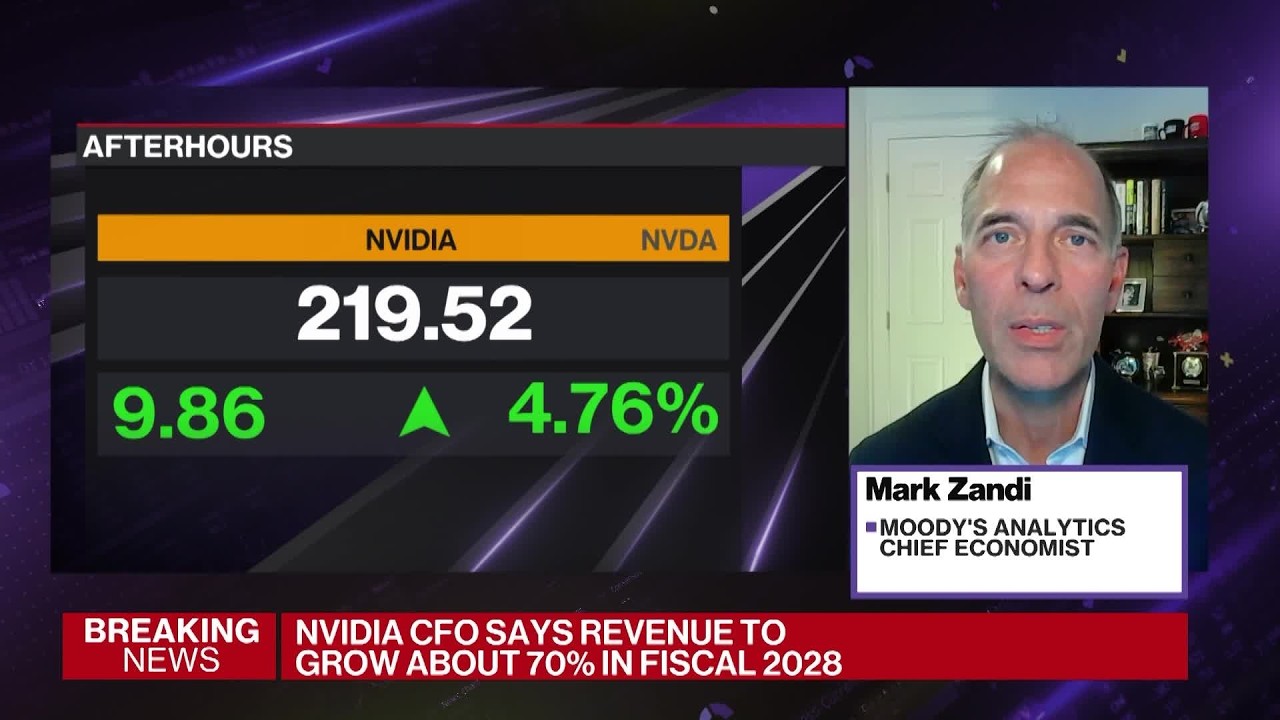
Nvidia’s earnings highlight AI’s significant role in driving current economic growth and investment demand, positioning AI-related companies as major market leaders. However, the sustainability of this growth depends on AI’s ability to boost productivity on the supply side, which has yet to be clearly demonstrated.
Nvidia’s recent earnings report highlights the significant role artificial intelligence (AI) is playing in driving macroeconomic growth. The speaker emphasizes that AI is a major contributor to the current GDP growth rate of about 2%, accounting for roughly a quarter of this expansion. Without AI’s influence, economic growth would be closer to 1.5%, indicating that AI is a critical factor in shaping the broader economic narrative and performance.
Nvidia is portrayed as the leading example or “poster child” of the AI-driven economic trend, benefiting immensely from increased investment and demand related to AI technologies. The growth seen in Nvidia’s business and stock price reflects the broader surge in AI-related companies, which have become a dominant force in the market. These companies, while representing about 10% of GDP, make up around half of the S&P 500 market capitalization and have driven two-thirds of the stock price gains since the emergence of ChatGPT four years ago.
The current impact of AI is primarily on the demand side of the economy, fueling investment spending and capital expenditures as businesses build out AI capabilities. However, the speaker notes that AI’s influence on the supply side—specifically productivity growth—has yet to materialize in a meaningful way. Productivity gains are crucial because they reflect fundamental improvements in business output and efficiency, which are necessary to sustain long-term economic growth and justify high stock valuations.
Measuring productivity growth is inherently challenging, especially during periods of rapid technological change, and the data may not yet fully capture AI’s effects. The speaker suggests that a noticeable increase in productivity growth, from the current 2% to around 2.25% or 2.5%, would be a strong indicator that AI is transforming business output rather than merely accelerating routine tasks. Such gains would validate investor optimism and support the elevated valuations of AI-focused companies.
In conclusion, while AI is clearly driving significant economic and market growth, the critical test lies in its ability to boost productivity on the supply side. If productivity improvements do not become evident soon, investors may begin to question the sustainability of current valuations and the transformative impact of AI. Thus, the ongoing AI investment cycle hinges on demonstrating tangible productivity benefits that fundamentally change how businesses operate and grow.