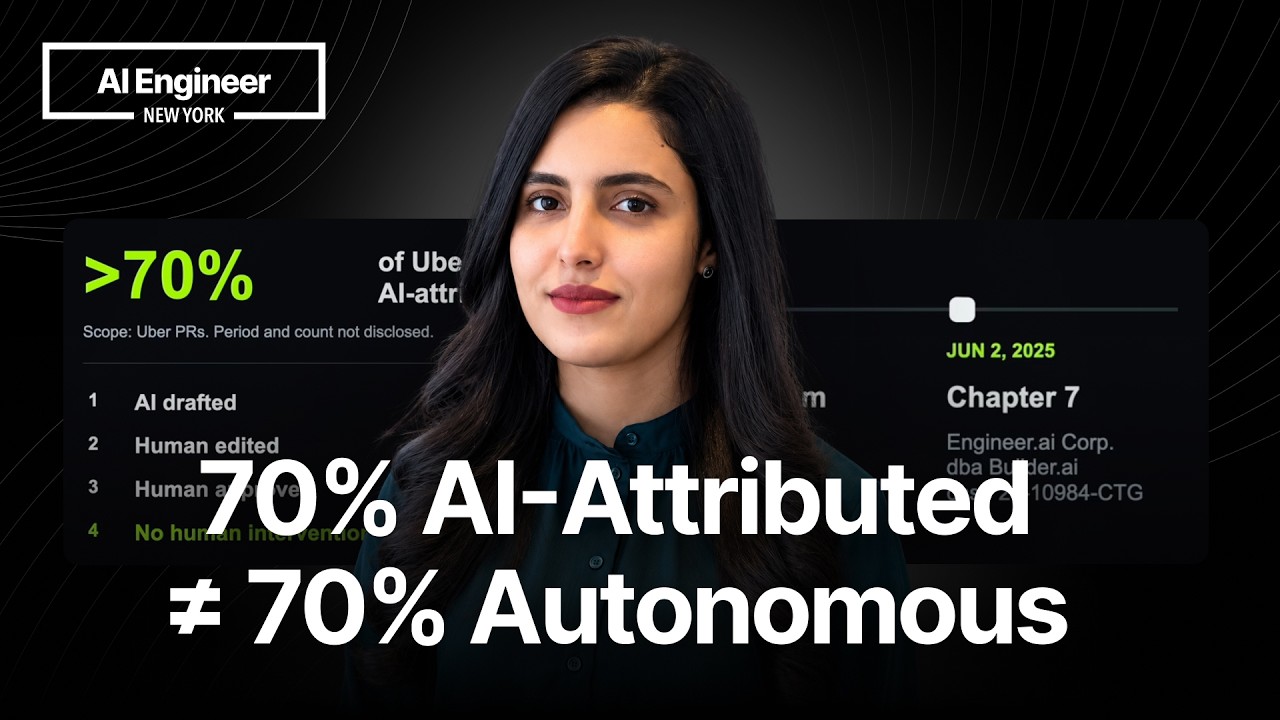
Soukaïna Abelhad, an AI tech lead, discusses the realities behind claims of high automation percentages in technical due diligence, particularly when a presentation deck states something like “70% automated.” She highlights that such impressive numbers often come from controlled experiments or observational data but warns that these figures can be misleading if taken at face value. Abelhad emphasizes that the danger lies not in fabricated numbers but in genuine measurements being extended beyond what they can support, urging a critical approach to evaluating such claims.
The first key check Abelhad recommends is arithmetic: comparing workload volume with fully loaded human labor. She cites data showing that teams with high AI adoption actually experience increased pull request volume, longer review times, and larger pull requests, indicating that AI may assist but does not necessarily reduce human labor. Due diligence should therefore include examining the company’s 18-month theory on workload and labor, accounting for all roles involved due to AI, such as operators and reviewers, to understand if AI truly reduces labor or merely shifts it.
Next, Abelhad stresses the importance of clear definitions around automation claims. For example, Uber’s claim that 70% of pull requests are AI-attributed does not clarify whether this means AI drafted, edited, or fully autonomously handled the code. She introduces the concept of straight-through processing from finance, which means complete end-to-end automation without human intervention within a defined boundary. Understanding where the boundary lies—whether at drafting, approval, or production—is crucial to interpreting automation claims accurately.
The third check focuses on evaluation maturity and trustworthiness of measurements. Abelhad references a Meta study where automated graders were more optimistic than human reviewers about AI-generated code quality, illustrating that automated validation often overestimates success. She advises asking who defines quality, whether experts agree on the evaluation, and how well automated judges are validated against expert judgment. This scrutiny helps identify what bad outputs escape detection and ensures that quality claims are credible.
Finally, Abelhad underscores that even when arithmetic, definitions, and evaluations hold up, the economic viability of AI automation must be assessed. She advises starting with the eligible workflow value, factoring in actual adoption rates, straight-through processing success, and accepted quality, then subtracting costs related to AI, human review, escalation, and rework. The ultimate metric should be the cost per accepted autonomous task. Her concluding advice is to carry these three checks—arithmetic, definition, and evaluation—into vendor or investment discussions and to remember that due diligence is about understanding what must be true for impressive numbers to truly matter.
Useful Links