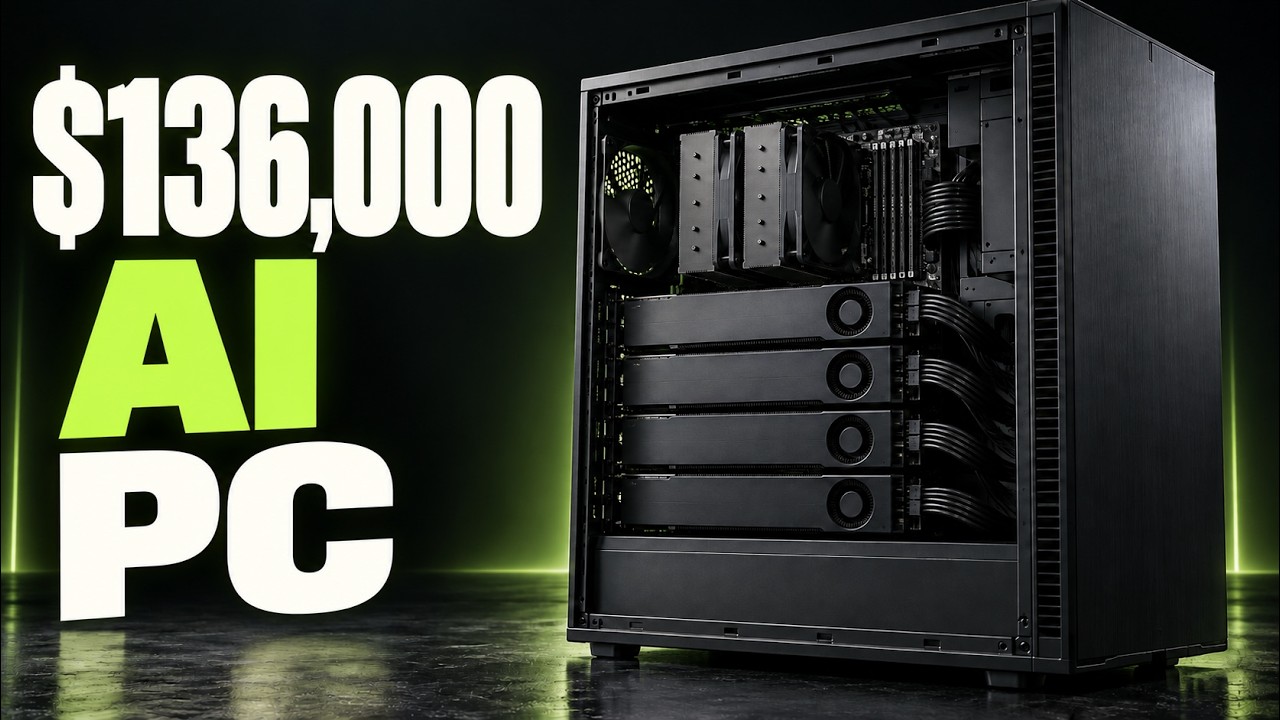
The ultimate AI personal computer (AIPC) for running large AI models at home, with no budget constraints, would consist of four Nvidia RTX Pro 6000 Max Q graphics cards, a 96-core AMD Ryzen Threadripper Pro 9995WX processor, and 2 TB of DDR5 RAM. This setup costs around $136,000 based on October 2026 prices. The key design principle is to maximize the amount of AI model data held in the fastest memory possible, primarily the graphics cards’ memory, to optimize performance. However, even this high-end build faces limitations, as the largest open AI models exceed the combined 384 GB of GPU memory and must spill over into system RAM, which drastically slows token generation speeds.
The choice of the RTX Pro 6000 Max Q cards over the more powerful 600 W workstation edition is deliberate. Although the Max Q version offers about 12% less compute power, it features a blower-style cooler that exhausts heat directly out of the case, enabling stable operation of four GPUs in a single desktop chassis without overheating. Each card has 96 GB of GDDR7 memory, totaling 384 GB across four cards, which can fit models like GLM 5.3 Flash but not the top three largest models such as MIMO v2.6 Pro or Kimmy K3, which require hundreds of gigabytes to over a terabyte of memory.
To accommodate the largest models, the build includes 2 TB of DDR5 system memory, which is necessary to hold the parts of the model that cannot fit on the GPUs. This memory capacity is extraordinarily expensive, costing nearly as much as the GPUs themselves, and is limited by the bandwidth of the CPU-memory interface. The 96-core Threadripper Pro processor and ASUS ProWSWRX9E Sage SE motherboard provide the necessary PCIe lanes and memory channels to support this massive memory and multi-GPU setup. However, the system memory bandwidth is much slower than GPU memory, causing token generation for the largest models to be very slow.
Power consumption is another major challenge. The four GPUs and supporting components draw about 1.9 kW at full load, exceeding the capacity of a standard US 15-amp outlet and requiring a dedicated 240-volt circuit installed by an electrician. Running the machine continuously would also incur significant electricity costs, around $3,000 per year, and generate substantial heat equivalent to a high-powered space heater. Storage is handled by an 8 TB NVMe SSD to quickly load large model files.
Compared to alternatives, Nvidia’s DGX Station offers a more integrated solution with 252 GB of high-speed HBM3 memory and 496 GB of slower LPDDR5X memory, holding some large models in a single box for about $92,500. Renting cloud GPUs is also a cost-effective option for many users. Ultimately, the custom build only makes sense if you need to run the absolute largest open AI models locally and are willing to accept slow token generation speeds and high costs. For most users, buying a pre-built system or renting cloud resources is more practical. The key takeaway is to prioritize memory capacity and bandwidth for your chosen model and ensure your power and cooling infrastructure can support the hardware.
Useful Links