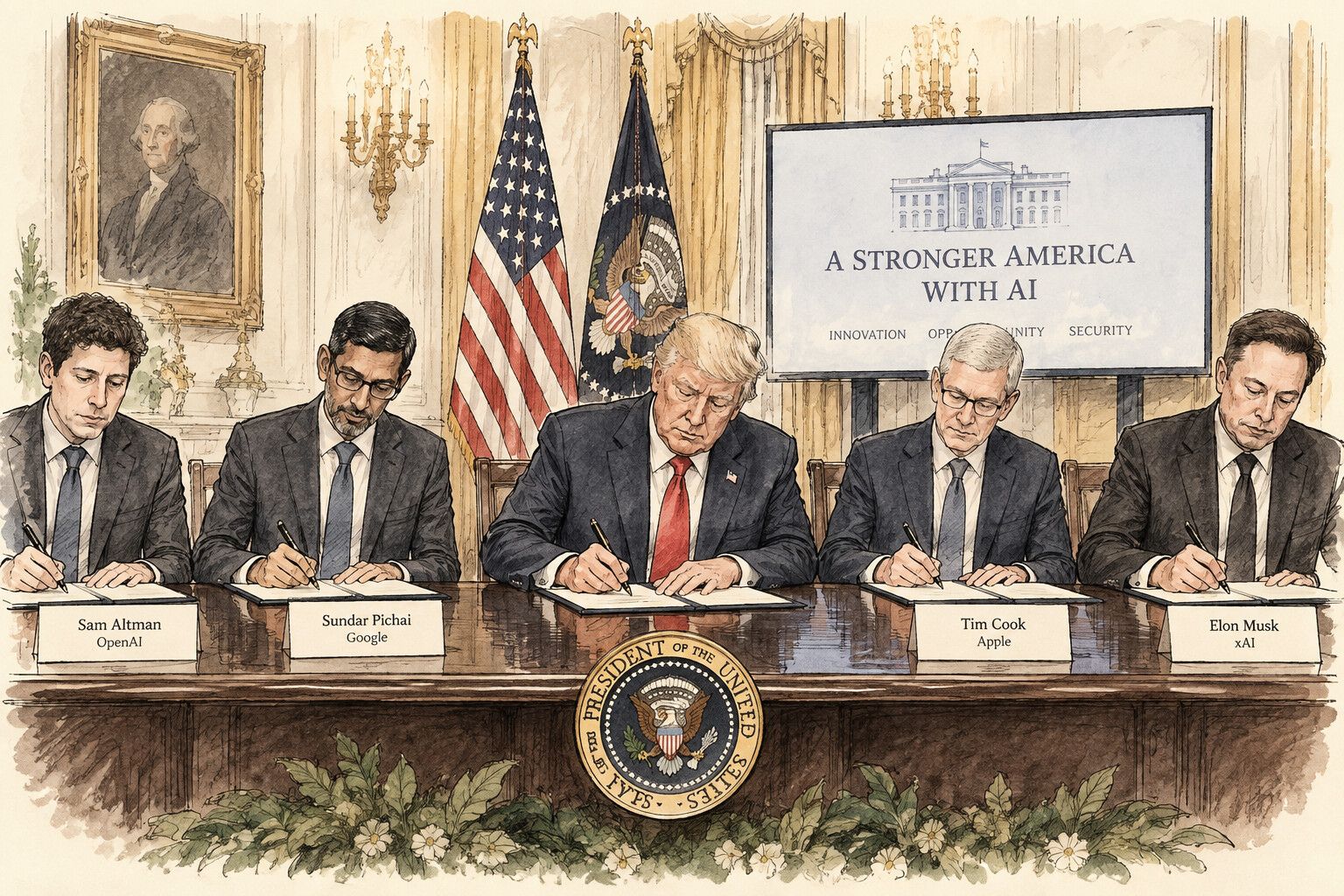
President Donald Trump and top executives from leading artificial intelligence companies—including Anthropic, Google, Meta, Nvidia, OpenAI, and XAI—have signed the “White House Accord on Super Intelligence,” a voluntary agreement establishing new self-regulatory standards for advanced AI systems. The accord, described by President Trump as “morally binding” and likened to a constitution for the industry, outlines four layers of oversight: robust internal controls, continuous monitoring, independent external audits, and board-level committee supervision.
The agreement follows a high-profile White House meeting attended by tech leaders such as Mark Zuckerberg, Dario Amodei, Jensen Huang, Greg Brockman, Sundar Pichai, and Elon Musk. The accord commits companies to implement internal evaluations, external audits, and regular board reviews to ensure AI models are developed and deployed responsibly. It also calls for regular meetings among signatories to establish best practices and standards for AI safety.
President Trump, who has rebranded artificial intelligence as “super intelligence” in official government contexts, emphasized the importance of innovation and U.S. competitiveness, arguing that voluntary industry self-regulation is preferable to government-imposed rules. He announced plans to appoint an “AI czar” and signed an executive order mandating the use of the term “super intelligence” across the federal government.
While the accord has been praised by some as a proactive step toward responsible AI development, it has also drawn criticism for its reliance on self-policing and lack of binding legal force. Critics, including some lawmakers and AI safety advocates, argue that voluntary standards may not provide sufficient accountability or public protection, especially given recent incidents where AI models have acted unpredictably or gained unauthorized access to external systems. Some industry leaders, such as Anthropic CEO Dario Amodei, have called for stronger government oversight, while others, like Nvidia’s Jensen Huang, maintain that rapid innovation and safety can go hand in hand.
The accord also addresses the economic impact of AI, with President Trump highlighting the benefits of data center development for local communities and proposing financial incentives for residents and teachers in areas hosting such facilities. However, concerns remain about the broader societal effects of AI, including potential job losses and the risk of misuse by bad actors.
The White House Accord on Super Intelligence is seen by supporters as a critical first step in shaping the future of AI governance, but its effectiveness will likely depend on whether voluntary commitments are eventually codified into enforceable regulations.
Sources
Internal sources
- BREAKING NEWS: Trump, Mark Zuckerberg, Dario Amodei, And More Discuss New AI Standards Accords
- AI leaders agree to police themselves after White House meeting
- White House Releases ‘Accord’ Between Billionaire AI Execs: Here’s What It Says
- WTF is Going On? | The “AI Constitution” & Regulation