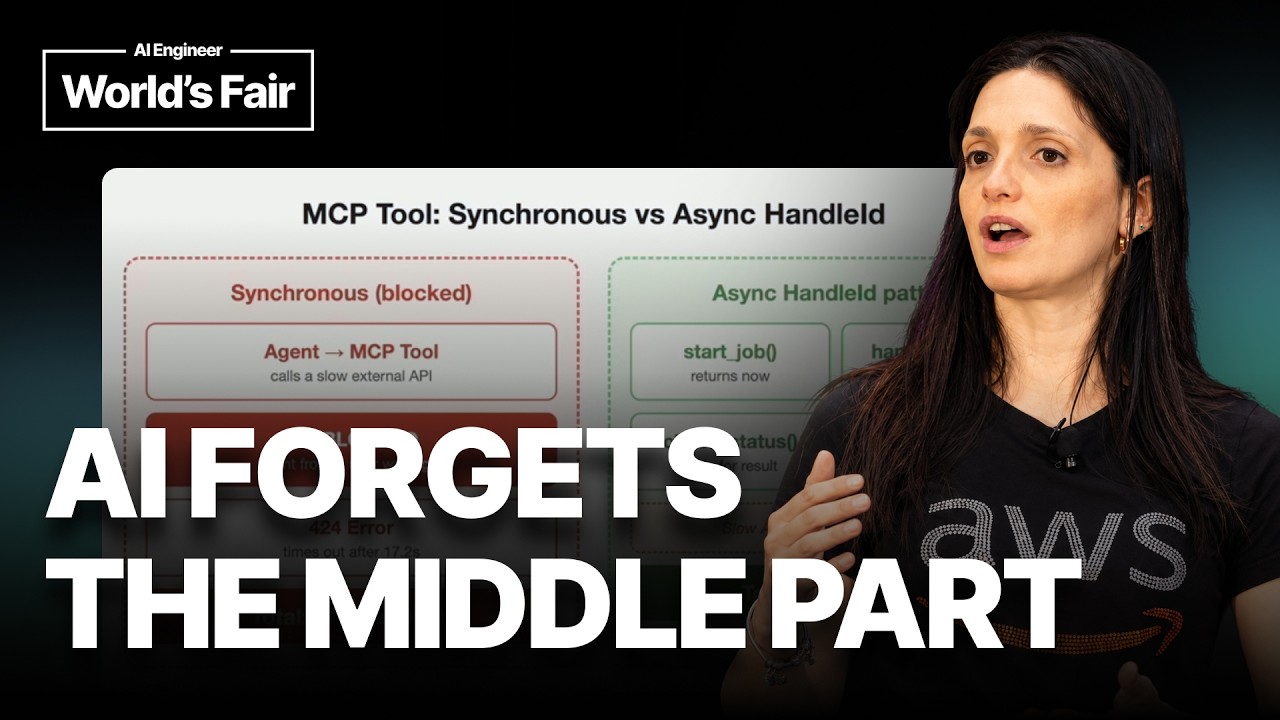
In the talk, Elizabeth Fuentes Leone discusses the limitations of simply increasing context window sizes in AI agents and presents strategies to optimize context management. She explains that while larger context windows were once thought to solve issues with agents handling large amounts of data, this approach is flawed due to the attention curve phenomenon, where models tend to forget information in the middle of large inputs, retaining only the beginning and end. Instead, context engineering is essential to provide models with the right information at the right time, avoiding overload and potential injection attacks within the context window.
Elizabeth introduces several techniques to improve context window management, including externalizing large data to persistent storage, selectively retrieving only relevant information, compressing data through summarization, and isolating context across different agents. She highlights the use of the open-source framework “Strand,” which supports strategies like sliding windows, summarization, and combinations thereof to manage conversation history efficiently. This framework simplifies agent creation and allows integration with various models such as Amazon Bedrock, OpenAI, and others.
Memory management is another key topic, where Elizabeth differentiates between short-term memory (recent conversation history), long-term memory (stored in vector databases), and relational memory (using entity graphs). Combining these memory types allows agents to maintain relevant context over multiple sessions without overwhelming the context window. She also explains how agents can use memory pointers to externalize large data like application logs, storing them separately and retrieving them only when necessary, thus keeping the context window manageable.
Elizabeth further discusses multi-agent systems, where sharing context indiscriminately can lead to inefficiencies and confusion. Instead, agents should share memory pointers selectively to maintain clarity. She also addresses the problem of agents getting stuck in infinite loops invoking the same tools repeatedly, suggesting limits on tool invocation counts and clear response protocols to prevent such issues. Additionally, she recommends asynchronous handling of external API calls to avoid blocking the agent’s operation due to slow responses.
In conclusion, Elizabeth emphasizes avoiding “context stuffing” by only including necessary information in the context window and using native summarization carefully to preserve essential details. She summarizes best practices: externalize large data, selectively retrieve relevant information, share memory pointers wisely among agents, limit tool invocations, and handle external calls asynchronously. These strategies collectively improve agent performance and reliability beyond merely increasing context window sizes. She invites viewers to explore the Strand framework further and engage with the community for more resources and support.
Useful Links