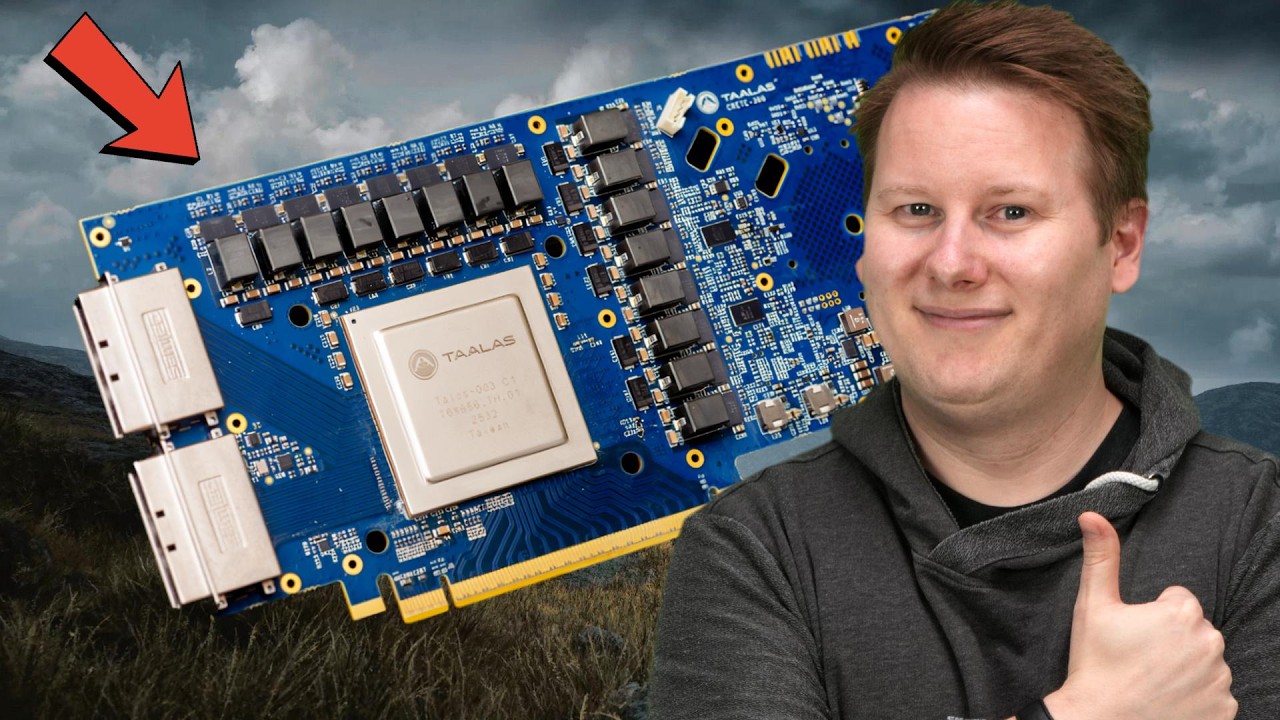
The video discusses the recent acquisition of an AI chip startup called Talis by AMD, highlighting the unique approach Talis takes in AI acceleration. AI accelerators are specialized silicon designed to speed up AI computations, often using programmable architectures similar to GPUs. However, Talis differentiates itself by creating chips that are non-programmable and specifically tailored to run a single AI model extremely efficiently. Their first chip, the Hardcore One, is designed for the Llama 3 8.1 3.18 billion parameter model and achieves token processing speeds far beyond current competitors, reaching up to 17,000 tokens per second compared to Nvidia’s 230 tokens per second.
Talis’s innovation lies in embedding the AI model directly into the chip’s metal layers, optimizing data routing and compute specifically for that model. While this approach means the chip can only run one model and risks becoming outdated as AI models evolve rapidly, the company argues that the massive speed gains justify frequent hardware refreshes. This design philosophy is reminiscent of Intel’s earlier EASIC acquisition, where partial chip customization allowed for significant performance improvements. Despite skepticism from the industry, Talis has demonstrated its technology publicly through a website demo, proving the chip’s impressive speed claims.
AMD’s acquisition of Talis is seen as a strategic move to enhance its AI hardware portfolio, which already includes Instinct GPUs and EPYC CPUs. The Talis team will remain relatively independent within AMD’s AI division, led by VP Bapana, and the acquisition is expected to close by the end of the year. The integration of Talis’s specialized chips could complement AMD’s existing programmable solutions by handling specific AI workloads that benefit from fixed-function, ultra-high-speed inference. This aligns with AMD’s vision of a heterogeneous AI compute environment where different types of silicon work together to optimize performance and efficiency.
Industry experts view Talis as analogous to Nvidia’s Groq acquisition, both companies focusing on SRAM-based architectures that require multiple chips to handle large models but excel at fast, model-specific inference tasks. The acquisition is also interpreted as AMD’s bet on the emerging trend of agentic AI and disaggregated inference, where AI workloads are broken down into smaller, specialized tasks handled by different hardware components. While Talis’s current chip supports only one model, future generations could expand capabilities, especially when combined with AMD’s advanced packaging and interconnect technologies.
Overall, the acquisition signals AMD’s commitment to expanding its AI capabilities by incorporating innovative, workload-specific hardware solutions. Talis’s approach challenges the conventional wisdom of programmable AI accelerators by prioritizing raw speed for fixed models, potentially reshaping how AI inference is deployed at scale. With AMD’s backing, Talis’s technology could become a key part of AI infrastructure, especially for applications requiring rapid, high-throughput token generation. The deal also reflects broader industry trends of major tech companies acquiring specialized AI startups to stay competitive in the fast-evolving AI hardware landscape.