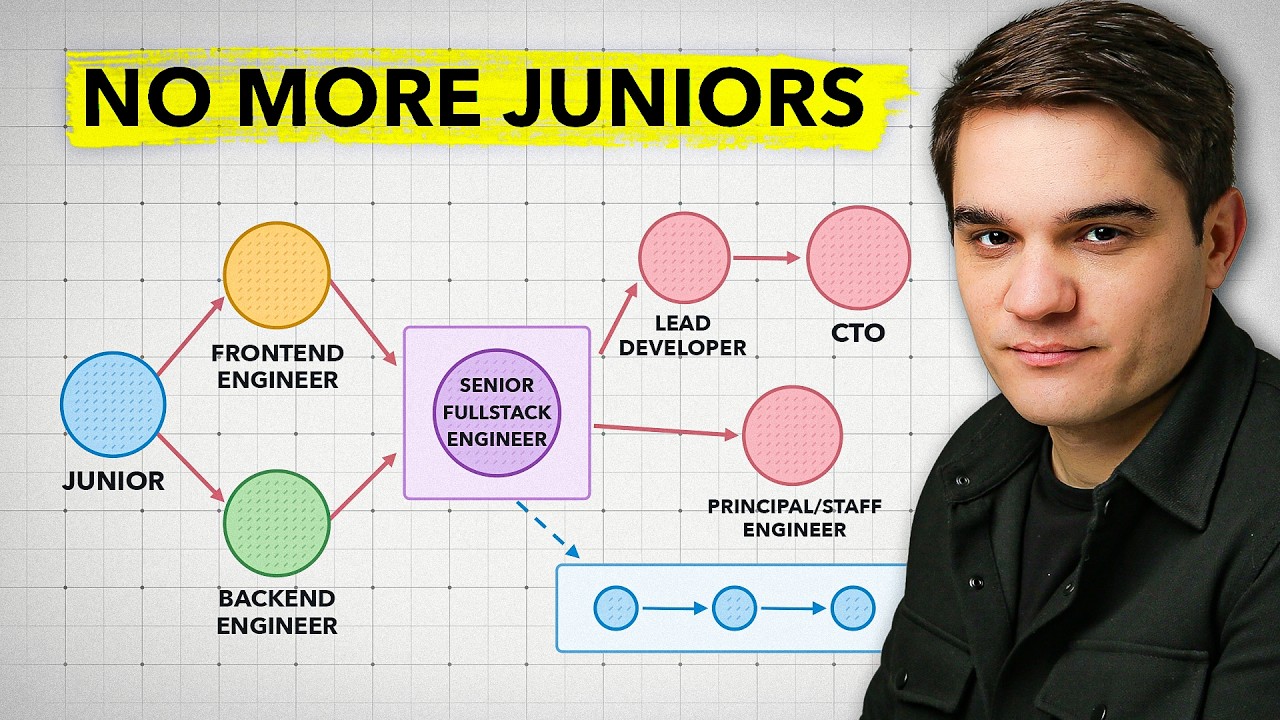
The video discusses how AI has transformed the software engineering career ladder, particularly impacting junior engineers. In the short term, junior job openings have decreased due to economic pressures and outdated perceptions of juniors needing extensive handholding. However, AI tools empower juniors to deliver end-to-end features with less supervision, effectively raising their productivity to levels comparable to senior engineers from a few years ago. Despite this, companies remain hesitant to hire juniors because they still view them through the old lens of requiring mentorship and are cautious about investing in less experienced talent amid rapid changes.
Mid-level engineers have also benefited from AI, as they can now own entire applications rather than just features. With AI automating much of the implementation work, mid-level engineers can focus more on architecture, system design, CI/CD pipelines, and cross-functional skills like DevOps and database management. This shift has democratized responsibilities that were traditionally reserved for seniors, expanding the scope of mid-level roles. However, this expansion also raises concerns about overlapping responsibilities and potential conflicts within teams, necessitating clearer alignment and coordination.
Senior engineers differentiate themselves primarily through quality rather than speed or quantity of output. While AI enables all levels to deliver features quickly, seniors excel in producing high-quality, stable software with fewer bugs and better token efficiency. They also play a crucial role in designing and maintaining the “software factory”—the systems, AI models, and processes that enable continuous delivery. The senior full-stack engineer is expected to work across the entire stack with strong fundamentals, adapting quickly to different technologies and ensuring the overall health and scalability of the codebase and infrastructure.
The role of engineering managers and CTOs is evolving as well. Many management tasks are being automated or streamlined by AI, leading to a leaner management layer. Engineering managers are increasingly expected to be hands-on, aligning teams, products, and codebases amid rapid development cycles and experimentation. CTOs and founding engineers now combine deep technical expertise with product management skills to lead AI-driven innovation, especially in traditional industries like finance and healthcare. The emphasis is on delivering quality, managing incomplete information, and steering teams through complex, fast-changing environments.
Ultimately, the video emphasizes that while AI has leveled the playing field in terms of coding speed and feature delivery, true seniority now hinges on the ability to make sound architectural decisions, ensure software quality, and understand the broader impact of technical choices. Developers must focus on building strong fundamentals and reasoning skills to effectively leverage AI tools. The analogy is made that owning AI tools is like owning a camera—having the tool doesn’t make one a skilled engineer or photographer. The video concludes by encouraging viewers to assess their skills, seek relevant training, and adapt to the new AI-native software engineering landscape.