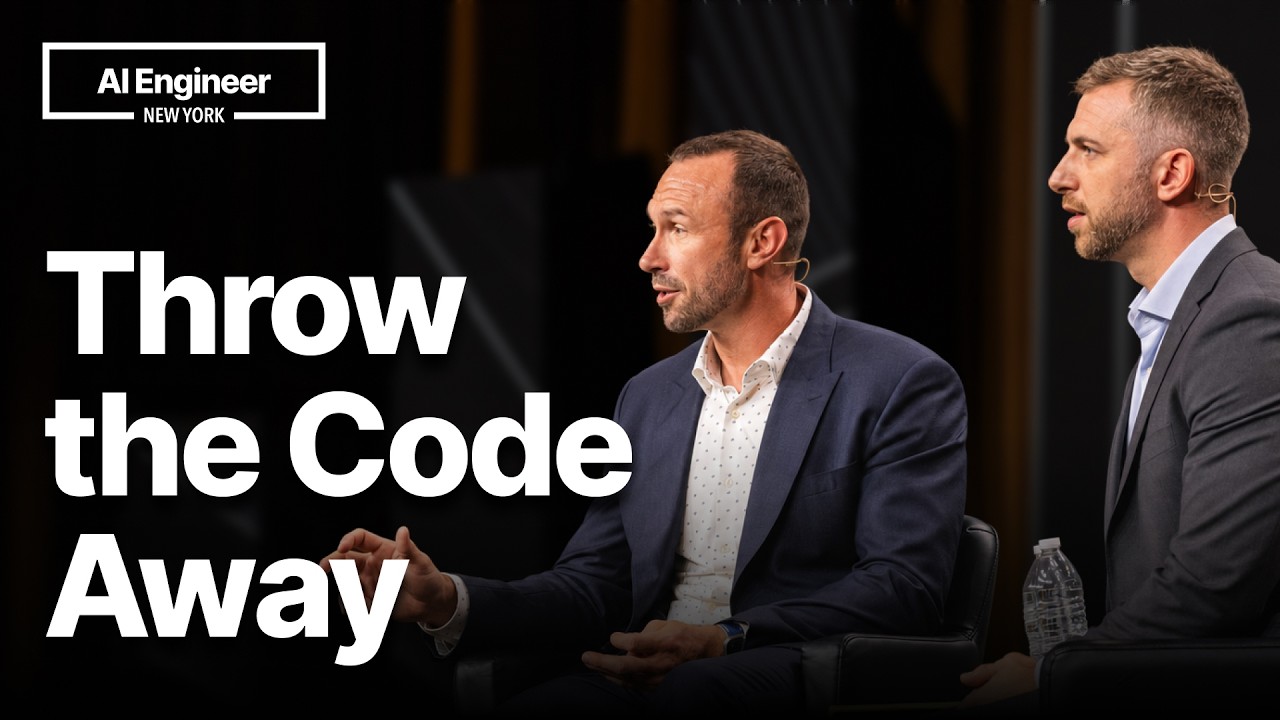
In this discussion, Scott Worland, CTO of Norm AI, and John Stecher, CTO of Blackstone, explore the evolving landscape of AI deployment in enterprise settings, particularly within financial services and legal sectors. John emphasizes the critical importance of having a robust data strategy to successfully leverage AI agents. He highlights that without moving data out of transactional systems into accessible, manageable formats, AI initiatives are likely to fail. Additionally, John points out the value of integrating AI to optimize workflows, such as automating software testing and code renovation, which frees up professionals to focus on higher-value tasks.
Scott shares Norm AI’s journey since its founding in 2023, detailing how the company has adapted to rapid advancements in AI capabilities, including expanding context windows and multimodal models. Norm AI developed a structured, workflow-based approach to deploying AI models, akin to a large map-reduce problem, which allowed them to produce consistent, high-quality outputs essential for regulatory compliance. They also built a substantial evaluation dataset with expert-labeled examples, enabling continuous benchmarking and improvement of their AI agents, ensuring reliability and accuracy in high-stakes environments.
Both speakers discuss the challenge of balancing innovation with operational realities. John explains how Blackstone evaluates the return on investment (ROI) for AI projects, sometimes choosing to delay implementation until models improve, reducing costs and increasing effectiveness. He advocates for rapid prototyping and proof-of-concept development to quickly test ideas and iterate, rather than over-investing in unproven solutions. This agile approach helps teams stay responsive to technological advances while managing risk and resource allocation effectively.
The conversation also touches on the “bitter lesson” in AI development—the idea that scalable, compute-driven models often outperform hand-crafted expert systems. John and Scott reflect on the importance of maintaining flexibility in technology stacks to incorporate frontier AI advancements without creating bottlenecks. They stress the need for rigorous evaluation frameworks to ensure AI outputs remain accurate and consistent, especially in regulated industries where errors can have significant consequences. Both emphasize the necessity of human oversight in critical system components to safeguard data security and maintain trust.
In closing, John expresses enthusiasm for the renewed excitement in engineering brought about by AI, noting that experienced engineers can now apply their deep system design knowledge through powerful new AI tools. Scott echoes this sentiment, highlighting the rapid pace of technological change and the importance of continuously updating systems to leverage cheaper, more capable AI solutions. Together, they convey a message of cautious optimism: while challenges remain, the current AI landscape offers unprecedented opportunities to innovate, improve workflows, and create new value across industries.
Useful Links