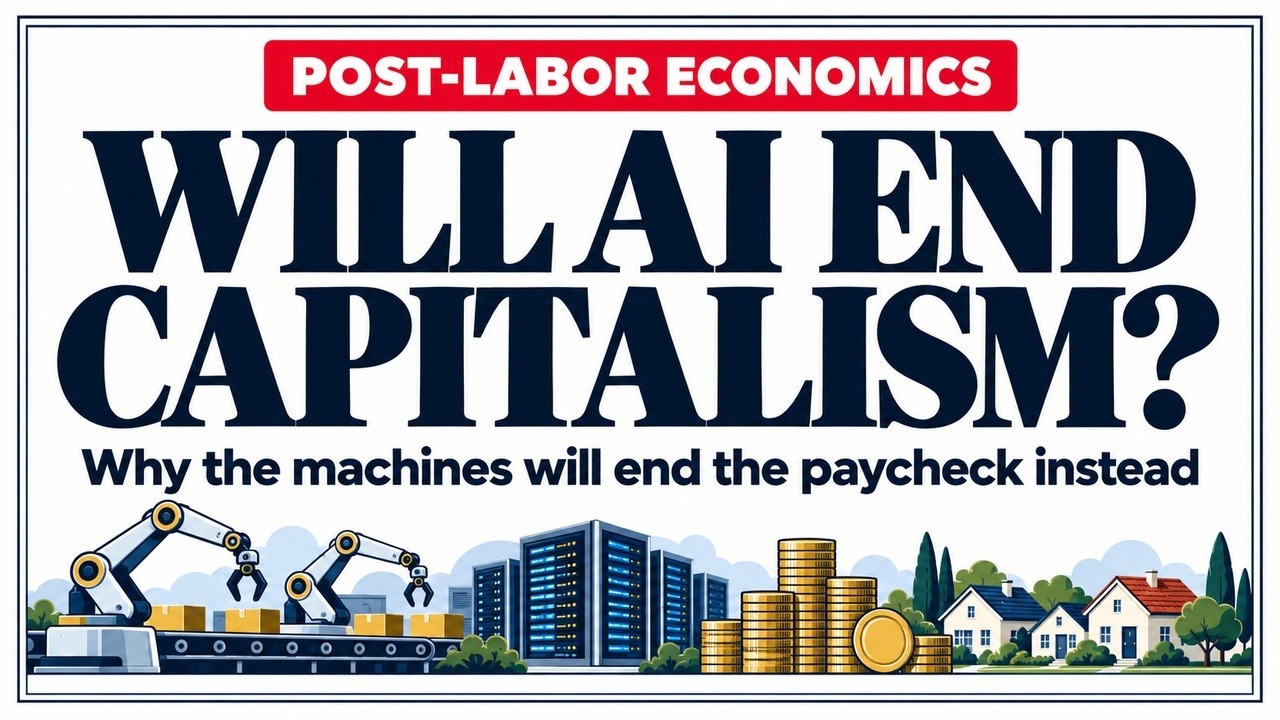
The video explores the question of whether artificial intelligence (AI) and automation will end capitalism. It begins by presenting the strongest arguments in favor of this idea. One key argument is that capitalism relies on labor arbitrage—companies hire workers, pay wages, and sell products for profit. If AI and robots can perform all tasks better and faster, labor becomes obsolete, undermining the foundation of capitalism. Additionally, wages are not just costs but also the source of customers’ purchasing power, so without jobs, demand collapses. Another argument is that if technology can produce unlimited goods at near-zero cost, scarcity disappears, making markets and money irrelevant, akin to the “Star Trek” vision of a moneyless society. A darker perspective suggests that capitalism will end because a few owners of AI will monopolize wealth, turning society into a form of “technofeudalism” where rent replaces profit.
However, the video argues that these perspectives confuse capitalism with labor or money, which are not its defining features. Capitalism is fundamentally about private ownership of capital—the means of production—and the operation of markets to allocate resources and income. Even if labor disappears, capital remains central. AI will not end capitalism but will end the paycheck as the primary way people earn income. Capital and markets coordinate production and distribution efficiently without centralized control, with prices serving as signals of scarcity and demand. AI will integrate into this system rather than replace it.
The video also addresses misconceptions about money. The labor theory of value, which claims value derives solely from labor, is outdated; value depends on scarcity and desire. Money is not just debt created by banks but a universally trusted medium of exchange, unit of account, and store of value. Historical examples, such as cigarettes used as money in prisoner-of-war camps, illustrate that money’s function is what matters, not its origin. Therefore, money will persist even in a post-labor economy because it remains essential for managing scarcity and facilitating trade.
Regarding abundance, while some goods may become extremely cheap, scarcity will persist in areas like time, location, preference, and attention. These “positional goods” retain value because they are limited, such as beachfront property or prime real estate. Even in a future with replicators or space colonization, competition for scarce resources will continue. Money allows people to express how much they value these scarce goods, enabling choice and economic agency, unlike lotteries or state allocation systems.
In conclusion, AI will not end capitalism but will transform it into “capitalism 2.0,” where income comes from owning capital rather than working. The critical challenge is preventing extreme concentration of capital ownership, which could lead to a feudal-like system. The solution is to democratize ownership of AI and automation so that wealth and economic agency are broadly shared. This transformation could eliminate economic hardship, allowing people to maintain ownership, save for the future, and choose how to spend their income, rather than abolishing capitalism or money altogether.