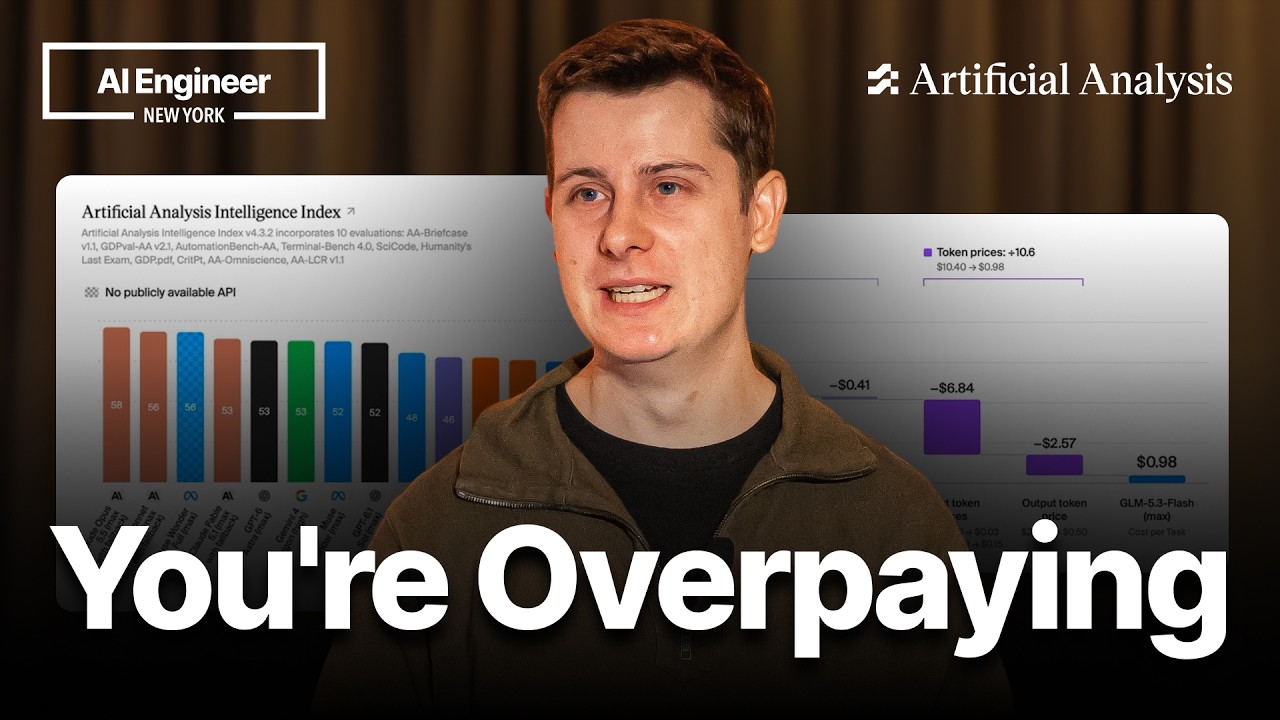
George Cameron, co-founder of Artificial Analysis, presented an insightful talk on optimizing the cost of AI intelligence. Artificial Analysis is an independent AI benchmarking company that evaluates the entire AI stack, including agent layers, language models, and hardware, to help developers make informed decisions. Their intelligence index synthesizes multiple evaluations to provide a single metric for assessing language model capabilities, focusing on practical use cases rather than AGI progress. The company is widely referenced by leading AI organizations and media, emphasizing the importance of understanding trade-offs between intelligence, cost, and performance.
Cameron highlighted the rapid pace of AI development, noting the increasing number of model releases and accelerating progress. He pointed out that open-weight models remain competitive, often within months of proprietary models, offering viable alternatives for developers. This dynamic landscape requires continuous monitoring to stay updated on the best options available. The intelligence index helps users navigate this complexity by providing a clear comparison of models across various capabilities and costs.
A significant portion of the talk focused on the cost implications of using AI models, especially in agent-based tasks. Cameron explained that costs can vary by orders of magnitude, with some models costing over $5 per task while others operate at just a few cents. He emphasized that cost drivers have evolved from output tokens to include input tokens, cache hit rates, and the number of interaction turns in agent workflows. Caching, in particular, was underscored as a critical factor that can reduce costs by up to ten times, making it essential for efficient AI deployment.
The complexity of agentic tasks was further explored through a breakdown of cost components, showing how reasoning efforts and token usage impact overall expenses. Cameron compared leading proprietary models like Opus 5.5 with cheaper open-weight alternatives such as GLM 5.3 Flash, illustrating the trade-offs between intelligence and cost. He advised developers to categorize tasks into “unlimited intelligence” (where more intelligence improves outcomes) and “limited intelligence” (where a certain intelligence threshold suffices), guiding budget and model selection accordingly.
To assist developers in making these nuanced decisions, Artificial Analysis recommends understanding the AI landscape, prioritizing metrics, shortlisting models, and conducting context-specific benchmarks. They recently launched Optima, a product that helps users upload their data and generate customized benchmarks to evaluate intelligence-cost trade-offs for their specific tasks. Cameron concluded by inviting interested individuals to explore their website and consider joining their growing team, emphasizing the critical role of cost optimization in the future of AI deployment.
Useful Links