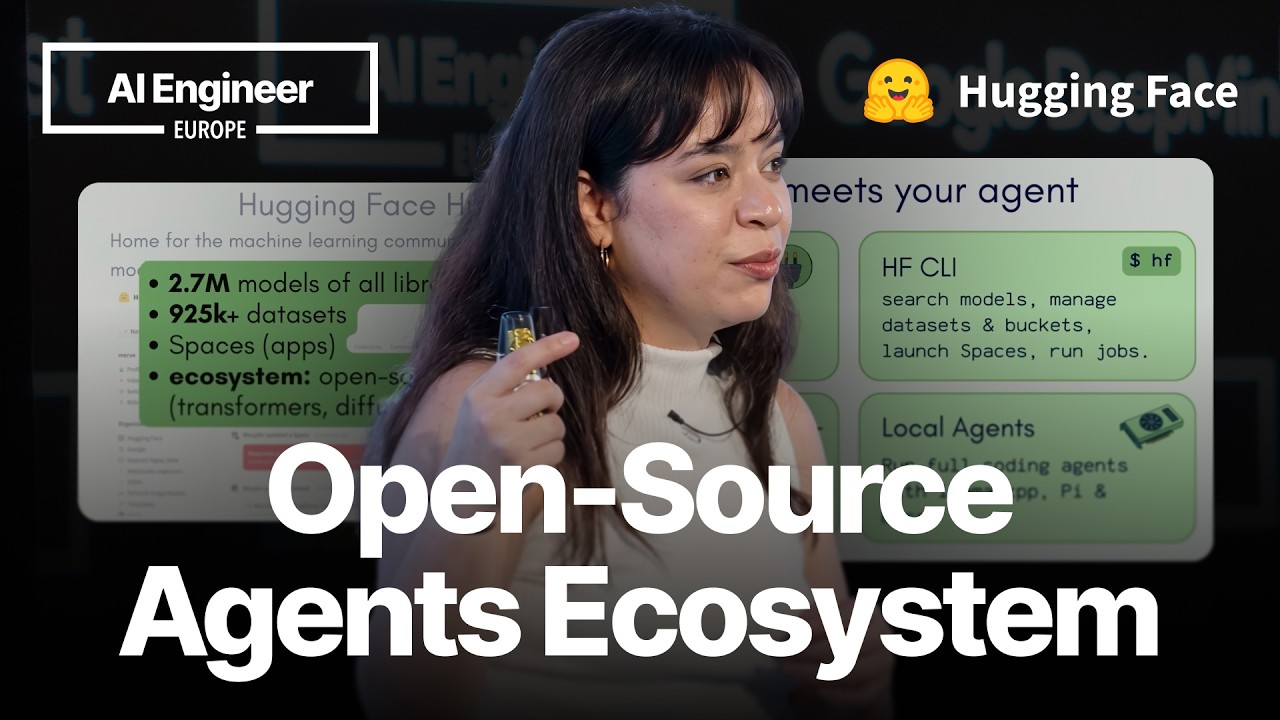
In this talk, Merve Noyan from Hugging Face discusses the evolving open agent ecosystem and how it empowers users to have an “AI engineer at their fingertips.” She begins by emphasizing the importance of open source in machine learning, highlighting the availability of open weight models with non-commercial licenses and open source models with commercial licenses like MIT or Apache 2.0. Open source models offer significant advantages such as transparency, privacy, and the ability to fine-tune or quantize models for deployment on edge devices, which is increasingly important given recent concerns about cloud performance and data security.
Merve then introduces the Hugging Face Hub as the central platform facilitating access to nearly three million models, datasets, and spaces. She explains the distinction between vision language models (VLMs) and large language models (LLMs), noting a trend where labs release models with vision capabilities from day zero. The Hub also features benchmark datasets that allow users to evaluate and compare open models easily, with GLM 5.1 currently leading in coding benchmarks. Additionally, Hugging Face offers inference providers that route requests to the best-performing or most cost-effective models, simplifying model selection for users.
A significant portion of the talk focuses on the integration of agents with Hugging Face models. Merve highlights new features such as the MCP server and skills that enable users to train models directly through agents by simply issuing commands. She showcases local coding agents like Pi and llama CPP, which allow users to run models locally with minimal setup. Hermes agents, which offer advanced memory management and easy integration with platforms like Slack or WhatsApp, are also recommended, especially when paired with powerful open models like GLM 5.1.
Merve further explains the new “traces” dataset repository type on Hugging Face Hub, which stores agent interaction logs that can be explored and used for training models. She provides tips for serving models locally using apps listed under the “other” tab on the Hub and discusses the GGUF file format that enhances compatibility and hardware efficiency. The talk also covers Hugging Face skills, a set of tools that enable agents to manage repositories, launch jobs, build demos, and explore datasets, making it easier to train and deploy models, including vision and object detection models.
Finally, Merve shares a practical example of using Hugging Face’s infrastructure to OCR and index 30,000 AI-related papers, demonstrating the power of combining OCR models with LLMs and automated job management. She highlights the new “buckets” infrastructure product for cost-effective storage and processing. Overall, the talk showcases how Hugging Face is streamlining the use of open source models and agents, making advanced AI capabilities accessible and manageable for developers and organizations alike.