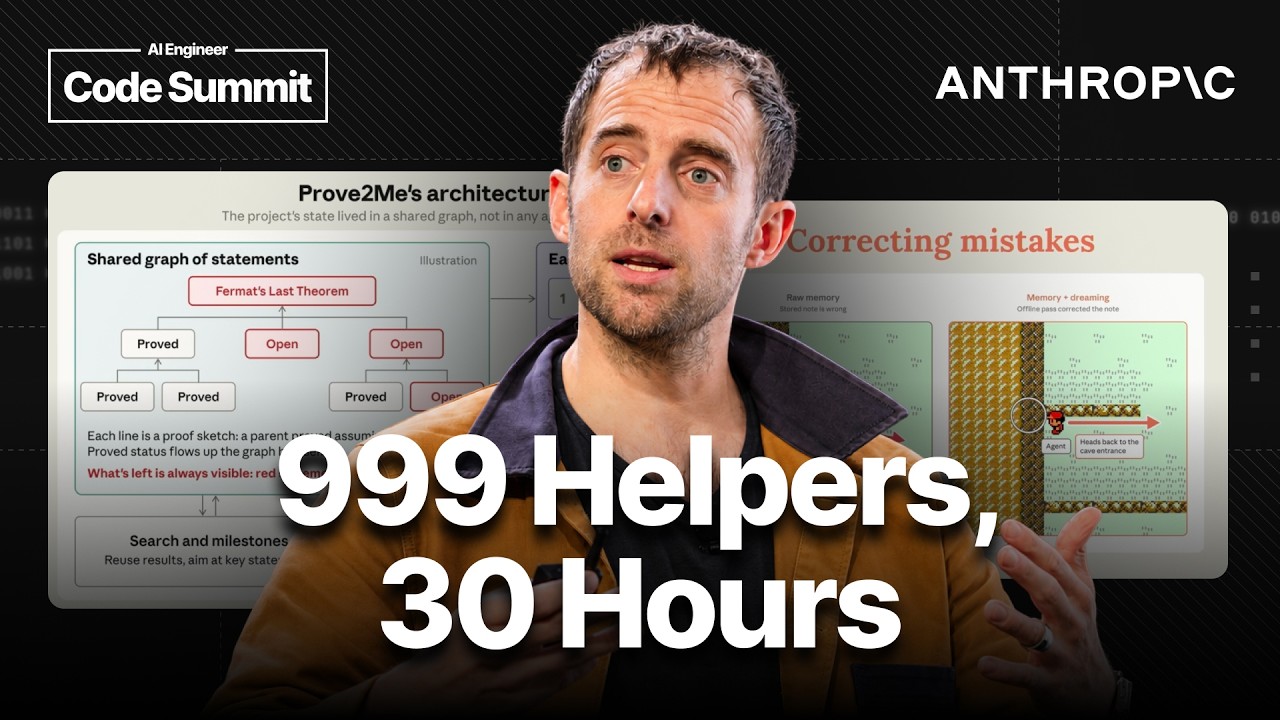
Lance Martin from Anthropic discusses two major advancements in leveraging Claude, their AI system, to tackle complex problems. The first story centers on using multi-agent collaboration to formalize Fermat’s Last Theorem, a famous mathematical proof that remained unproven for centuries until Andrew Wiles’ proof in the 1990s. Anthropic initially used a dozen Claude agents with a domain-specific harness called “prove to me” and human guidance to formalize the proof in Lean, a system for computationally verifying proofs. For their latest effort, they scaled up to a thousand agents working autonomously without the harness or human intervention, relying only on simple primitives like Git and a SQL database for coordination. The agents self-organized, created their own orchestration tools, and progressively formalized the proof over about 30 hours, demonstrating that large teams of AI agents can solve long-horizon, complex tasks with minimal scaffolding.
The second story focuses on Claude’s evolving memory capabilities, which enable it to manage and utilize knowledge over extended interactions. Lance highlights the paradox of memory: agents write to memory myopically during tasks but need a globally coherent and non-redundant memory system to reflect and reason effectively. Drawing parallels to human memory consolidation during sleep, Anthropic developed a “dreaming” mechanism that allows Claude to reflect on and reorganize its memories, improving coherence and correcting errors. Experiments show that newer Claude models are better at knowing when to write to and read from memory, producing more strategic and relevant memory content, as demonstrated in tasks like playing Pokémon and answering sequential questions in a continual learning benchmark.
In the continual learning benchmark, Claude was tested on answering sequential questions about a database, with the ability to write notes to memory between sessions. Results showed that earlier models struggled to use memory effectively, while more advanced versions like Fable 5 demonstrated significant improvements in memory usage, leading to better task performance. Similarly, in the Pokémon gameplay example, earlier Claude models wrote excessive and indiscriminate memory notes, which hindered performance, whereas newer models produced concise, strategic memories that enhanced gameplay success. This illustrates how improved memory management directly correlates with better problem-solving and task execution.
The dreaming process is particularly powerful for correcting mistakes in memory. Lance shares an example where Claude initially wrote an incorrect memory that caused it to get stuck in a loop during gameplay. By employing dreaming, Claude was able to reflect on and fix the erroneous memory, allowing it to progress further in the game. Beyond error correction, dreaming also enables Claude to build structured knowledge representations like wikis from raw transcripts and notes. In a corporate knowledge task, Claude used dreaming to create a wiki that improved its ability to answer questions about company documents, outperforming simple search-based methods. Dreaming also helps fill gaps and fix errors in these knowledge structures, enhancing overall memory quality.
In conclusion, Lance emphasizes that these advancements demonstrate Claude’s growing ability to orchestrate large teams of agents autonomously and to manage complex, long-term memory effectively. The multi-agent formalization of Fermat’s Last Theorem showcases AI’s potential to tackle historically challenging mathematical problems without heavy human intervention. Meanwhile, the memory and dreaming capabilities highlight how Claude can build, refine, and utilize knowledge over time, improving its reasoning and task performance. These developments mark significant steps toward more capable and autonomous AI systems, and Lance invites further discussion at the Anthropic booth.
Useful Links