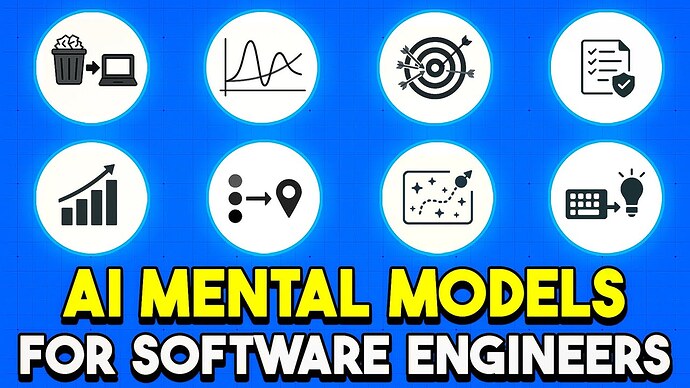
The video begins by introducing the concept of the “model spec,” a framework released by OpenAI that shifts software development from writing code to writing detailed specifications. These specifications, often written in markdown, serve as the blueprint from which AI agents generate software. This approach likens software to a projection of its specifications, similar to how higher-level programming languages or frameworks like React translate human-readable instructions into executable code. The speaker emphasizes that while this idea is not new, it is gaining traction in the AI era, but also cautions that AI-generated code is often inconsistent and requires significant refinement due to the inherent randomness and hallucinations in large language models (LLMs).
The video then explores the challenges of using AI for software development, highlighting that while AI can generate code snippets, building reliable software remains complex. The speaker introduces “context engineering,” which involves feeding LLMs extensive contextual information—such as codebases, documentation, and style guides—to improve output quality. However, increasing the amount of context can paradoxically reduce model accuracy, making it difficult to scale AI-generated solutions effectively. This leads to the discussion of “retrieval augmented generation” (RAG), a technique that combines semantic search with LLMs to provide up-to-date and relevant information, enabling models to work with the latest libraries and frameworks despite their training data limitations.
Next, the video delves into advanced AI concepts like “agenting coding,” where recursive LLMs iteratively refine their outputs by self-calling until a satisfactory result is achieved. Despite the hype, the speaker reveals that these agents rely heavily on repeated prompting and checks, which can be inefficient and unreliable. The video also critiques the use of natural language as a programming medium, arguing that traditional programming languages evolved to provide precision and determinism that natural language lacks. The speaker introduces the “MCP” protocol, designed to standardize interactions between AI models and external APIs, but remains skeptical about its novelty, viewing it as a combination of existing technologies like REST APIs and remote procedure calls.
Further, the video discusses other AI methodologies such as “chain of thought” prompting, which simulates step-by-step reasoning in LLMs but is more of a human-friendly illusion than a true reflection of the model’s internal processes. It also covers “time to test compute,” a method where multiple solutions are generated and ranked to select the best one, though this approach is more effective for simple tasks than complex problems. The speaker expresses excitement about emerging ideas like the “language concept model” from Meta, which aims to model the world through concepts rather than tokens, potentially advancing AI beyond current LLM capabilities. Additionally, “model distillation” is highlighted as a way to create smaller, efficient models that retain much of the performance of larger ones, signaling a trend towards more practical AI deployments.
In conclusion, the speaker advises software developers, especially JavaScript engineers, to focus on mastering their craft rather than rushing into AI engineering, which is a niche field requiring advanced expertise and offers limited job opportunities. They stress the importance of continuous learning and adapting to AI tools to remain competitive, warning against complacency and the “shiny object syndrome” of chasing every new AI trend. The video encourages developers to leverage AI as a tool to enhance productivity while maintaining a strong foundation in software engineering principles. Ultimately, the speaker views current AI advancements as incremental rather than revolutionary, urging a balanced and informed approach to integrating AI into software development careers.