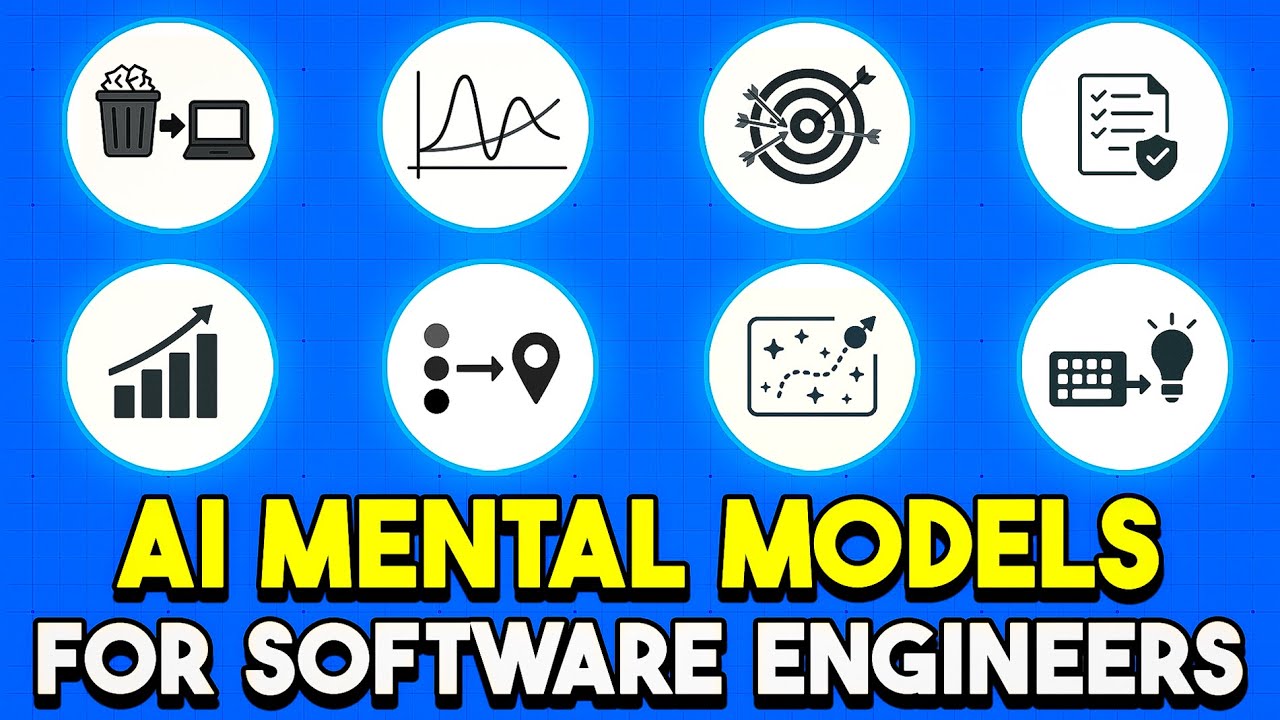
The video begins by introducing the concept of the “model spec,” a framework released by OpenAI that shifts software development from writing code to writing detailed specifications. These specifications, often written in markdown, serve as the blueprint from which AI agents generate software. This approach likens software to a projection of its specs, similar to how higher-level programming languages like JavaScript or frameworks like React translate human-readable instructions into machine-executable code. The speaker emphasizes that deterministic systems—those that produce consistent outputs given the same inputs—are foundational to reliable software, contrasting this with the inherent randomness and hallucinations present in large language models (LLMs).
Next, the video explores “context engineering,” a technique that involves feeding LLMs with extensive, relevant context such as codebases, documentation, and style guides to improve output quality. Despite advances in context window sizes—some models now handling up to two million tokens—there is a trade-off as model performance can degrade with excessive context. The speaker also discusses retrieval-augmented generation (RAG), where semantic search is used to provide LLMs with up-to-date and specific information, enabling them to generate code that aligns with the latest library versions or company-specific requirements. This method is seen as a promising direction for enterprise AI applications.
The discussion then moves to agent-based coding, where LLMs recursively call themselves to iteratively refine code until a success criterion is met. While this approach, exemplified by tools like Cloud Code, is hyped as revolutionary, the speaker cautions that it relies heavily on repeated prompting and lacks the precision of traditional programming languages. The video also introduces the Model-Client-Protocol (MCP), an emerging standard that facilitates secure, two-way communication between AI models and external APIs. MCP aims to standardize interactions, allowing models to perform tasks like querying Google Maps seamlessly, though the speaker views it as an incremental improvement rather than a groundbreaking innovation.
Further concepts covered include chain-of-thought prompting, which helps LLMs break down complex tasks into sequential steps, and “time to test compute,” a method where multiple solutions are generated and ranked to select the best one. However, these techniques have limitations, especially with complex problems. The video also touches on emerging ideas like language concept models (LCMs) that focus on conceptual understanding rather than token prediction, and model distillation, which creates smaller, efficient models from larger ones without significant loss in accuracy. The speaker notes that AI model improvements have plateaued recently, signaling a need for new innovations.
In conclusion, the speaker advises JavaScript developers and software engineers to focus on mastering their craft rather than chasing every AI hype. While AI tools can augment development, true value lies in deep technical skills and understanding. The AI engineering field is niche and competitive, often requiring advanced degrees, whereas traditional software development offers broader opportunities and stability. The video encourages continuous learning, avoiding complacency, and leveraging AI knowledge strategically to remain irreplaceable in the evolving tech landscape. Links to further training and resources are provided for those interested in advancing their careers.