In this video, the creator builds upon a previous tutorial where they demonstrated how to create an LLM-powered wiki using Claude code and Obsidian, focused on advanced trading techniques. The goal of this episode is to enhance the wiki by making it more visual, interactive, and practical for everyday use. The creator also addresses a common question about the difference between an LLM wiki and Retrieval Augmented Generation (RAG). They explain that while RAG uses embeddings and mathematical similarity to retrieve information from large datasets, the LLM wiki relies on the model reading a table of contents and selecting relevant pages based on titles and summaries, making it better suited for smaller, curated knowledge bases.
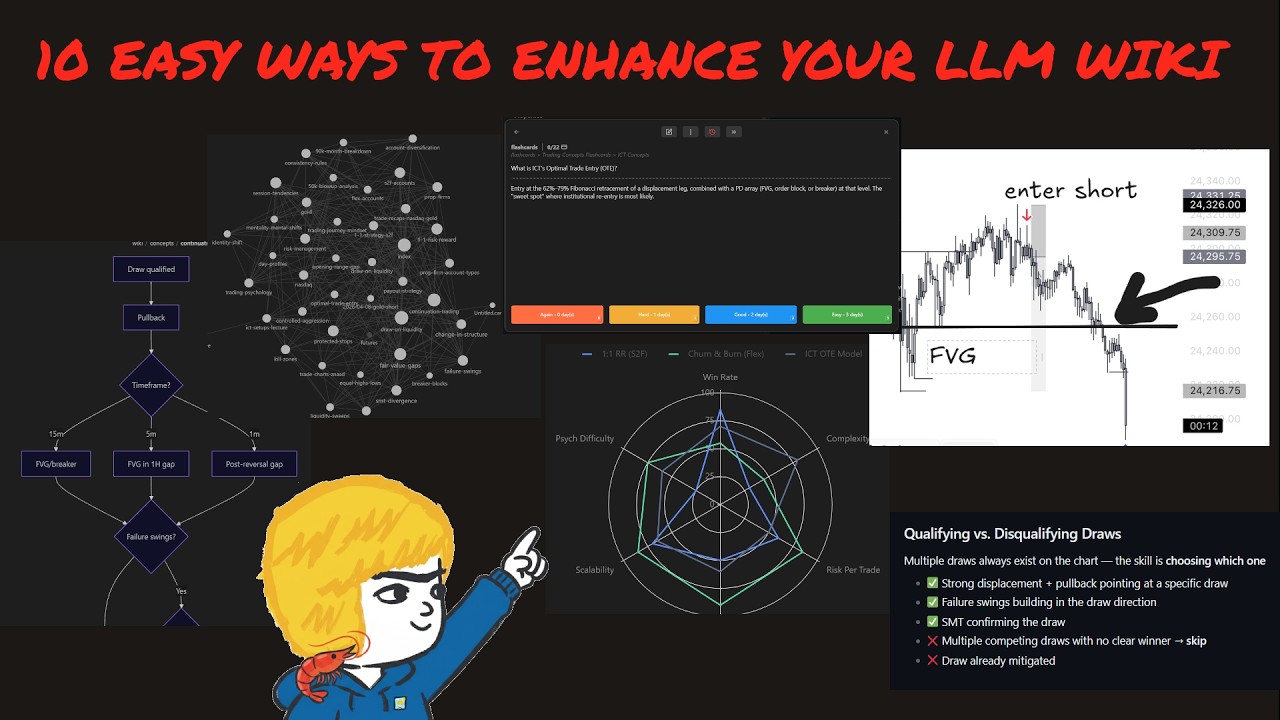
The video then introduces ten enhancements to improve the LLM wiki experience. The first few are built-in Obsidian features or community plugins, including graph view for visualizing connections between pages, canvas for creating spatial layouts and strategy maps, and data view for live-updating tables and dashboards. Other enhancements include Marp slides for turning wiki pages into presentations, Excalidraw for hand-drawn style diagrams, charts view for rendering various interactive charts, and Mermaid diagrams for flowcharts and decision trees—all aimed at making the knowledge base more dynamic and visually engaging.
Further enhancements involve more technical setups, such as deploying an MCP server that exposes the wiki as an API accessible by multiple AI tools, not just Claude code. This allows for broader integration and collaboration, especially useful for teams. Another specialized feature is a trade journal cross-referencing system that links individual trade logs to theoretical concepts within the wiki, providing a practical bridge between theory and practice. This feature, while tailored for trading, can be adapted to other domains where journaling and cross-referencing are valuable.
The final enhancement discussed is the integration of spaced repetition flashcards using the Anki app or Obsidian’s spaced repetition plugin. This feature automatically generates flashcards from the wiki content, facilitating better memorization and learning of complex concepts. The creator demonstrates how Claude can format the wiki content into question-answer pairs suitable for flashcards, making the knowledge base not only a reference tool but also an educational resource.
To conclude, the creator shares that all the enhancements, templates, and code are available open source on their GitHub repository, TonebyStudio/LLM-Wiki. They encourage viewers to explore, customize, and expand upon these ideas to suit their own knowledge bases. The video emphasizes the potential of such interactive and evolving knowledge bases in various fields and invites the community to share their experiences and innovations in building and visualizing knowledge bases using AI tools.