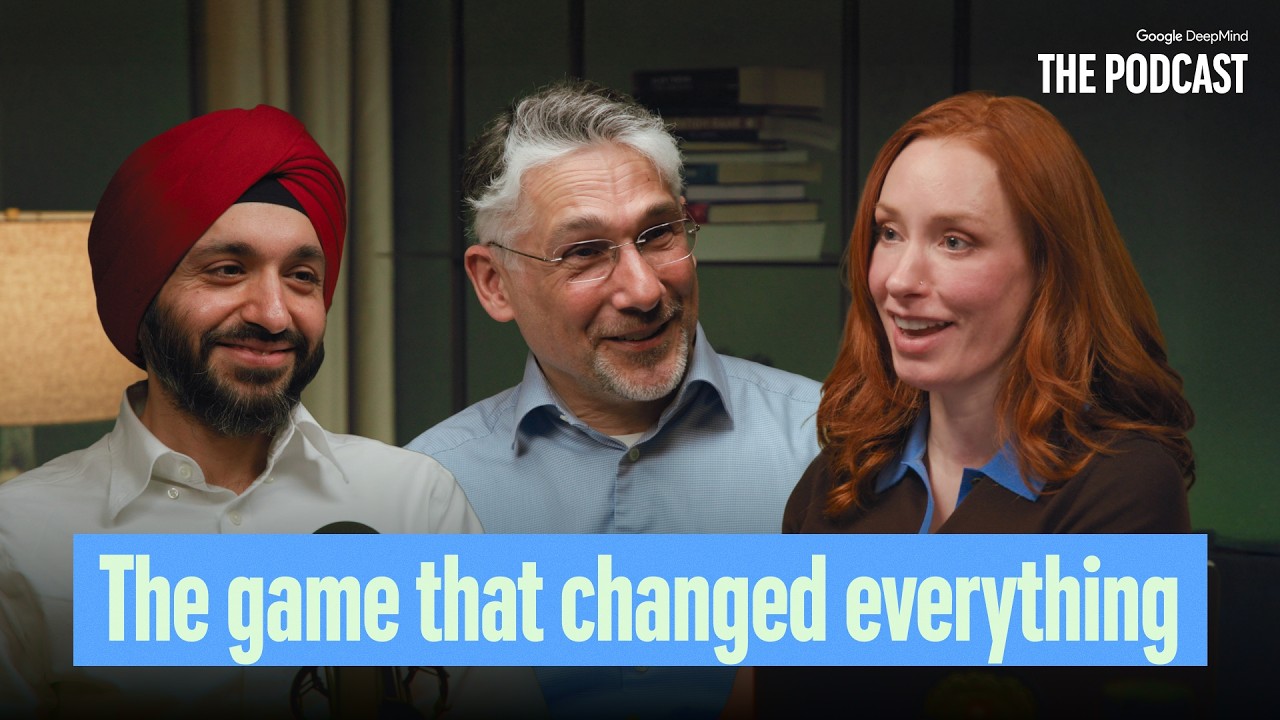
The podcast episode marks the ten-year anniversary of AlphaGo’s historic victory over Lee Sedol, a legendary Go champion, in 2016. Hosted by Professor Hannah Fry, the discussion features Thore Graepel, a key architect of AlphaGo, and Pushmeet Kohli, who leads DeepMind’s science work. The episode opens by recalling the significance of the AlphaGo vs. Lee Sedol match, which was a turning point for artificial intelligence. Go, with its simple rules but immense complexity, was long considered an unsolved challenge for AI, far surpassing chess in difficulty. AlphaGo’s 4-1 win demonstrated that AI could master tasks previously thought to be the exclusive domain of human intuition and creativity.
The guests explain why Go was such a formidable challenge for AI. Unlike chess, Go’s search space is exponentially larger, making brute-force approaches infeasible. AlphaGo succeeded by combining two key elements: “fast thinking” (intuitive pattern recognition using deep learning) and “slow thinking” (explicit planning and search, similar to traditional AI). This hybrid approach mirrored how human experts play Go, blending intuition with calculation. The team’s early experiments, including matches against professional players, revealed AlphaGo’s rapid improvement and its ability to not only match but surpass human strategies.
A pivotal moment in the match was AlphaGo’s now-famous “Move 37,” a move so unconventional that professional commentators initially thought it was a mistake. This move, which no human would likely have played, ultimately proved decisive and expanded the boundaries of Go strategy. Conversely, Lee Sedol’s “Move 78” in game four confounded AlphaGo, leading to its only loss in the series and demonstrating that humans could still surprise AI. These moments highlighted both the potential and the limitations of AI, as well as the emotional and intellectual impact on the Go community and AI researchers alike.
The conversation then shifts to AlphaGo’s legacy and its influence on subsequent AI breakthroughs. The development of AlphaZero, which learned to play Go, chess, and shogi without any human data, showed that AI could not only replicate but also transcend human knowledge. The techniques pioneered in AlphaGo—especially in navigating vast search spaces—have since been applied to scientific challenges like protein folding (AlphaFold) and algorithm discovery (AlphaTensor and AlphaEvolve). These advances illustrate how AI can tackle complex problems in mathematics, science, and engineering, sometimes producing solutions that are initially counterintuitive or difficult for humans to interpret.
Finally, the guests reflect on the broader implications for AI and science. They discuss the challenges of distinguishing genuine breakthroughs from “hallucinations” (incorrect or unverifiable outputs), the importance of interpretability, and the evolving role of human experts in an era where AI can generate novel insights. The episode concludes by emphasizing that AlphaGo was a paradigm shift: it proved that AI could achieve and even surpass human-level intelligence in specific domains, opening the door to new possibilities in science and technology. The legacy of AlphaGo continues to shape the AI revolution, raising profound questions about the future of human-machine collaboration and discovery.