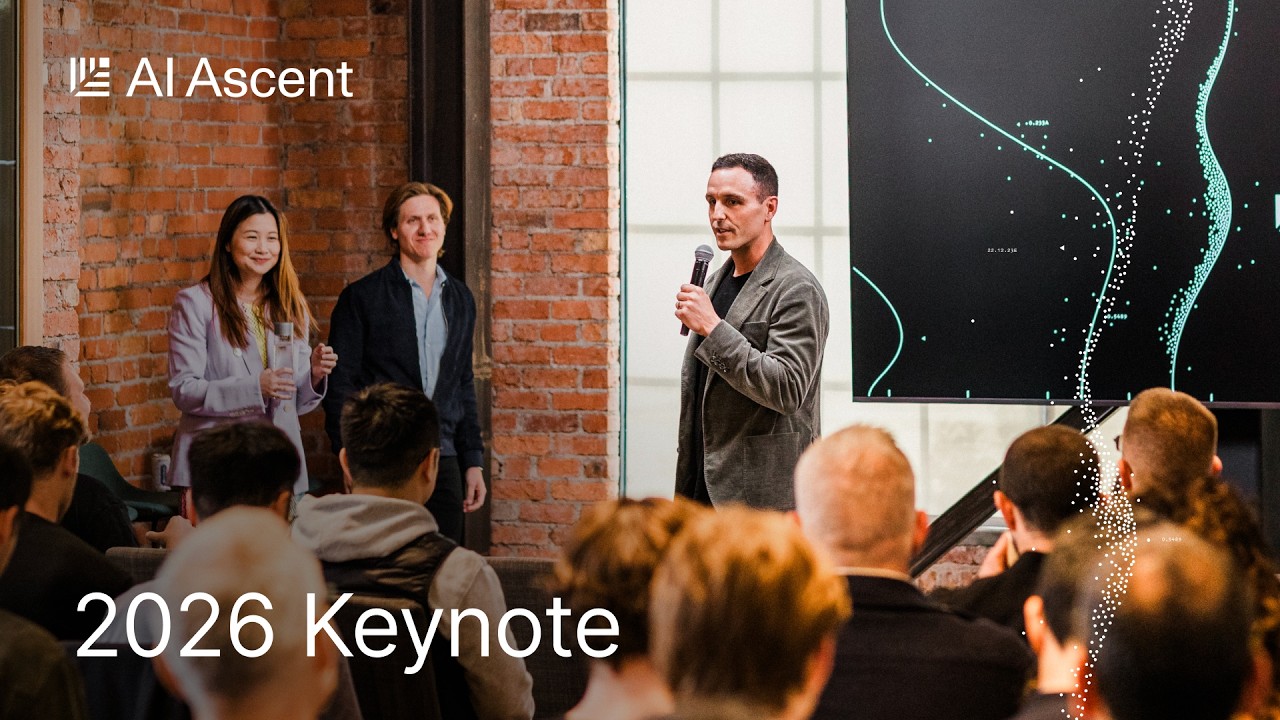
The keynote at Sequoia AI Ascent 2026 opened with a reflection on the evolution of technology, emphasizing how decades of advancements—from silicon-based transistors to the internet and mobile devices—have culminated in the current AI revolution. This wave is distinct in being both software and services-driven, with an immense market opportunity estimated in the trillions. The pace of AI development is unprecedented, marked by rapid advancements such as the emergence of long-horizon agents, which some consider a form of artificial general intelligence (AGI). The speakers highlighted that AI is a revolution in computation, fundamentally changing how information is processed and creating transformative productivity gains akin to moving from horses to cars.
The discussion then shifted to strategic advice for startups building on top of foundational AI models. The presenters introduced the acronym MAD—Modes, Affordance, and Diffusion—as pillars for success. They stressed the importance of adopting a customer-back approach, focusing on creating products that deeply wrap around customer needs rather than merely chasing the latest technological capabilities. Affordance refers to designing AI tools that are intuitive and easy to use, lowering barriers for adoption. Diffusion highlights the gap between rapidly advancing AI capabilities and their slower adoption in enterprises, representing a significant opportunity for application-layer companies.
Sonia’s segment focused on the rise of AI agents, tracing their evolution from early, often failing prototypes like AutoGPT to today’s sophisticated systems capable of autonomous reasoning, planning, and persistent goal completion. Agents now integrate powerful models, tools, and harnesses that enable them to perform complex tasks over long periods. This has led to a proliferation of agents across domains—from coding assistants to professional services in medicine, law, and finance—offering scalable, cost-effective alternatives to human labor. The keynote emphasized that agents are becoming increasingly autonomous, with some already operating without human oversight in production environments.
Looking ahead, Constantine framed the AI revolution as analogous to the industrial revolution but focused on cognitive work rather than physical labor. He illustrated this with historical anecdotes, such as the transformation of aluminum from a precious metal to a common material through technological innovation, paralleling how AI will democratize access to advanced cognitive skills. He also discussed the concept of “alien design,” where AI-driven creations may defy human intuition, and predicted the emergence of new scientific frameworks to understand and master AI, akin to thermodynamics in the industrial era. Despite these changes, he underscored the enduring importance of human relationships and connection in a rapidly evolving technological landscape.
In conclusion, the keynote painted a picture of a future where AI agents exponentially accelerate innovation and productivity, reshaping industries and daily life. While AI will handle much of the cognitive workload, human adaptability and connection remain central. The speakers encouraged attendees to embrace the rapid pace of change, collaborate closely, and focus on building meaningful relationships, as these human elements will provide lasting value amid the transformative AI era. The overarching message was one of optimism and opportunity, highlighting that the next hundred years of progress could be compressed into just a hundred days thanks to AI.