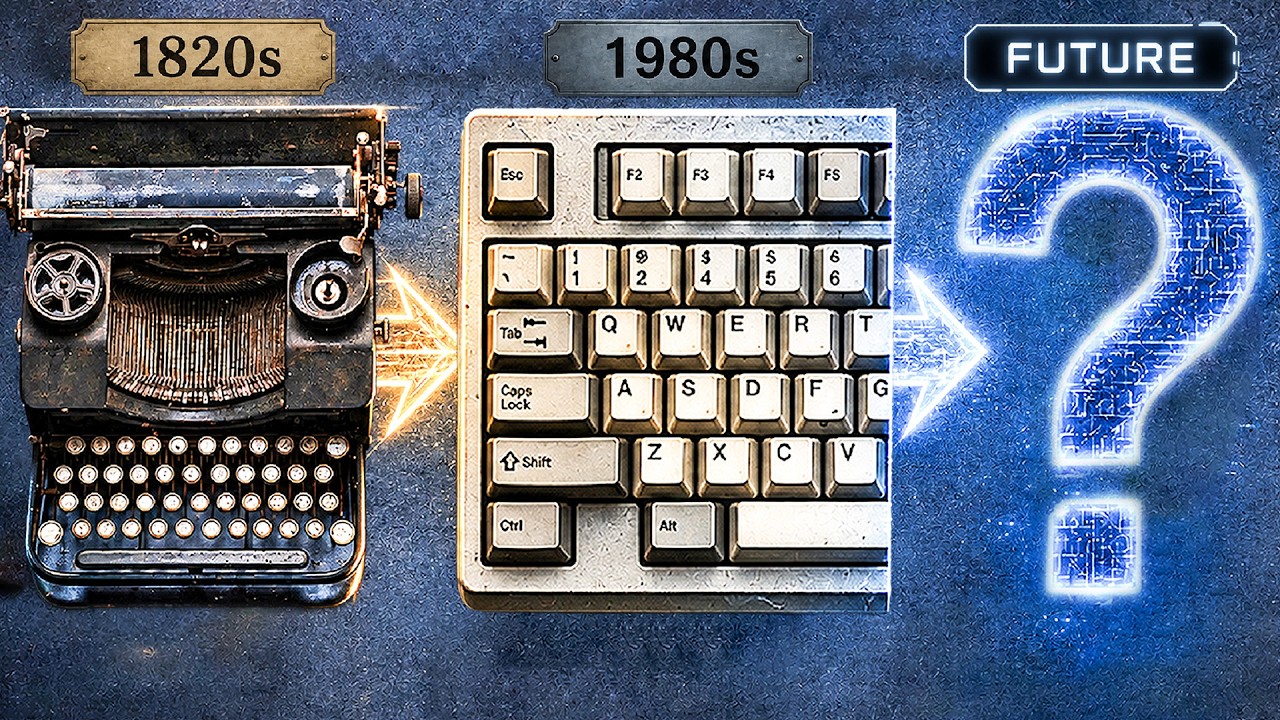
The video explores Typeless, a startup revolutionizing human-computer interaction by using AI to convert natural speech into accurate, context-aware written text, surpassing traditional dictation tools and offering features like real-time translation and quick search. While not yet a full keyboard replacement, Typeless significantly enhances productivity by enabling users to communicate with computers more intuitively, potentially paving the way to retire the centuries-old keyboard.
The video discusses how the traditional keyboard, an invention dating back to the mid-1800s designed to prevent mechanical typewriter jams, has remained largely unchanged despite significant technological advancements. While the keyboard has been a successful interface, it inherently slows down human-computer interaction by requiring users to translate their thoughts into keystrokes. However, with the rise of AI, there is now an opportunity to rethink and potentially retire the keyboard by fundamentally changing how humans interact with computers.
The focus of the video is on Typeless, a startup founded by Stanford alumni, which is reimagining this interaction by starting with the keyboard layer. Typeless is not yet a full replacement for keyboards but excels at dictation, allowing users to speak naturally and have AI convert their spoken thoughts into polished written text. Unlike traditional dictation tools, Typeless processes entire speech sessions at once, enabling more natural, imperfect speech with corrections and repetitions handled seamlessly by AI.
One of Typeless’s standout features is its superior accuracy, especially with uncommon words and context-aware transcription. It outperforms built-in dictation tools like Windows’ by understanding the full context of sentences and documents, which helps it choose the correct words and formatting. Users can also customize the system by adding niche or community-specific terms to a personal library, enhancing recognition further. Additionally, Typeless adapts its output style depending on the application, producing more formal text for emails and casual text for notes.
Beyond dictation, Typeless offers two additional functionalities: real-time translation supporting over 100 languages and an AI-powered quick search feature. The translation tool allows users to speak in one language and have their words instantly translated into another, with promising results even in less commonly supported languages like Persian. The quick search function acts like a lightweight assistant embedded in the workflow, providing fast answers to factual questions without the need to leave the typing environment, although it currently lacks conversational follow-up capabilities.
Overall, Typeless presents a seamless and natural way to reduce the friction of typing by leveraging AI to handle the mechanical and repetitive aspects of writing. While it does not yet replace keyboards entirely, it significantly enhances productivity and communication by allowing users to think out loud and interact with their computers more intuitively. Available across major operating systems, Typeless invites users to experience a new form of human-computer interaction that could eventually lead to retiring the traditional keyboard.