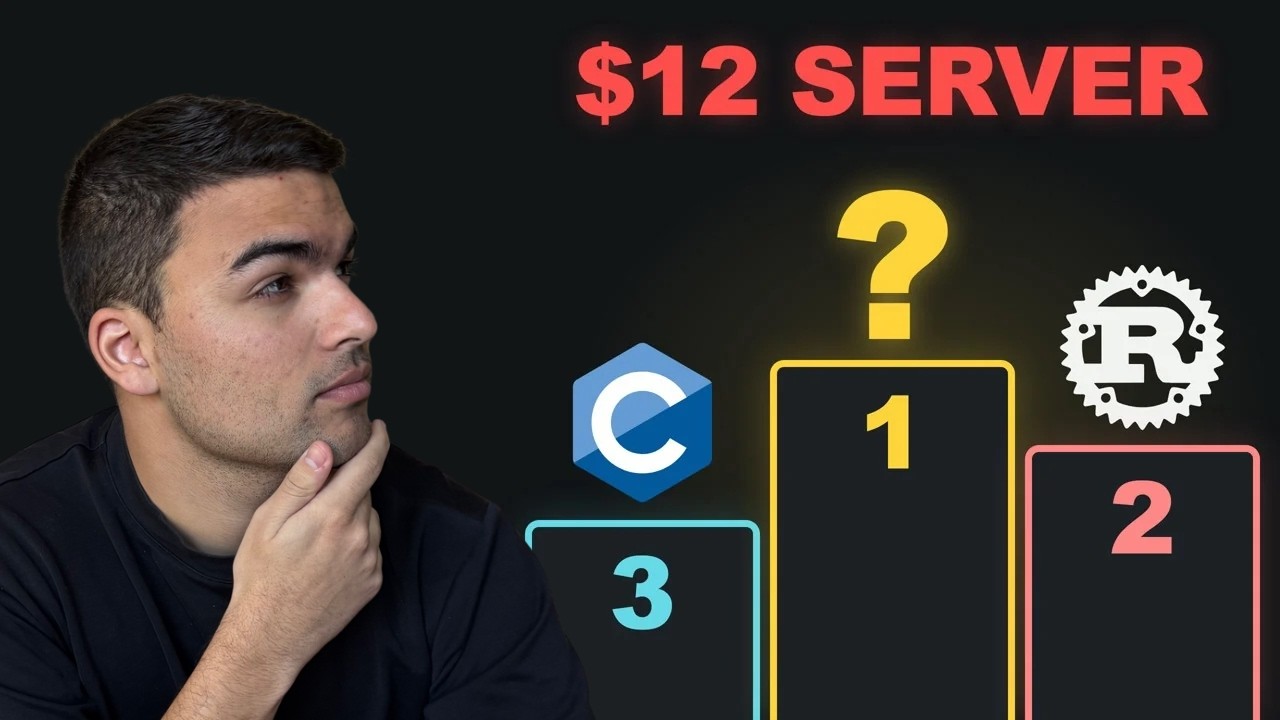
In this video, the creator challenges developers to build the most performant application possible on a $12 server with limited resources: one VCPU and two gigabytes of RAM. The task was to implement a simplified social media API using SQLite without caching or token reuse, handling a realistic user workload. The challenge attracted hundreds of submissions, including some highly unconventional approaches such as writing a web server in assembly, using theorem-proving languages, and even creating a custom database engine compatible with SQLite’s file format. The video focuses on analyzing the top 10 entries as of October 31st, exploring their code, optimizations, and iteration processes to understand how they achieved such high performance.
The video provides a detailed walkthrough of a typical request flow in a conventional web application using SQLite, highlighting the various stages such as network packet handling, HTTP parsing, routing, database querying, JSON serialization, and response sending. It emphasizes how even small optimizations at each step can significantly impact performance when handling tens of thousands of requests per second on a single CPU. A key common optimization across all top submissions is the use of IOUring, a Linux kernel feature that allows efficient handling of large numbers of persistent socket connections by bypassing traditional file descriptor limits and enabling batched I/O operations.
Several standout implementations are discussed in detail. One assembly-based submission uses IOUring and custom event loops to handle 240,000 users with minimal memory usage, carefully balancing batch sizes to avoid latency spikes. An F# implementation leverages a custom Kestrel server with IOUring and moves SQLite checkpoints to a background thread to reduce stalls, achieving lower latency. Another developer submitted both C and assembly versions with similar designs, using batching and checkpoint offloading, and discovered that increasing the number of in-flight accepts dramatically improved performance. A Rust implementation optimized the feed query by conditionally scanning ranges of post IDs to reduce database lookups, while a C server used SIMD instructions to batch token authentication and bypassed SQLite’s SQL execution layer by directly accessing B-tree cursors.
The video also covers more experimental and rule-bending entries. A Crystal implementation disables garbage collection and manages memory manually to reduce overhead. An Ada submission clearly exposes checkpoint coordination to manage write-ahead log growth without stalling reads. The top two tied winners include one using the Lean theorem prover to formally verify feed query invariants and generate C code, and another that completely replaces SQLite’s engine with a custom implementation of its B-tree and write-ahead log formats, achieving the highest user count and lowest latency but arguably violating the challenge rules. These entries showcase extreme approaches to squeezing out performance, often at the cost of maintainability and adherence to the original constraints.
Overall, the video highlights that despite the diversity of languages and techniques, the top-performing submissions converge on similar core ideas: maintaining persistent connections efficiently, batching requests and database operations, minimizing redundant work, and carefully managing SQLite’s checkpointing to avoid blocking the main event loop. The creator encourages viewers to apply these principles in their own applications by analyzing request workflows, query plans, and resource usage. The video also celebrates the iterative nature of optimization, showing how small, incremental improvements can lead to substantial gains. Finally, the creator invites viewers to engage with future experiments and subscribe for more deep dives into performance challenges.
Useful Links