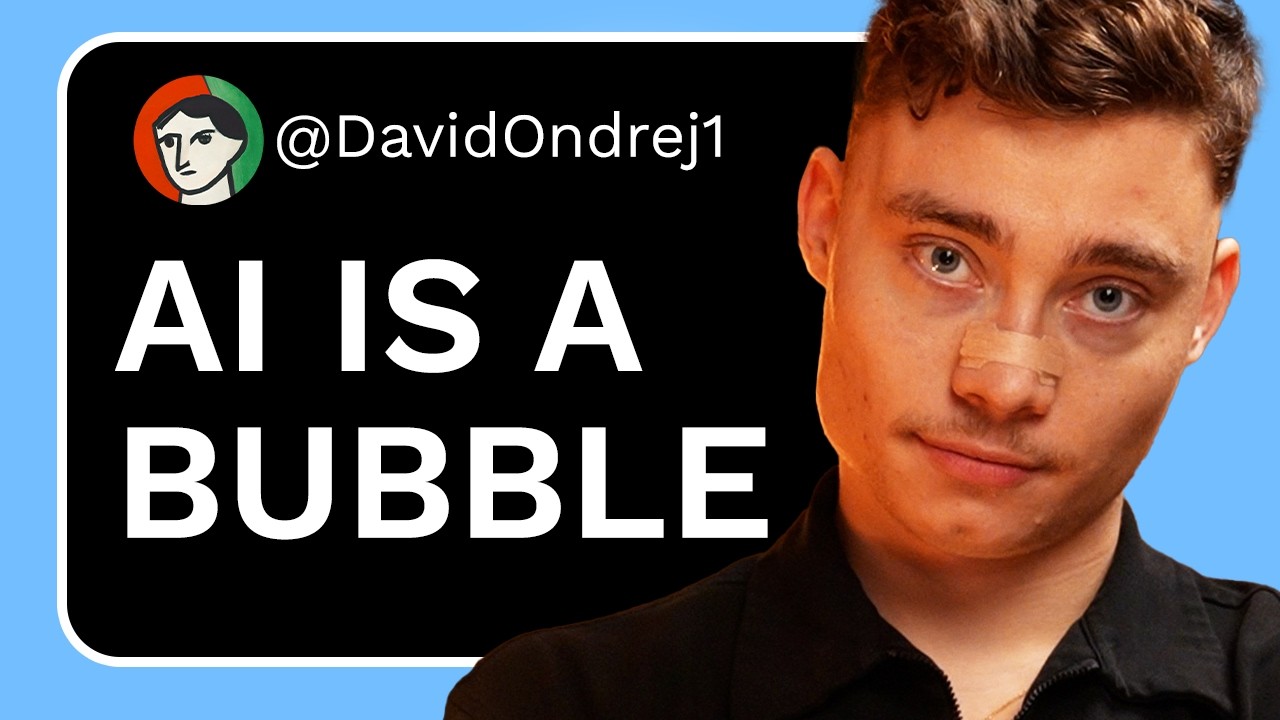
David Andre argues that AI is not a bubble due to its practical applications, rapid revenue growth, and advancements like reinforcement learning and specialized smaller models enhancing efficiency and autonomy. He highlights Nvidia’s pivotal role in AI’s compute power ecosystem and predicts significant social and economic shifts by 2026, urging individuals to engage deeply with AI technology to maintain a competitive edge.
David Andre shares insights from his 28 months of experience in the AI industry, addressing the common debate about whether AI is a bubble. He argues that despite massive investments and some startups raising huge sums without proven products or revenue, AI is fundamentally different from past bubbles like the 2008 crash or the 2021 crypto boom. Unlike crypto, AI already has practical use cases and companies like OpenAI and Anthropic are experiencing unprecedented revenue growth. While a stock market pullback is possible, Andre believes AI’s transformational potential and real-world applications make it unlikely to be a bubble.
A key trend Andre highlights is the rise of reinforcement learning (RL) and its impact on AI capabilities. RL allows AI models to improve by interacting with specific environments, such as online shopping sites, enabling them to perform complex tasks beyond text prediction. This approach is driving significant advances in coding and math, where results can be validated objectively. He emphasizes that current large language models (LLMs) are limited by their training on internet text alone and that RL environments provide new, valuable data that can push AI performance further.
Andre also discusses the growing importance of smaller, specialized AI models that are faster and more cost-effective than massive, generic models like GPT-4.5. These smaller models enable more practical applications by maintaining user productivity and reducing latency. He notes that AI agents are increasingly capable of working autonomously for hours, opening up new possibilities for complex tasks such as deep research and large codebase refactoring. This shift towards efficiency and specialization marks a significant evolution in AI deployment.
Another major point is the “infinite money glitch” involving Nvidia and AI companies like OpenAI. Massive investments flow into AI research, which then spend heavily on compute resources, much of which is supplied by Nvidia, creating a feedback loop that benefits chip manufacturers. Despite the high costs and unprofitability of many AI startups, Nvidia’s dominance in GPU production positions it for tremendous growth. Andre predicts Nvidia could become a $10 trillion company within a few years, underscoring the critical role of compute power as the bottleneck in AI development.
Finally, Andre predicts significant social and economic impacts from AI in 2026, including widespread job displacement in repetitive roles like customer support and secretarial work, leading to protests and unrest. He foresees a resurgence in coding education as technical skills will amplify the benefits of AI tools, creating a divide where skilled programmers become exponentially more productive. His overarching advice is to engage deeply with cutting-edge AI technology to stay ahead, as those who master it will gain a substantial competitive advantage in the evolving landscape.