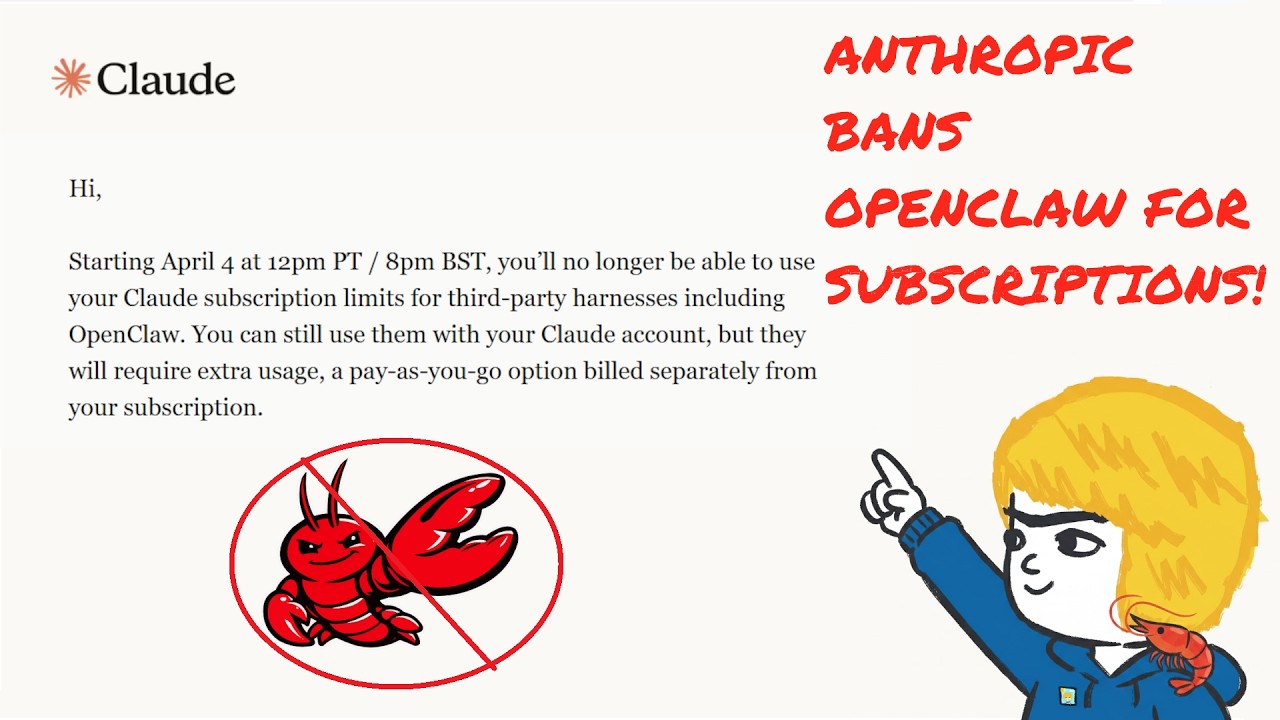
The video discusses the recent announcement from Anthropic that they will no longer allow the use of clawed subscriptions with OpenClaw starting April 4th. The creator, who has been using a $200/month clawed max subscription primarily for coding and OpenClaw agents, received an email informing them of this change. Although not entirely surprising, as Anthropic had always preferred users to utilize their API rather than subscriptions, this is the first time the policy is being strictly enforced. Anthropic cited engineering challenges in meeting the high demand for Claude, explaining that the current subscription model was not designed for the heavy usage patterns seen with OpenClaw, which often resulted in users consuming thousands of dollars worth of compute for a fraction of the cost.
The video highlights that Anthropic has been gradually preparing for this shift by adding features similar to OpenClaw within their own Claude ecosystem, such as scheduled tasks and a computer mode that allows Claude to use local resources. Users affected by the subscription ban are encouraged to check their claw.ai settings, where they can access $200 in extra usage credits for claw code and claw desktop, which can still be used with OpenClaw but not through the main subscription. Additionally, there is currently a discount of up to 30% on purchasing extra usage bundles, which users might want to take advantage of before the policy change takes effect.
The first major takeaway from the video is that compute resources are in short supply. Anthropic’s decision was driven by the inability to keep up with the surging demand for Claude, especially after a spike in users following dissatisfaction with OpenAI. The company is also planning to lease a new data center in 2026, but until then, infrastructure constraints are forcing them to prioritize their own platforms and users. Rumors about an upcoming next-generation model, Mythos, which would require significant compute resources, may also have influenced this decision.
The second takeaway emphasizes the importance of open-source models. The sudden policy change illustrates the risks of relying on a single private company’s platform, as users can lose access to tools they depend on overnight. The video creator notes that while open-source models currently do not match the performance of Claude for coding tasks, recent advancements have significantly narrowed the gap. Models like Kimi, JGLM, Quen, Deepseek, and Miniax are improving rapidly, and fine-tuned smaller models are beginning to outperform generic frontier models on specific tasks, suggesting that open-source solutions will become increasingly viable in the near future.
Finally, the creator shares their plan to transition their OpenClaw agents to alternative models using Open Router, which allows easy switching between different open-source models tailored to various tasks such as coding, reasoning, or vision. They mention currently using Quen 3.6 Plus and considering GLM 5V Turbo as a future option. The video concludes with a call for viewers to share their experiences and preferred models following the subscription ban, reinforcing that while the change is unfortunate, there are already capable alternatives available, and the open-source ecosystem is poised to grow stronger.