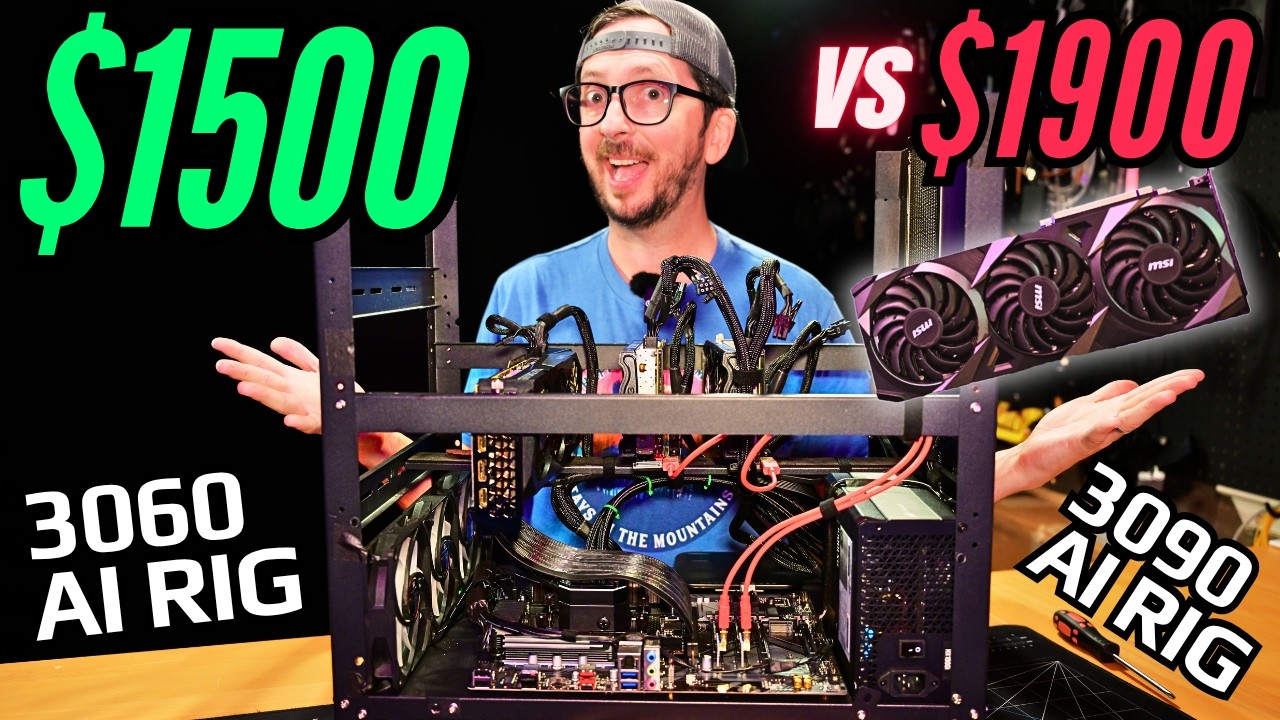
The video explores the performance of NVIDIA GeForce RTX 3060 GPUs compared to the RTX 3090 in a local AI build focused on running modern large language models (LLMs). Using a compact rack frame previously employed for a quad 3090 setup, the presenter tests a system equipped with three 3060 GPUs against models like Gemma 4 (26B) and Quinn 3.6 (27B) using Hermes Agent and other AI tools. The build features an AMD Ryzen 5950X CPU, 16GB RAM, and a B550 motherboard, with power limits set to optimize GPU efficiency. The presenter highlights the value proposition of 3060s, especially the 12GB variants, which offer a good balance of VRAM and cost, making them a viable option for local AI workloads.
Initial testing with the 3060 setup showed impressive prompt processing speeds, with token generation rates reaching up to 3,500 tokens per second at peak and maintaining respectable performance even at large context windows (up to 128K tokens). The system efficiently handled the Gemma 4 model, delivering around 68 tokens per second in text generation tasks, which is about 50% of the 3090’s performance. For the denser Quinn 3.6 model, the 3060s managed roughly 17 tokens per second, again about half the speed of the 3090, but still better than expected given the GPUs’ budget status.
When the 3090 was swapped in, it unsurprisingly outperformed the 3060s, especially in text generation tasks, with token rates roughly double those of the 3060 setup. The 3090 maintained high throughput across various token lengths, peaking at over 4,000 tokens per second in prompt processing and sustaining around 130 tokens per second in text generation. Despite this, the presenter was surprised by how closely the triple 3060s matched the 3090 in many prompt processing benchmarks, suggesting that for many local AI applications, the 3060s offer a compelling cost-to-performance ratio.
Power consumption was also discussed, with the triple 3060 setup peaking around 580 watts during heavy workloads, while the 3090 system used less power overall during inference. The presenter noted that the 5950X CPU was the most expensive component in the build and suggested that users could save costs by reusing existing hardware or opting for a less costly processor. The overall build cost was roughly $1,500, with the GPUs representing a significant but not overwhelming portion of that total, especially given the inflated prices of 3090 cards on the used market.
In conclusion, the video emphasizes that while the 3090 remains the superior GPU for local AI workloads, the 3060s perform surprisingly well and represent a practical, budget-friendly alternative for users needing a reliable backup or secondary inference rig. The presenter encourages viewers to reconsider the 3060’s capabilities, especially given their widespread availability and reasonable pricing. The video also highlights the importance of tuning and batch optimization to maximize performance and invites viewers to explore further resources on setting up local AI systems. Overall, the 3060-based Mini Monster build is praised as a flexible, efficient, and cost-effective solution for local AI enthusiasts.