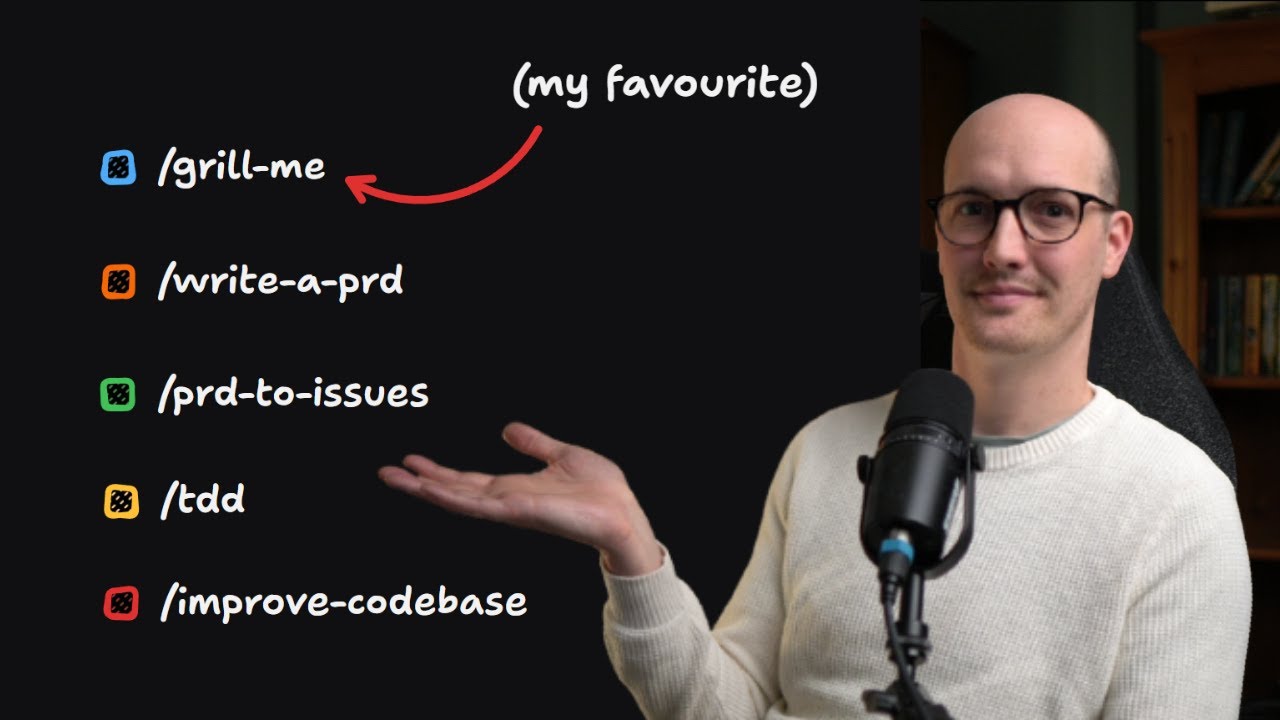
The speaker, an experienced engineer, discusses the importance of process when working with AI coding agents like Claude Code. Unlike human engineers, these AI agents lack memory and context, making it essential to have strict, well-defined processes to guide them effectively. The speaker has developed a set of “skills”—essentially prompts or workflows—that encode these processes, ensuring the AI consistently produces high-quality code. These skills are shared in a public repository and are also the focus of a course the speaker offers, aimed at helping developers get ahead with Claude Code.
The first skill highlighted is the “grill me” skill, which prompts the AI to relentlessly interview the user about every aspect of a proposed plan or feature. This ensures a shared understanding between the user and the AI before any code is written. The skill is inspired by the concept of a “design tree,” where every branch and dependency of a design decision is explored thoroughly. The speaker emphasizes that even a short, well-crafted skill can have a significant impact, as it forces the AI to ask detailed questions and clarify requirements.
Once a shared understanding is reached, the next step is to use the “write a PRD” (Product Requirements Document) skill. This skill guides the AI in creating a comprehensive PRD, which includes a problem statement, solution overview, user stories, and key implementation decisions. The PRD serves as a durable reference point for the project, outlining the destination but not the exact journey to get there. The speaker notes the importance of user stories and the need for flexibility in how they are formatted.
To break down the PRD into actionable steps, the “PRD to issues” skill is used. This skill helps the AI convert the PRD into a set of GitHub issues, each representing a vertical slice of the project that can be worked on independently. The skill also establishes dependencies between tasks, enabling parallel work and efficient project management. The speaker explains the value of this approach in surfacing unknowns early and maintaining a clear workflow, especially when using autonomous agents to implement features.
Finally, the speaker describes two more skills: the “TDD” (Test-Driven Development) skill and the “improve codebase architecture” skill. The TDD skill enforces a red-green-refactor loop, encouraging the AI to write tests before code and focus on interface changes for better testability. The architecture skill helps identify and refactor confusing or tightly coupled parts of the codebase, proposing multiple interface designs and creating refactor proposals as GitHub issues. By regularly applying these skills, the speaker has seen a marked improvement in code quality from AI agents, reinforcing the idea that treating AI agents like human engineers—with clear processes and expectations—yields the best results.