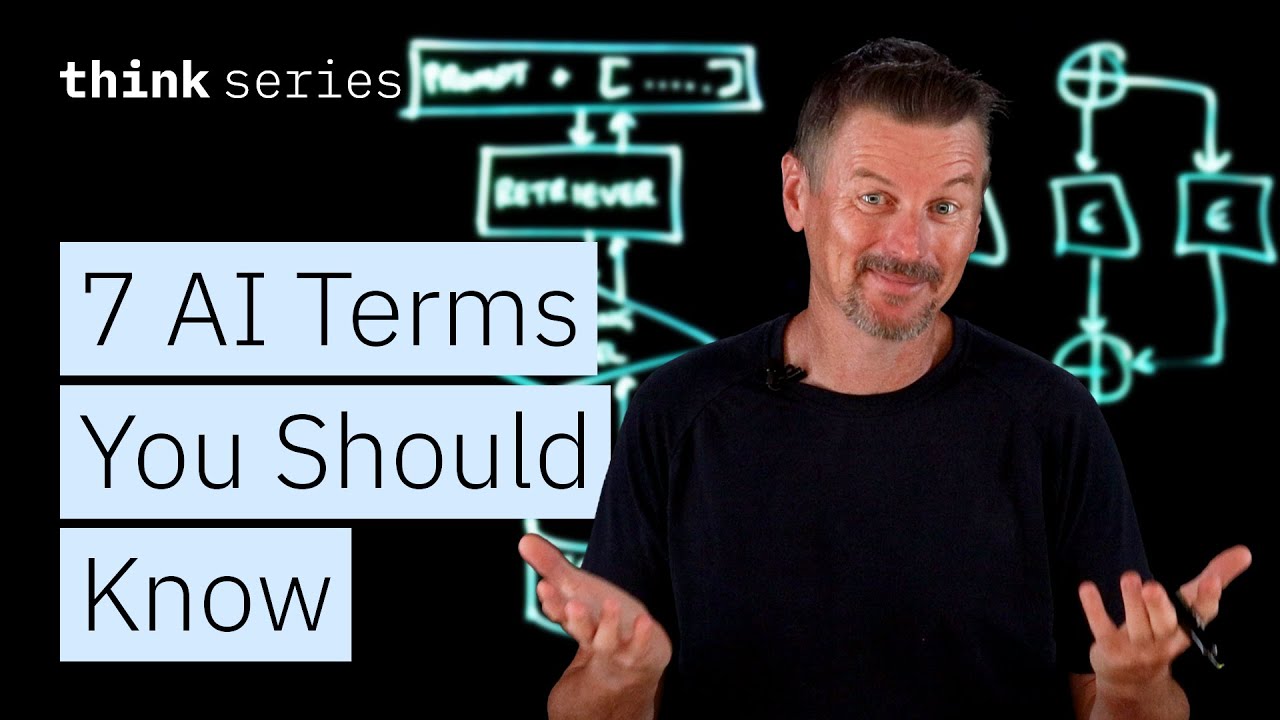
The video begins by highlighting two key truths about artificial intelligence: it is ubiquitous, appearing even in everyday items like toothbrushes, and the field is evolving rapidly, making it challenging to stay updated. To help viewers keep pace, the presenter introduces seven essential AI terms. The first term, agentic AI, refers to AI systems that can autonomously perceive their environment, reason through problems, act on plans, and observe outcomes in a continuous loop. These agents can serve various roles, from travel booking to data analysis and DevOps tasks, and are typically powered by specialized large language models.
The second term, large reasoning models, are a type of large language model fine-tuned specifically for reasoning tasks. Unlike standard models that generate immediate responses, these models work through problems step-by-step, using training on verifiable problems like math and code. This stepwise reasoning is crucial for AI agents to plan and execute complex, multi-step tasks effectively. The third term, vector databases, involves storing data as vectors—numerical representations capturing semantic meaning—rather than raw files. This allows for efficient similarity searches, enabling AI to find related images, texts, or other data based on meaning rather than exact matches.
Building on vector databases, the fourth term is Retrieval Augmented Generation (RAG). RAG systems enhance large language model prompts by retrieving relevant information from vector databases to provide contextually enriched responses. For example, a RAG system can pull specific sections from a company handbook to answer employee questions accurately. The fifth term, Model Context Protocol (MCP), standardizes how large language models connect to external data sources and tools, such as databases, code repositories, or email servers. MCP simplifies integration by providing a uniform interface, allowing AI to access diverse systems without custom connections for each.
The final two terms focus on advanced AI concepts and future possibilities. Mixture of Experts (MoE) divides a large language model into specialized subnetworks or “experts,” activating only those needed for a specific task to improve efficiency and scalability. This approach allows models to grow larger without proportional increases in computational cost. Lastly, Artificial Superintelligence (ASI) represents a theoretical future AI that surpasses human intelligence across all domains and can recursively improve itself. While ASI remains speculative, it embodies the ultimate goal of AI research, with profound implications for humanity’s future. The video concludes by inviting viewers to engage with AI topics further at the upcoming IBM TechXchange conference.