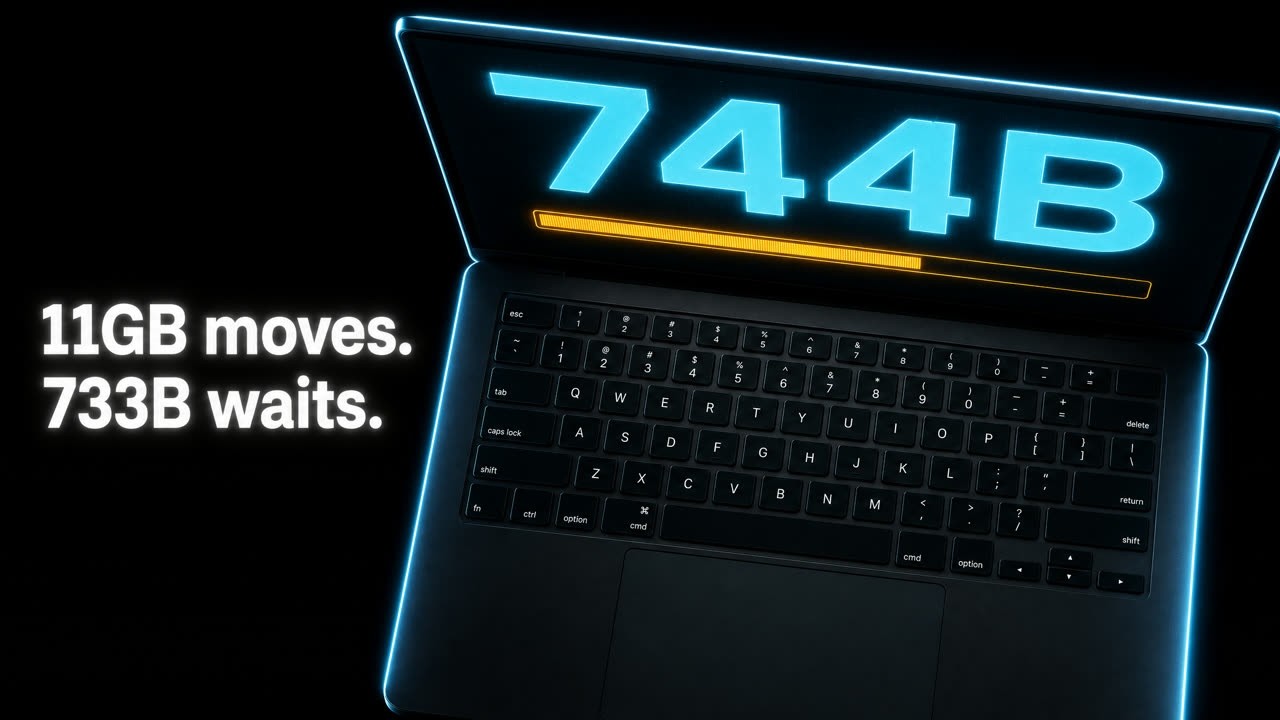
Zhipu AI’s 744 billion parameter model, GLM-5.2, can now run on a standard twelve-core laptop with limited RAM by using the Colibri tool, which streams model components from SSD storage and activates only a fraction of the model’s parameters per token. Although this approach results in slower performance compared to cloud services, it enables advanced AI capabilities locally without expensive hardware, marking a significant shift in AI accessibility and experimentation.
A 744 billion parameter AI model, Zhipu AI’s GLM-5.2, has been made runnable on a standard twelve-core laptop with no GPUs and only 25 to 32 GB of RAM, thanks to a developer named JustVugg and a tool called Colibri. This breakthrough challenges the common perception that massive AI models require enormous computational resources and expensive hardware clusters. The key insight is that although the model has 744 billion parameters, only about 40 billion are activated per token, and just 11 GB of data changes between tokens, making it feasible to run the model locally by streaming data from disk rather than loading everything into memory.
GLM-5.2 is a Mixture of Experts (MoE) model, which means it consists of many specialized sub-networks or “experts,” but only a small subset is activated for each token. This architecture drastically reduces the amount of computation needed per token compared to dense models where all parameters are active. Colibri leverages this by loading the dense core of the model (about 9.9 GB in a compressed 4-bit integer format) into RAM, while the large pool of experts (around 370 GB) remains on the SSD and is streamed on demand. This approach swaps the need for large GPU memory for the speed of SSD storage, enabling the model to run on modest hardware.
The trade-off for this streaming approach is speed. When the cache is cold and the required experts are not in memory, generating a single token can take several minutes, resulting in a painfully slow experience compared to cloud-based APIs. However, Colibri implements Multi Token Prediction (MTP), a speculative decoding technique that guesses multiple tokens ahead to reduce disk reads and improve throughput. On faster hardware like Apple’s M1 Max with speedy internal storage, Colibri can achieve around one token per second, making it usable for complex reasoning tasks despite being slower than commercial cloud services.
GLM-5.2 is a highly capable model, trained on 28.5 trillion tokens and optimized for coding and reasoning tasks. It holds top scores among open-weight models on benchmarks like the Artificial Analysis Intelligence Index and Terminal Bench, reportedly outperforming OpenAI’s GPT-4.5 in some developer tasks. Released under an unrestricted MIT license, it offers hobbyists and developers a powerful alternative to costly cloud APIs, enabling them to run advanced AI locally without prohibitive hardware investments.
The viral success of Colibri on platforms like Hacker News highlights a paradigm shift in AI accessibility. It demonstrates that cutting-edge AI models no longer need to be confined to expensive datacenters but can be run on everyday laptops by cleverly managing memory and storage trade-offs. JustVugg emphasized that the goal was not speed but simply making the model work locally, marking a significant milestone in treating AI as a computer science challenge rather than just a consumer product. This innovation opens new possibilities for AI experimentation and development outside traditional cloud ecosystems.